

“The “Gifts of the East,” which appeared in large quantities in the Rus’ regions in the 7th and 8th centuries, are not limited to jewellery. As noted above, it was in the 8th century that chainmail and helmets of a characteristic Iranian shape appeared, tracing back to Assyrian prototypes. These Iranian helmets served as models for Russian gunsmiths, who produced such helmets until the 17th century…


The fate of chain mail in archaeological literature was shared by helmets, which were also declared to be nomadic (Varangian [Viking] helmets were too sharply distinguished by their conical shape).
The similarity between helmets from Chernaya Mogila [Black Barrow] and Gulbishe, and Iranian and Assyrian ones, noted by D. Ya. Samokvasov, was later misinterpreted. The presence of similarly shaped helmets among the steppe nomads was considered a sufficient argument in favour of recognising all helmets from Rus’ burial mounds as nomadic. Without going into a detailed analysis of the material, one could equally well declare all steppe helmets to be Kyiv Rus’ products. In fact, all three groups of helmets—Iranian, Polovtsian, and Rus’ — have their own distinctive features.

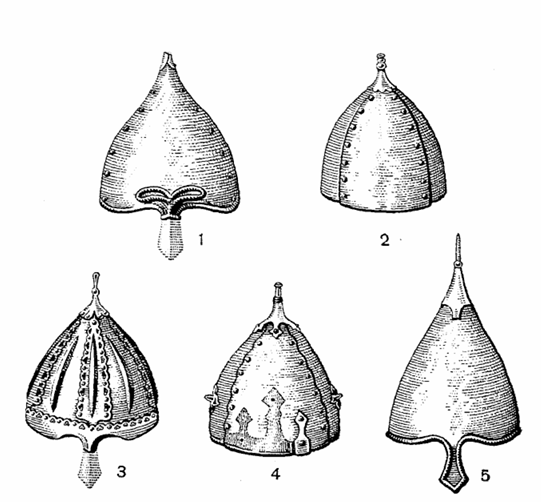
An example of early imported helmets is the frequently mentioned helmet from the Oskol River, published by E.E. Lenz. The helmet has a distinctive hemispherical shape with a gently upward-pointing tip. The crown is riveted from four plates with copper rivets. The front features a darter to protect the nose and a curved line above the eyes. The chainmail aventail, which covered the warrior’s neck, was attached using a complex system of rectangular loops and a special rod threaded through them.
In early Rus’ helmets (Gulbishe – end of the 9th century, in Gnezdovo – Bolshoy Kurgan – end of the 9th century), we observe complete continuity of the general shape of the helmet, but also differences in the details.
The helmet from Gulbishe is riveted with iron rivets and has no eye cups or nose guards. The complex device for attaching the aventail, which was permanently attached to the helmet, is missing. All this suggests a slight simplification of the Iranian model, which obviously arose on Rus’ soil.
The Gnezdovo helmet also lacks an aventail rod. The unique character of the applied iron bands with a lace pattern, punched with round punches, makes this beautiful helmet unique and precludes comparison with Eastern examples, where similar ornamentation is unknown. The high level of blacksmithing in Smolensk, known to us from a number of other products, could have ensured the production of helmets that combined the requirements of strength with elegance. Technically, the production of helmets could not have been difficult for Russian blacksmiths, since they had already discovered the ability to rivet plates on hearth boilers.
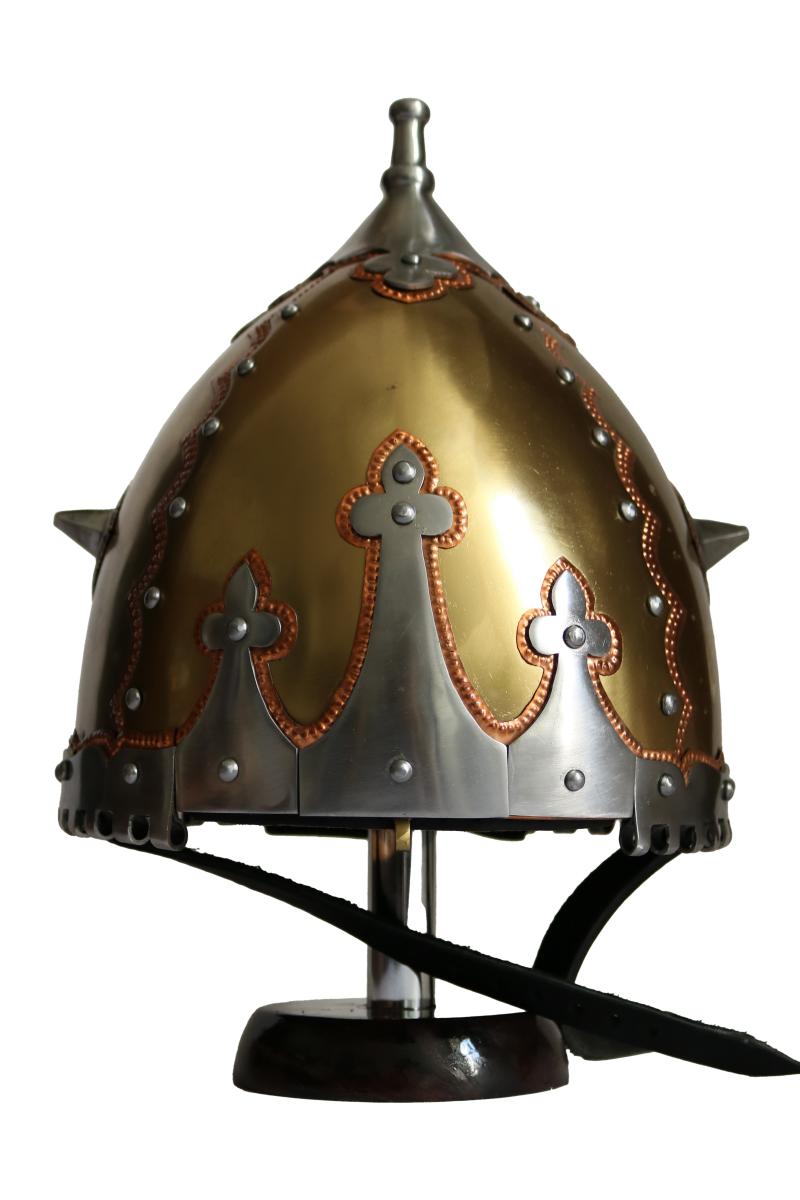
The helmet from the Black Barrow also has its own characteristics that prevent it from being classified as nomadic or Iranian: on the sides, it has two conical spurs, reinforced with diamond-shaped plates. The helmet’s crown has a socket for attaching a plume of feathers. The Chernihiv helmet is the first known Rus’ “golden helmet,” later celebrated in the poetic lines of “The Tale of Igor’s Campaign,” chronicles, and epics: the helmet’s iron crown is embossed with a gilded copper sheet.” (Academician B. Rybakov)
Read about B. Rybakov and his monograph in the previous post:
< Chainmail Armor of Kyiv Rus: Ahead of Western Europe and Vikings by centuries
“Fierce Bull Vsevolod!
You stand your ground, you spurt arrows at warriors, you clang on helmets with swords of steel.
Wherever the Bull bounds, darting light from his golden helmet, there lie pagan Kuman heads:
cleft with tempered sabers are [their] Avar helmets— by you, Fierce Bull Vsevolod!” (The Song of Igor’s Campaign)
The book “Kyiv Rus in Heimskringla Sagas and Byzantine Texts” has more material on civilisation of Kyiv Rus and its origin.

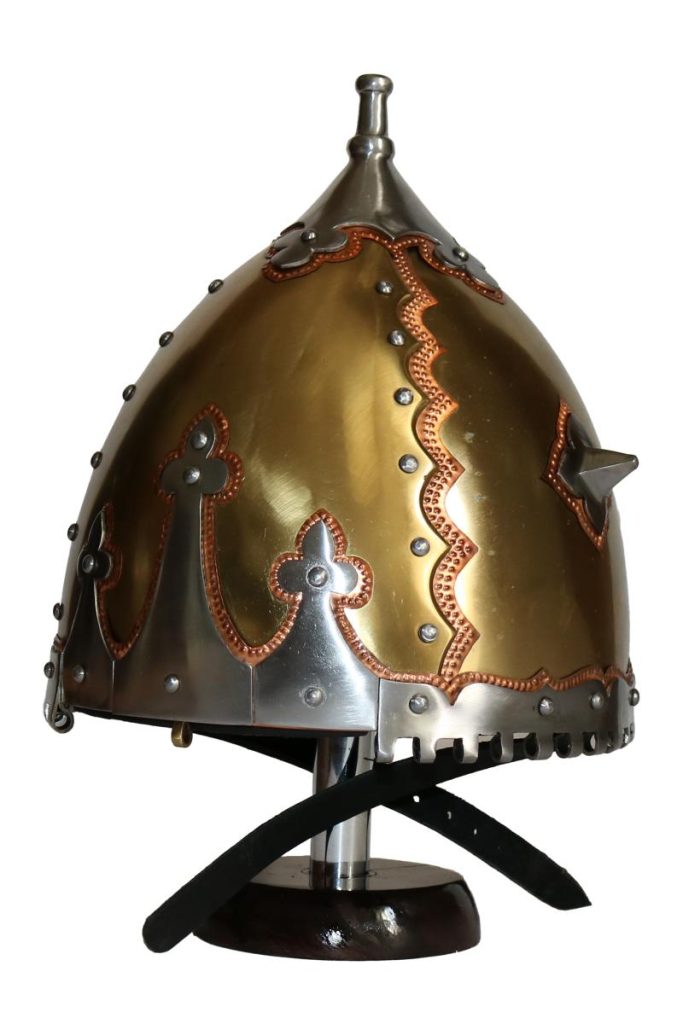

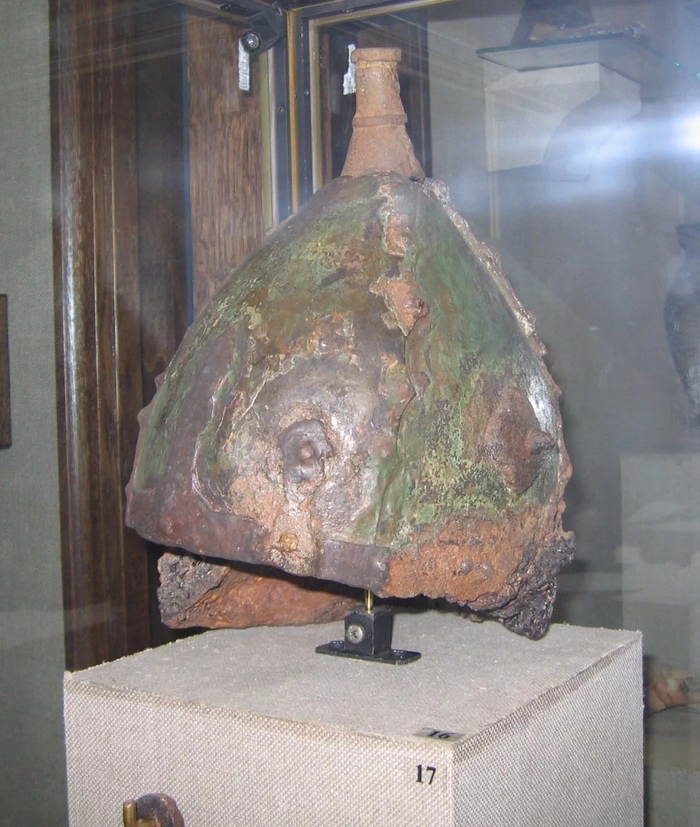

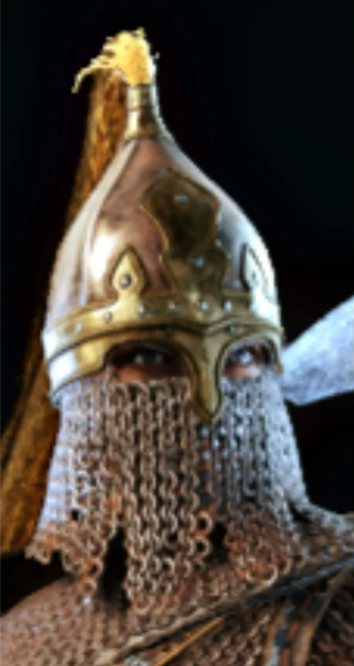
One of the variants of Kyiv Rus’ warrior from Black Barrow in Chernihiv.