

“There is Shakespeare for literature, Karinska for costumes!” (George Balanchine)


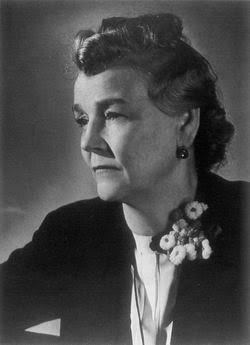
“When George Balanchine was asked by the Ford Foundation in 1963 what was the thing he most needed for his work he answered with one word: “Karinska!” It was the supreme compliment of one artist to another. At the time Madame Barbara Karinska was seventy-seven years old, and her subsequent fourteen-year exclusive association with Balanchine’s New York City Ballet marked her final glorious ascent in that mysterious land where ballet costumes are made. It is a place where she ruled without peer with, as she said of herself with characteristic grandeur, “the courage of a man and the heart of a woman.”
The “Karinska” label in the waistband of a costume (tutus have no necks) is, quite simply, to a dancer the indication, like “Cartier,” like “Teuscher,” like “Rolls Royce,” of the best. “To the New York City Ballet I gave my heart,” said Karinska while Balanchine said of her, “I attribute to her fifty percent of the success of my ballets that she has dressed.” In the course of their long collaboration Karinska clothed over seventy-five of them. While Balanchine was giving American dance its own line, its own svelte elegance, its own unique kind of glamour, its own classical tradition, Karinska was alongside him smoothing that line, enhancing that elegance, coloring that glamour and framing that tradition with silk and satin imported from France.
Karinska’s association with Balanchine was her longest and most deeply satisfying, but he was by no means the only dance choreographer whose visions she dressed. In a career spanning forty-five years she costumed ballets of Marius Petipa, Michel Fokine, Léonide Massine, Frederick Ashton, Antony Tudor, Bronislava Nijinska, Agnes de Mille and Jerome Robbins as well as Balanchine, often working simultaneously for rival companies with equal devotion. She rendered three-dimensional, functional and portable the imaginings of such artists as Christian Bérard, André Derain, Pavel Tchelitchew, Salvador Dali, Isamu Noguchi, Balthus and Marc Chagall. Karinska’s ageless hands can be seen, like those of a benign Madame LaFarge, weaving a delicate but indestructible thread that connects and clothes ballet in our century.” (Costumes by Karinska, Biography book)
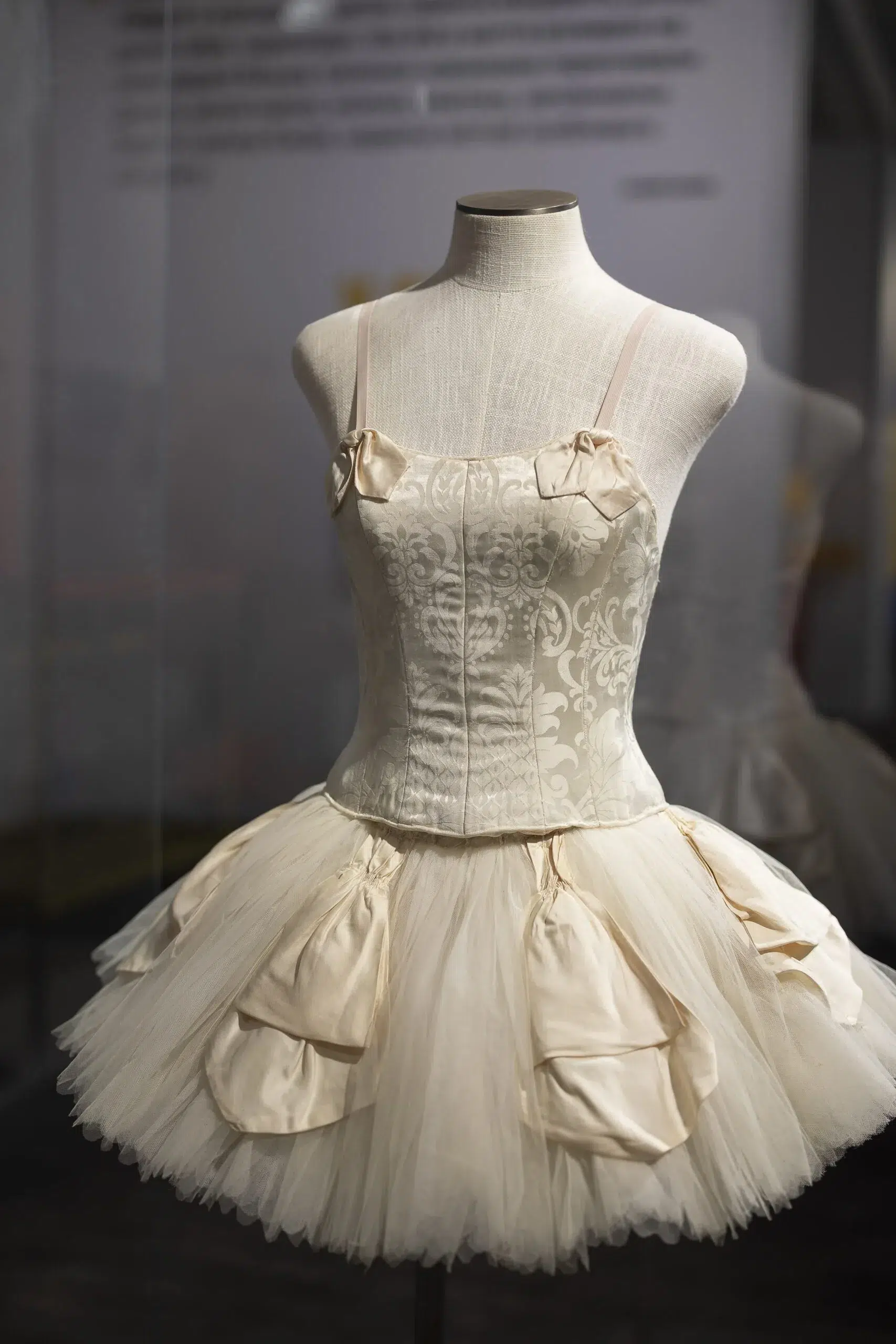
“Barbara Karinska (born Varvara Jmoudsky) had arguably the greatest impact on the balletic silhouette in the 20th century. Among her many innovations in costuming, Karinska was the creator of the powder puff tutu, a skirt that replaced the metal structure of the traditional pancake tutu with a softer, more fluid line that created greater range of motion for the dancer. She accomplished this with a proprietary technique of layering and cutting tulle to create a similar line to the standard tutu, but infinitely more flattering to the body.
A great beauty in her day, Karinska had an eventful life that saw her move from Russia to France, then England, and eventually the U.S. She was a collaborator with some of the most renowned artists of her time, including Salvador Dalí, Joan Miró, and Jean Cocteau, and won an Oscar for her work on the film Joan of Arc in 1948. However, it is for her partnership with Balanchine that she is best remembered. A Ford Foundation grant enabled Balanchine to make Karinska his costume designer in residence, and they worked together until their deaths in 1983. Of Karinska, Balanchine once famously said, “I attribute to her 50 percent of the success of my ballets to those that she has dressed.” (New York Public Library)
“A native of Ukraine Barbara Karinska began in the early 1940s as a costume designer for film productions and acted for the first time in 1940 in Paradise Lost by Abel Gance in making a movie with.
Barbara Karinska (born Varvara Jmoudsky) had arguably the greatest impact on the balletic silhouette in the 20th century. Among her many innovations in costuming, Karinska was the creator of the powder puff tutu, a skirt that replaced the metal structure of the traditional pancake tutu with a softer, more fluid line that created greater range of motion for the dancer. She accomplished this with a proprietary technique of layering and cutting tulle to create a similar line to the standard tutu, but infinitely more flattering to the body.
Barbara Karinska created fashions in ballet that are as easy to spot as a Chanel suit. Though her name may not precede her designs (there’s no “Karinska tutu” or “Karinska leotard”), once you know what she did, you start seeing her every time you look at classic New York City Ballet dances.”
Per Wikipedia, Barbara Karinska was born Varvara Andriivna Jmudska (Ukrainian: Варвара Андріївна Жмудськa) in 1886, in the city of Kharkiv, Ukraine.
(Even Russian Wikipedia admits that Barbara Karinska is of Ukrainian descent).
In 1860, Russians constituted in Kyiv region – 1%, in Kharkiv – 5% of the population >
< Serge Lifar, world ballet great, recollects his native Kyiv of 1905-1921