

Academician B. Rybakov in his 1979 book ‘Scythia of Herodotus’:


“After half a century of destructive Greco-Persian wars, during which the many thousands of armies of the Asian despotism repeatedly invaded the rich Greek lands, a great national upsurge was felt in Athens, the main city of the victors who defended the freedom of Hellas. The democratic reforms of the strategist Pericles, the tragedies of Aeschylus, Euripides, and Sophocles, the sculptures of Phidias, the bold philosophy of Anaxagoras, the architectural designs of Ictinus and Hippodamus—all these are manifestations of that flourishing that marked the overcoming of the anxieties and dangers of a grueling, universal war.
Immediately after the peace with the Persians, two immortal works were created: the Parthenon and Herodotus’s “Histories.”
Both are symbolic: the construction of the Parthenon, begun in 447, was intended to repair the destruction of the Athenian acropolis by the Persians in 480, while Herodotus’s “Histories” was intended to recount the struggle against the Persians.
Herodotus arrived in Athens in the same year, 447 (having already completed most of his exploratory travels), and began his famous public lectures on the history of the recently ended Greco-Persian Wars. While the Parthenon was being built, Herodotus was developing the literary form of his monumental work, which was later divided into nine books, corresponding to the number of muses. The Athenians, according to rumor, recognized the historian’s work with an unusually generous reward, giving him 10 talents of silver.
The historian of that time, unlike modern historians, did not have access to archives, did not seek out written documents, and did not study chronicles of events; he himself had to access these documents for the first time to create, to record for the first time on papyrus and parchment, the stories he had heard about the events.
To faithfully illuminate the events that took place in all corners of the Greek, Persian, and Egyptian worlds, a historian had to travel across these territories, find eyewitnesses, question them, and record their stories; this was the practice of history.
Herodotus devoted about ten years (approximately 455–445) to the arduous labors of a traveler. He traveled around the Aegean Sea, visited many cities of continental Greece, and visited Persia, Egypt, Italy, Macedonia, and Scythia.
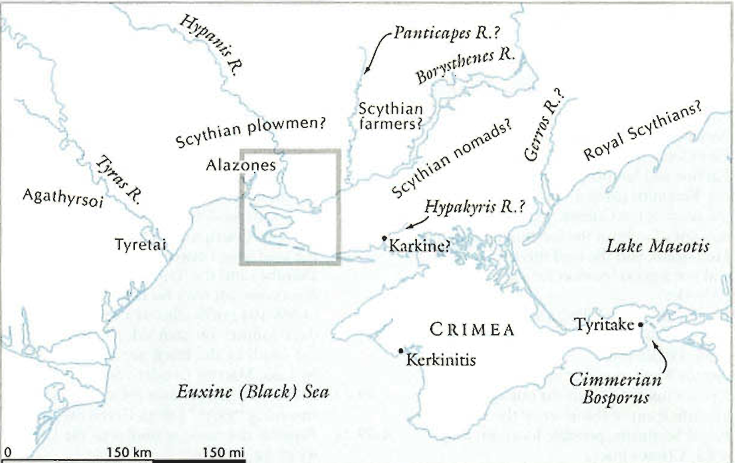
The boundaries of his travels are outlined on the map of the Old World by a giant quadrangle: Elephantine on the Nile – Thurii in southern Italy (2,300 km); Thurii – Sindica near the Kerch Strait (2,000 km); Sindica – Babylon (1,600 km); Babylon – Elephantine (1,500 km).
Of greatest interest to the history of our homeland [Ukraine] is the fourth book of Herodotus’s work (“Melpomene”), dedicated to the campaign of the Persian king Darius I Hystaspes in Scythia.
In it are described the rivers and nature of Scythia, the customs of the Scythians, the tribes neighboring them, and the most interesting information about Darius’s campaign is reported, which differs significantly from the later version of Ctesias. It was probably to establish the truth in the conflicting memories of this campaign that Herodotus undertook one of his last journeys—a trip to the northern shores of the Black Sea…
If Herodotus wanted to learn the truth about Darius’s Scythian campaign, which was an introduction to the Greco-Persian Wars, and acquaint his readers with the misadventures of the king who defeated the Greeks, then he had to follow in Darius’s footsteps and discover all the details of the Persian defeat.
Herodotus undertook his journey 60–70 years after Darius’s Scythian campaign. He could have encountered elderly eyewitnesses to the events, and the sons of eyewitnesses could have told him much.
Contemporaries enthusiastically greeted the work of Herodotus, a traveler and explorer, a historian and, to some extent, a politician. Sophocles wrote an ode in honor of Herodotus. Traces of his influence are preserved in the plays of Euripides and Aristophanes. In 445, Herodotus was honored by the Council of Athenians for reading his books to them. Herodotus was close to Pericles and Protagoras. He was one of the founders of the colony at Thurii in southern Italy (443), where, perhaps, his “Histories” took its final form.
Professor F. G. Mishchenko, a leading expert and translator of Herodotus from Kyiv, wrote: “Herodotus’s geographical, topographical, historical, and especially everyday information about Scythia and the Scythians are rightly considered valuable and should be recognized as unique for their time.”
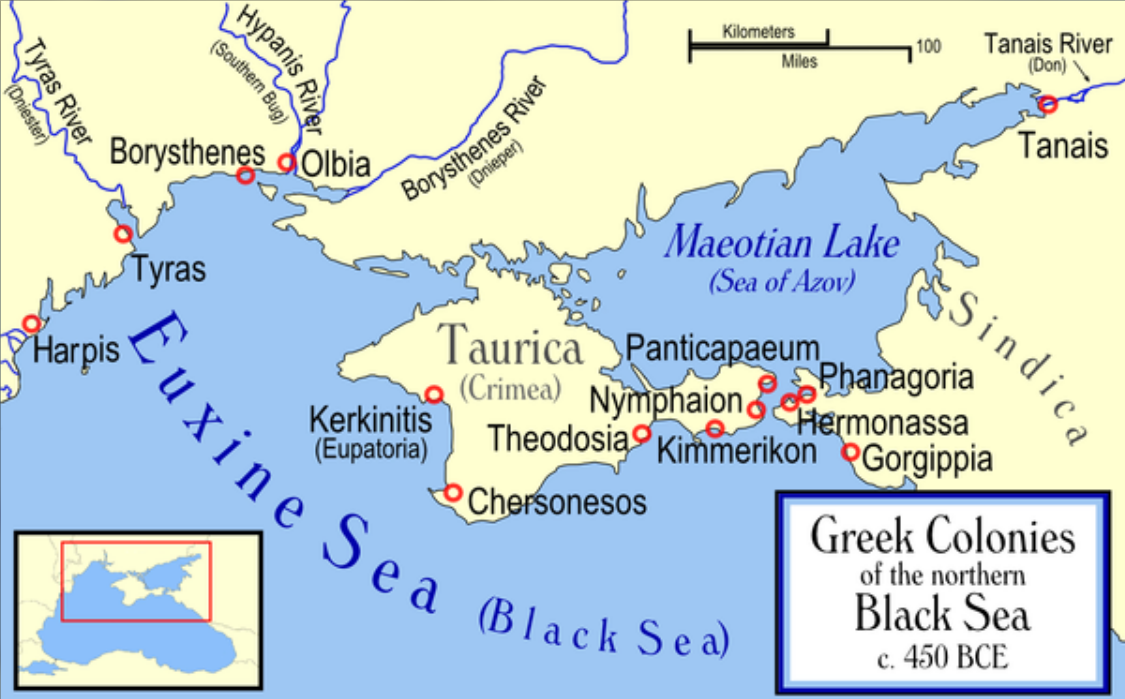
Based on the level of detail of the description, it is generally accepted that Herodotus was in Pontic Olbia and that it was here that he collected his main information about the Scythians.
Olbia was, so to speak, Herodotus’ headquarters, from where he could make excursions that were relatively short and not very far, if we take into account the means of communication in the middle of the 5th century BC.
Herodotus does indeed speak in detail about Olbia, located near the mouth of the Southern Bug, but he calls it the “Marketplace of the Borysthenites,” although geographically the city gravitates towards the Hypanis [Southern Bug River], not the Borysthenes [Dnieper River].
From here, from the Hypanis, Herodotus describes the peoples upstream this river. He has a good idea of the Dnieper-Bug estuary; he knows that at the mouth of the Dnieper, “salt collects by itself in enormous quantities”; he drank the “clean and pleasant-tasting” Dnieper water (§ 53).
He knows the cape separating the mouths of the Bug and Dnieper rivers—it’s called Cape Hippola; a sanctuary of Demeter is located on it. On the other side of the sanctuary, near Hypanis, live the “Borysthenites,” i.e., Dnieper merchants who come to Olbia…
There’s no doubt that Herodotus visited Olbia and its environs. But were Olbia and “short excursions” near it the only places Herodotus traveled?
The material above shows that the facts in the book “Royal Scythia, Greece, Kyiv Rus” were correct. The book also has the story of the Persian King Darius the Great’s campaign into Scythia.