

Repin & Cossacks’ Reply
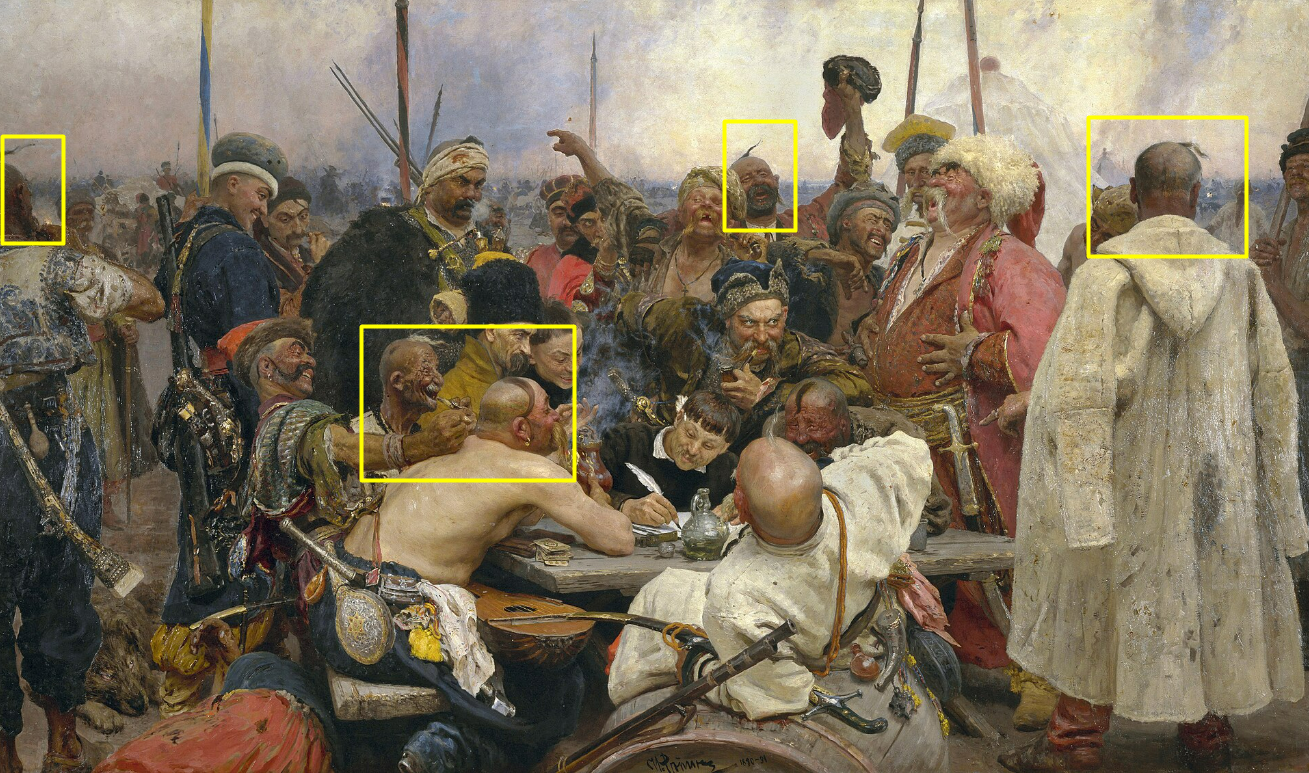
World-famous painter Ilya Repin devoted 10 years to creating his painting The Reply of the Zaporizhzhian Cossacks to the Turkish Sultan. It is a huge canvas, 2 meters by 3.5 meters, with nearly life-size figures, but 10 years are 10 years.


Why did it take Repin so long to paint it? Did he have other priorities, or did he lack inspiration? On the contrary! Repin’s letter to art critic Stasov dating from 1880 documents the very beginning of the masterpiece’s creation:
“Oh, oh, forgive me, I won’t; what a shameless person I am. Until now I couldn’t answer you, Vladimir Vasilyevich; and the Zaporozhian Cossacks are to blame for everything; what a people they are!! How can I write here when my head is spinning from their din and noise… You even decided to encourage me. Long before your letter, I completely accidentally unrolled the canvas and was unable to stop; I took up the palette and now for two and a half weeks without rest I’ve been living with them, I can’t part with them —they’re a cheerful people… No wonder Nikolai Gogol wrote about them; it’s all true! Amazing people!.. No one in the whole world felt freedom, equality, and brotherhood so deeply! Zaporizhzhia remained free throughout its life and never submitted to anything. There’s no point in thinking about it, even if it’s a mocking picture, I’ll still write it anyway, I can’t help it. Stay healthy. Yours, Ilya.”
Repin Half-Ukrainian
Stasov knew Repin better than others, and three volumes of their correspondence testify to it. Repin also made a portrait of Stasov. Here is an interesting insight Stasov shared in his works about the painter that may explain Repin’s passion for this particular work:
“Repin was half-Ukrainian by birth, and these ancient, deep forces of his homeland, unknown to him, rose up in his chest and began to sound when the thought flashed through his mind to write “The Circle of Zaporozhian Cossacks”
Repin’s Daughter Vera
Repin’s daughter, Vera, later recalled how immersed her father was in Ukrainian history during that period. According to her, almost every day Repin read verses aloud to his children in Ukrainian. His daughters even gradually came to know all the heroes in the painting, such as Otaman Sirko with his grey whiskers, Cossack Holota ‘who feared neither fire, nor sword, nor swamp’.
and Taras Bulba with his sons Ostap and Andrii.
According to Vera, Repin even modelled the figures of the Zaporozhians from yellow clay.
Repin’s Research
In an attempt to create a historically authentic representation of Ukrainian Cossacks, Repin spent a lot of time travelling to the areas where the Cossacks dwelt.
Repin took four trips to the Zaporizhzhe district on the Dnieper River to sketch the Cossacks’ descendants; he also read extensively in Cossack history and consulted with scholars and studied and copied relevant seventeenth-century artifacts in various museums.
In another letter to Stasov, Repin wrote about the city of Dnipro, saying that “it is awash in greenery: cherry orchards, wealthy mansions, and cottages. This prosperity has a positive influence on the descendants of the Zaporozhian Cossacks; they are very kind, hospitable, and gentle in nature.”
Repin’s research and artistic note-taking for the Cossacks’ Reply surpassed in volume what he had done for any other of his paintings. On display with the final version of the painting were thirty-one preliminary studies.
A Repin’s Biography adds more details:
“His principal works are not the result of a single, swift transcription of something vividly seen or spontaneously apprehended. They are the outcome of prolonged study and adjustment. As many as a hundred preliminary sketches were made for The Cossacks’ Reply, of which, during an interval of some ten years, he painted three separate versions. This theme, in fact, haunted him.”
Khokhol Haircut
An eyewitness to Repin working on the Cossacks reported his meticulous, even labored attention to every detail:
“He uses a lot of accessories when painting, and there is not a single object in the picture which is not historically accurate and well thought-out.”
In the painting, we see many characters wearing a distinctive lock of hair widely known as the Khokhol haircut.
Why did the Cossacks wear it, and did it have any meaning?
Edward Daniel Clarke
Around 1800, or some 80 years before Repin, British traveller Edward Clarke met Zaporozhzhian Cossacks in the area of Krasnodar.
Here is what he said about those Cossacks in his book that became a European bestseller and was republished numerous times:
“The distinctive mark of a Black Sea Cossack, borne by the lower order among them, of a braided lock from the crown of the head, passing behind the right ear, is retained even by the officers, but concealed by the younger part of them, with very artful foppery, among their dark hair. They seemed ashamed to have it noticed, although, like a relic on the breast of a Catholic, it was preserved even with religious veneration; and there was not one of them who would not sooner have parted with his life than with this badge of the tribe to which he belonged.
The custom is of Polish origin but in this part of the world it serves like the sign among free masons, and distinguishes the Tchernomorski Cossack from the Cossack of the Don, as well as from every other tribe of Cossacks in the Russian empire. The Tchernomorski are much more cheerful and noisy than the Don Cossacks; turbulent in their mirth; vehement in conversation; somewhat querulous; and, if not engaged in dispute, are generally laughing or singing.”
Western Ukraine was part of the Polish-Lithuanian Commonwealth for several centuries, and that was the reason why Edward Clarke mistakenly ascribed the Cossacks’ haircut to Polish origin.
The previous video on this channel shows that a Kyiv ruler wore such a haircut in the 10th century already.
And this fact may explain why Ukrainian Cossacks wore it with such veneration.
Why Black Sea Cossacks
The Chernomortsy, or the Black Sea Cossacks, were the same Zaporozhian Cossacks. They played a crucial role in the war with the Turks, especially in its naval part.
In 1788, they, under the command of the Father of the American Navy, Admiral John Paul Jones, saved the Russian Black Sea Fleet from total annihilation by the Turkish Armada.
In correspondence with General Potemkin, preparing for the battle, John Paul Jones noted:
Our force in row boats is greatly superior to the Turks, and we can at any time go to the assistance of Kinbourn, though the wind should be contrary.”
Those rowboats were the famous Zaporozhian Cossacks’ chaikas that became the American Admiral’s only means for maneuvering the large ships when the wind was unfavorable.
As for the rest of the flotilla, the American Admiral faced a considerably larger Turkish fleet. Besides, the Russian ships were poorly built, manned by impressed serfs, and were not fully armed.
Battle of Liman
In the famous Battle of the Lyman, the major striking force under the circumstances became the above-mentioned Ukrainian Zaporozhian Cossacks on their rowboats.
Two courageous Otamans, Sydir Bilyi and Antin Holowaty, took immediate command of the Cossack fleet. Prince.
Prince Nassau, the nominal commander of the Cossack Fleet, was hiding behind the batteries at the time of the battle.
Later, when the battle was almost over, “the prince of Nassau was told that the Admiral’s flag of the Turkish Fleet, which had been displayed on the vessel of the capitan pacha, was struck, and he hastily advanced to claim it… The Zaporozhians picked up the flag from the water, and the prince of Nassau, a long while afterwards, had the glory …of having snatched it from their hands“
Saving Russian Fleet & Suvorov
During that battle, Cossack leader Sydir Bily was fatally wounded.
At the eve of that battle, he had made agreements with the Cossacks who fought against Russia on the side of the Turks. That agreement not only brought victory to the Russians, but also saved the life of Suvorov, who was encircled at the time.
After the war, in 1792, Catherine II expressed her perverted gratitude by deporting Zaporozhian Cossacks from their ancestral homeland to the Kuban Peninsula. Some time earlier, she forbade the very name of Zaporizhzhia.
She also made John Paul Jones regret ever coming to her service.
There is a monument in Krasnodar these days. There are, of course, Catherine and Potemkin. And there are Zaporozhian Cossacks with their famous haircuts who saved the first two from the fiasco. But who betrayed the Cossacks in return.
Ilya Repin also painted the Cossacks on the Black Sea.
Cossack Jones
Zaporozhian Cossacks and John Paul Jones formed a special bond from the start.
The Cossacks were so impressed by his bravery that a couple of days before the Battle of the Liman, they awarded Jones the rare privilege of being inducted into the Cossack Brotherhood. Admiral was given a Cossack smoking pipe, a saber, and the red Cossack trousers – sharovary – which he proudly wore aboard his ship. During the ritual, he was also given a new Cossack name – Cossack Pavel Dzhones.
Thus, the Founder of the American Navy became an Honorary Cossack of the Zaporozhian Army.
On June 17, 2013, U.S. Ambassador John F. Tefft visited Ochakiv and Kherson to commemorate the 225th anniversary of John Paul Jones’s induction into the Cossack Brotherhood.
Clarke’s Comparison
Muscovites have been slandering Ukrainians for centuries.
Dr Edward Clarke discovered it through his own experience:
“We began to perceive that the farther we advanced from the common hordes of the Russians, the more politeness and hospitality we should experience; exactly the reverse of that which we had been taught to expect by the inhabitants of Moscow.”
He also noted a civilizational abyss between Ukrainian Cossacks and Russians:
“The Cossack is rich; the Russian poor. The Cossack is high-minded; the Russian abject. The Cossack is for the most part clean in his person, honourable, valiant, often well informed, and possesses, with his loftiness of soul, a very noble stature; the Russian is generally filthy, unprincipled, dastardly, always ignorant, and rarely dignified by any elevation of mind or body…”
Bunin
The first Russian writer to be awarded the Nobel Prize in Literature, Ivan Bunin, observed exactly the same difference between Ukrainians and Russians.
In his short story “The Cossack Way,” he recollected his first trip to Ukraine in 1898, a hundred years after Edward Clarke’s travels:
“I liked the khokhols very much at first sight. I immediately noticed the sharp difference that exists between a Great Russian muzhik and a khokhol. Our peasants are mostly worn-out folk, wearing coats-zipuns full of holes, bast shoes-lapti and foot wraps-onuchi, with emaciated faces and uncombed hair. While the khokhols produce a pleasant impression: tall, healthy and strong, they look at you calmly and gently, are dressed in clean, new clothes.”
It should be noted that Bunin uses the term khokhol as descriptive of all the Ukrainians, and there is nothing derogatory or denigrating in it.
Barge Haulers
Ilya Repin portrayed the Russian attire Ivan Bunin was writing about in The Religious Procession in Kursk.
Repin’s The Barge Haulers on the Volga can serve as a representation of Russia’s slaverish population even to this day.
One art critic made a keen observation in this regard, saying that “Ukraine in Repin’s paintings is all beauty, joy, happiness, a grand and even reckless struggle against powerful enemies. Russia is wallowing in ugliness and cruelty.”
Gopak, Last Painting
It should not come as a surprise that the final work of Ilya Repin became a painting about Ukrainian Cossacks. He even continued painting it with his left arm when his right arm became weak.
In one of his last letters, Repin wrote: “Kind, dear compatriots, I ask you to believe in the sense of my devotion and endless regret that I can’t move to live in a sweet, joyful Ukraine. Loving you from childhood, Ilya Repin”.
Promo
The book “Kyiv Rus in Heimskringla Sagas and Byzantine Texts” has the details of Kyiv’s naval attacks across the Black Sea in the 9th century already. It quotes Scandinavian sagas of the Viking kings coming to Kyiv to serve and find refuge. The origin of Ukrainian Cossackdom is rooted in that epoch.
Flags
After Ukraine’s independence, people suddenly realized that, already in the time of Tsarist Russia, Ilya Repin portrayed the colors of the flags of the Cossacks’ Host that would become the colors of Ukrainian Independence. As can be seen, one flag wrapped around the pole shows blue and yellow, which are the official colors of the Ukrainian statehood. The other one shows red and black, which are the colors the Cossacks used in wartime.
The similar national colors of Sweden and Ukraine may have a different meaning than is currently thought and go back to Indo-Aryan traditions. The book “Cradle of Civilizations’ explores the subject.