

Ancient Flight-Archery Record Inscription


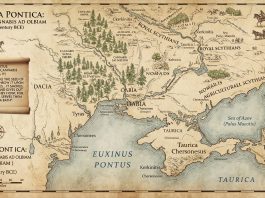
In 1900, during excavations of ancient Pontic Olbia on the Black Sea coast of what is now Ukraine, archaeologists found a Greek stone inscription. The inscription, dating to the 5th century BC, became the oldest clear evidence of some form of flight shooting competition.

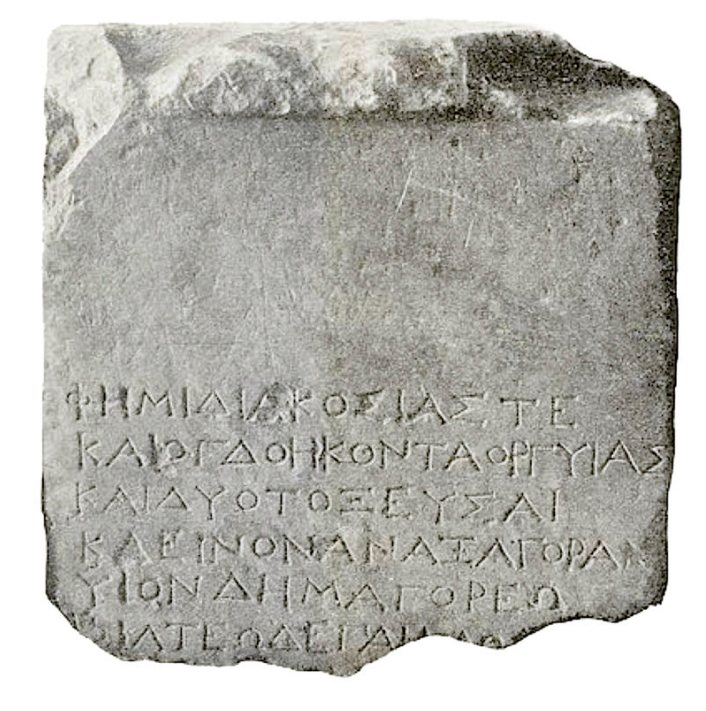
The following year, the American Journal of Archaeology published the news. The full translation of the inscription reads as follows:
’I proclaim that the famous Anaxagoras, son of Demagoras, shot 282 orguias with his bow.’
Currently, it is believed that the Attic measure mentioned on the stone monument equals roughly 522 meters, and not 501 meters that the Journal mentioned. In any case, that was likely a remarkable distance, and it was apparently deemed worthy to be set in stone. As the Olbians were Greek traders living in Scythian territory, it is assumed that Anaxagoras used a very powerful composite bow acquired from the Scythians.
Scythian cultural, especially martial, influences in Pontic Olbia were strong. Evidence of this is the fact that in this city appears a rare phenomenon where the coins were minted in the form of arrowheads.
The stone inscription from Olbia that is considered to be the earliest known historical record of a flight-archery contest and the arrowhead coins are housed in the Odesa Archaeological Museum of Ukraine.
Herodotus in Olbia
Ancient Olbia is the city that Herodotus visited in the 5th century BC and used as his headquarters for his travels in Scythia. The first video on the channel explains why the Father of History made the journey. Another video shows the borders of Scythia that Herodotus defined, which many modern historians overlook for some unknown reason.
It is most likely in Pontic Olbia that the Greek colonists told Herodotus the legend of the Scythian nation’s origin. The legend involves a bow that Heracles left in Scythia for his sons to prove they are worthy to be his heirs.
Bow of Heracles and Scythians
According to the legend, Heracles arrived in Scythia with the herd of cattle stolen from Geryon. There, in the sacred place named Hylaia, he encountered a snake-legged local chthonic divinity. From the subsequent union of Heracles and Echidna, three sons were born.
Heracles left one of his two bows and the instruction that the son who could draw his bow would inherit the Scythian land. Scythes, the youngest, was the only one who was able to draw Heracles’ bow, thereby proving himself to be the strongest, and so he inherited the land and the power.
Bow as Symbol of Heraclean Ancestry
Several facts need to be highlighted.
First, in the eyes of the Greeks living in Scythia, the Scythians had the bow of demigod Heracles.
Second, the bow was so powerful that even two legendary sons of Heracles were not capable of stringing it.
Third, because only Heracles’ youngest son could string that bow, the Scythians living in the land saw their bows as much more than just weapons.
The Heraclean bow was their standard and the symbol of the Scythians being true heirs of the demigod. The competition in Olbia that Anaxagoras won may well have honored Heracles the Archer, the progenitor of the Scythian race. And here is an interesting fact that may support such a supposition.
Eminako Coin
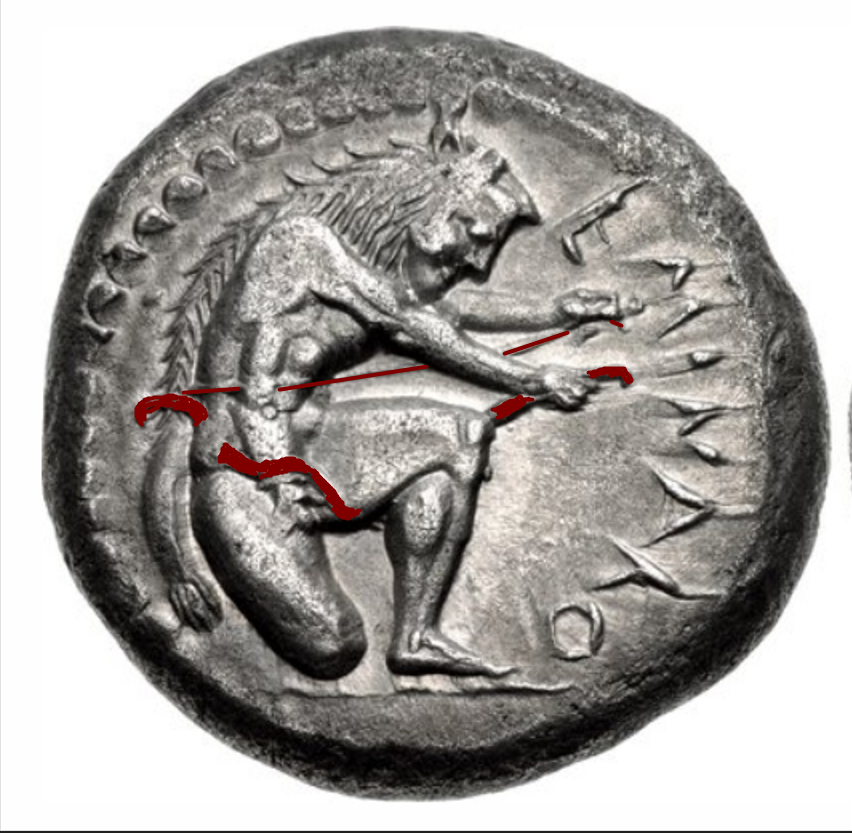
At approximately the time Herodotus was in Pontic Olbia, the city minted the following coins for Scythian King Eminakos. The inscription EMINAKO in ancient Greek letters is the first known instance of a Scythian ruler being named on a coin. The coin was struck around 440 BC and recalls the mythological tale just mentioned.
The obverse of the coin depicts Heracles in a lion’s skin that covers his head and back, stringing a bow. The detailed image suggests that the waist belt was used to fixate one end of the bow while pulling the other.
Dolphin Coins on Olbia
The reverse shows a studded wheel with four spokes and four dolphins swimming counterclockwise around.
As a matter of fact, Olbia minted its own coins in the form of dolphins because the city’s patron god was Apollo Delphinius. The coins first appeared as temple tokens or sacrificial offerings linked to the cult of that titular deity around the 6th century BC.
Scythian Bow as Hallmark
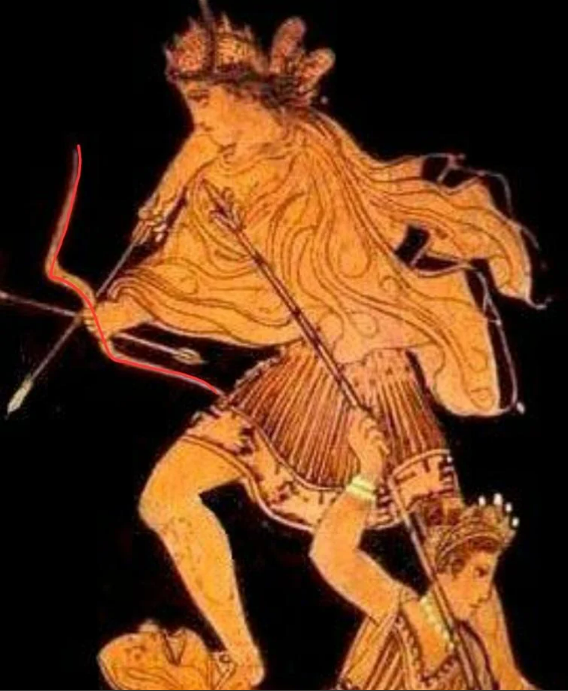
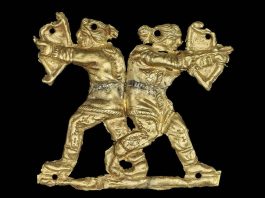
The Scythian bow was the hallmark of the nation, and differed greatly from the bows of other nations. Short, reflexed, double-curved limbs were its distinctive features as can be seen on many famous artifacts produced in Scythia and Greece.
Ancient Greeks and Romans later adopted Scythian-style bows for their superior performance. Historical reconstructions of divine or heroic bows from that period frequently drew direct inspiration from Scythian archer geometry.
Cupid’s Bow
Cupid’s Bow most commonly refers to the mythical weapon of the Roman god of erotic love, affection, and attraction. Cupid carries a double-curved, S-shaped bow as can be seen on many peices of art.
Eros, the Greek counterpart to Cupid, wields the same type of asymmetrical or double-curved recurve bow as Cupid does. The bows of the two gods were most likely modeled after the classic Scythian reflex bow.
The book ‘Royal Scythia, Greece, Kyiv Rus’ has the story of famous Roman poet Ovid and his impression of the Scythian bow. It has little-known facts about the goddess Artemis, whose symbols were bow and arrows.
The book ‘Cradle of Civilizations’ explores the origin of many famous myths, including the ones about Heracles and Artemis.
Recently, an almost fully intact Scythian bow was discovered in one of the kurgans in Ukraine. The author of this channel plans to devote the next video to that bow.
As usual, the best way to support the channel is to order a book, leave a comment or review, and subscribe to the Royal Scythia channel.