

Herodotus


According to Greek historian Herodotus, the Scythian religion centered on seven divinities. He described them in the following way:
The only gods the Scythians try to appease are Hestia, who is their most important divinity, Zeus, and Earth, whom they consider to be the wife of Zeus; after these, they worship Apollo, Ourania-Aphrodite, Herakles, and Ares. While these are the traditional gods of all the Scythians, the Royal Scythians also sacrifice to Poseidon. In the Scythian language, Hestia is called Tabiti.
Greek Hestia
For the convenience of his Greek readers, Herodotus called the most important Scythian divinity by the name of a Greek goddess, Hestia. Who was she?
In classical Greek religion, Hestia was the goddess of the hearth or fireplace. As the goddess of sacrificial fire, Hestia received the first offering at every domestic sacrifice.
Hestia was one of the Olympian gods, and that is where her major difference from Scythian Tabiti lay.
Because in the hierarchy of the seven Scythian gods, which was divided into three levels, Scythian Tabiti held the most prominent place.
Tabiti Etymology
We read that the original name of the Scythian goddess may have been Tapatī, which means “the Burning One” or “the Flaming One”.
There is a goddess Tapati in Hinduism with a similar function.
This word appears in the classical language of the Indo-Aryans, known as Sanskrit.
And in the religious text of Zoroastrians known as the Zend-Avesta.
Different forms of this word are present in a vast number of the Indo-European languages.
Interestingly, in the Ukrainian language, the word topyty is an almost exact replica of the name of the Scythian goddess and means to heat.
Scythian Matriarchat?
The etymology of the name shows that Scythian Tabiti was a primordial sovereign deity of fire derived from the common fire-deity of the Indo-Europeans.
Another interesting specificity of the Scythian fire deity is that it appears in a female hypostasis, while in the other Indo-Iranian traditions the fire god is, as a rule, a male figure.
The fact that the most revered deity of the Scythians was the female deity at the head of the Scythian pantheon makes scholars believe that matriarchy once existed in Scythian society.
Queen of the Scythians
Another passage in Herodotus indirectly confirms such supposition.
During the war between the Scythians and Persians, the Scythian king Idanthyrsos, outraged by the Persian king’s claims to call himself his master, replied to Darius angrily: ‘I recognize as my masters only Zeus, my progenitor, and Hestia – the Queen of the Scythians.”
As the Queen of the Scythians, Tabiti protected the social order and was the Guardian of the State.
Fiery Gifts
But there was one other reason why the Scythian king named goddess Tabiti his master.
Herodotus narrated a Scythian genealogical myth which may denote another function of Tabiti.
It is about Targitaos, the first king and the ancestor of all the Scythians, and his three sons.
The gold objects – a cup, an ax, and a plow with a yoke fell from the sky and caught fire when the older two brothers approached them.
But when the youngest son approached, the fire stopped burning, and he became the owner of the gold objects.
The elder brothers understood this sign and surrendered the kingdom to the youngest brother.
Since Tabiti is the goddess of heat and fire, the flaming objects falling from the sky came from her realm.
And it means that she was the one who decided which of the three brothers could possess them.
Thus, goddess Tabiti legitimized the power of Scythian kings through sacred bonds, and it is in this aspect she was their master.
Iconography
A prevailing opinion states that no direct anthropomorphic statues or physical likenesses of Tabiti survive, as she was instead honored through the living flames of the central hearth.
But many notable scholars challenged this belief.
For example, a prominent Scythologist, Boris Grakov, in his book The Scyths, wrote the following:
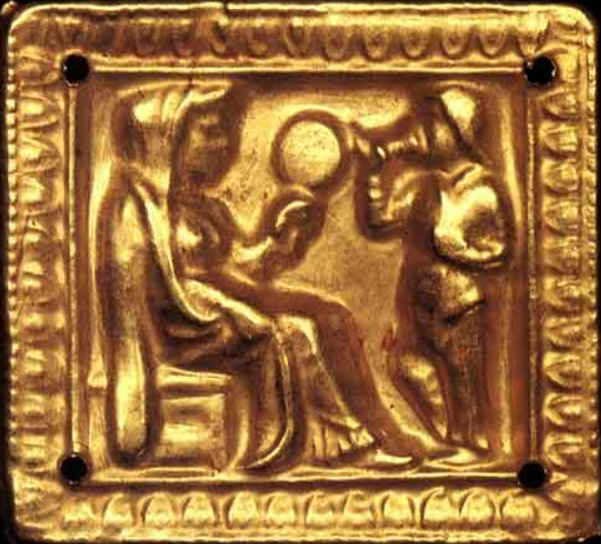
The image of a Scythian warrior or king drinking from a sacred vessel before a goddess seated solemnly on a throne, holding a mirror, likely represents a ritual performed before a female deity, a rite of initiation into the goddess’s power and patronage.
According to Boris Grakov, this supreme goddess is Tabiti.
Books to Read
The book Royal Scythia, Greece, Kyiv Rus takes a closer look at the Scythian culture that existed mostly in the area of present-day Ukraine. The Scythian tactics in expelling the Persian Army of Darius the Great is part of the narration.
The book Cradle of Civilisations explores the origin of many famous myths. The book postulates that the territory of present-day Ukraine was the cradle of the Indo-Europeans. Recent DNA studies have confirmed the hypothesis.