

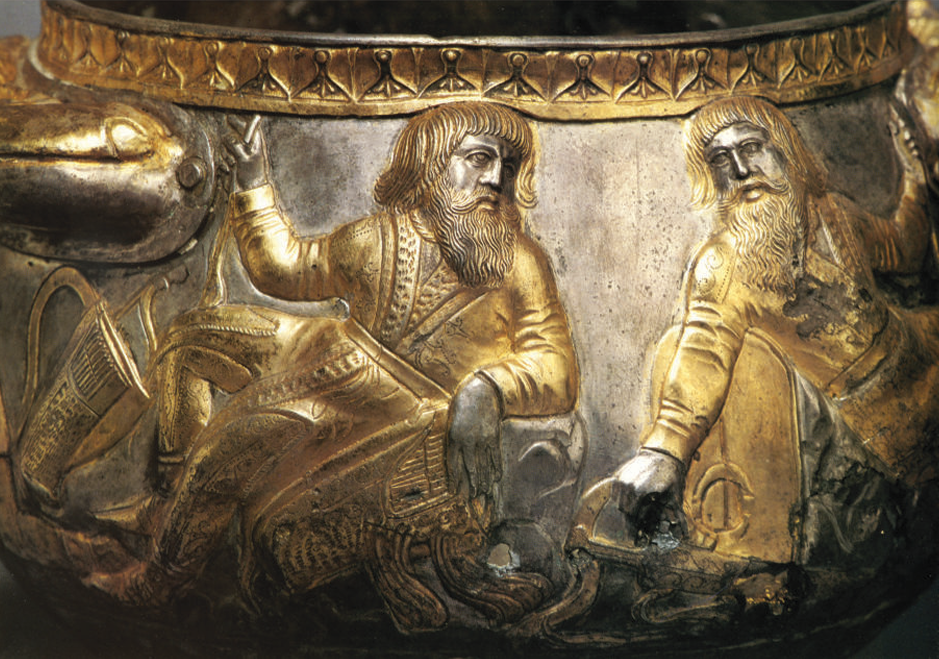


The famous 4th-century BC gilded silver bowl decorated with reliefs of elite Scythian warriors was discovered in the Gaimanova Mohyla Royal kurgan in the Zaporizhzhia Oblast of Ukraine.
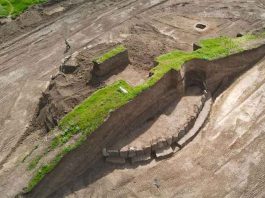
The kurgan was excavated in 1970 by a group of Ukrainian archaeologists.
In 1976, the Institute of Archaeology of the Ukrainian Academy of Sciences described the discoveries for UNESCO in the following words:
The most outstanding work of Scytho-Classical art found in the Gaimanova Mogila kurgan is a small spherical gilded silver cup, with two flat horizontal handles decorated with rams’ heads.
The central design on the cup is a wide frieze in high relief, depicting Scythian warriors.
The warriors stand against a background of an open, stony area and are connected by their shared activities.
They are superbly integrated into the form of the vessel. The four major figures are displayed in pairs on the surface of the cup while the other two kneel under the cup’s handles.
First Pair
On one side of the cup stand two elderly warriors, engaged in conversation.
Long-haired and bearded, they are dressed in rich clothing and carry ceremonial precious weaponry.
Their long kaftans, with triangular gussets, are trimmed with fur and embroidered on the shoulders and chest with fantastical designs.
Their hairstyles are highly distinctive, and their weapons in particular betoken the highest authority.
The mace of the warrior on the right and the two-thonged whip held by the one on the left suggest that the two men belonged to the elite of Scythian leaders.
Second Pair
On the opposite side of the cup, an elderly bearded warrior and a young Scythian are conversing.
Their clothing is just as luxurious, their weapons just as costly, but their poses are somewhat different.
The young Scythian holds in his right hand a ritual drinking-bowl, and his left hand is outstretched, like that of the elderly warrior.
Figures Under Handles
Under one handle of the vessel, a youth on his knees is prostrating himself before a wineskin, while the kneeling figure under the other handle is an elderly warrior, with his gorytus (the combination quiver and bow-case typical of the Scythians) beside him.
He has one hand stretched up to his forehead and is gripping something with the other.
All the figures are gilded, and only the faces and hands are silver. Each image is individual in style.
It is worth emphasizing that this is the first known example of Scythian décorative art depicting Scythian leaders of the highest rank.
Central Scene
As can be seen, of the six figures, only two figures occupying the central part of the vessel between the handles are in excellent state of preservation.
These figures provided a wealth of material for the study of the weapons, dress, and physiognomy of noble or royal Scythians.
Here are depicted two Scythian warriors engaged in conversation, as evidenced by the relative positions of their figures, the turning of their heads towards each other, and the attentive concentration of their faces.
Both Scythians are mature, with luxurious wide beards, long moustaches, and long, smoothly combed hair that reaches their shoulders.
They are dressed in expensive clothes, armed with precious weapons, and hold symbols of power in their hands.
Faces
Let’s take a closer look at their faces. The warrior on the left is depicted half-turned to the right. His broad, rounded face is turned to the left and presented almost full-frontal. His nose is long and straight, and his eyes are large and semicircular, with clearly defined pupils. His forehead is covered by a smooth, hanging fringe of straight strands of hair.
The warrior on the right sits half-turned, his head turned to the left towards his interlocutor. There is a certain portrait resemblance between the two warriors, and it can mean that they were closely related, possibly even brothers.
Both warlords have the same hairstyles, beards, and facial features.
Speaking of facial features, it is important to point out that there is nothing Asiatic or even Near Eastern in them.
In this regard, a previous video on this channel titled ‘A Scythian Face Reconstructed Forensically’ has more insights into the topic.
Clothes
Now let us take a closer look at the clothes of Scythian nobility.
The left warrior wears a long-skirted caftan with a fur-trimmed lapel. The caftan’s flaps end in hanging triangular wedges, the edges of which are also trimmed with fur.
The sleeves of the caftan are narrow, long, and end with narrow cuffs that fit tightly around the wrists.
The warlord is belted with a wide, smooth belt, connected in front with long ties, the ends of which hang down.
On the chest, the caftan is decorated with a symmetrical dotted geometric pattern of curls on both sides.
There is also a dotted pattern along the shoulder, applied in the style of modern shoulder straps with S-shaped curls in the middle.
He wears long, narrow trousers tightly fitting his legs and heavily decorated with geometric patterns. A rather thick seam is clearly visible along the side of the leg, suggesting the trousers are made of leather.
Along the seam is a dense pattern of small dots, and a little further away, on the right and left sides of the seam, is a vertically extended pattern of geometric curls, also applied with a dotted line. Similar details are also clearly visible on the right leg.
On his feet are soft, short ankle boots with pointed toes and a ribbon bandage at the ankle.
The Scythian warlord on the right is dressed in a long-skirted caftan of a completely identical style to the caftan of the warrior on the left.
But there are differences in the decorative pattern. Although the warriors’ shoulders are decorated with the same pattern along the shoulder, the second warrior’s caftan is more richly and variedly decorated. A row of dotted ornamental scrolls runs along the caftan’s lapel.
The right warrior’s long, narrow trousers are devoid of ornamentation. Soft ankle boots replicate the shape of the left warrior’s boots.
Gryvnas/ Torcs
On the first warlord’s neck, there is a massive gold twisted torc, visible under the hair and beard.
On the neck of the second warrior is a torc made from a massive rod, from which semicircular flat plates with notches extend to the side.
Weapons
Time to look at the military gear of the Scythian warlords.
The Archer
The first Scythian warrior has a gorytos with arrows and a bow hanging from his left belt.
The gorytos clearly shows two compartments: the lower, wider one holds the bow, while the upper, narrower one holds the arrows.
The arrow compartment has a wide triangular cutout, one-third the length of the arrows.
The quiver appears to be made of hide, with the woolen covering rendered by fine, dense notches. A decorative strip, applied with a dotted line to a smooth surface, runs along the top of the quiver. Two long, lush tassels hang from the lower part of the opening, where the arrows are visible.
With his right hand, bent at the elbow, the first warrior holds the whip by the base of the handle, and the opposite end rests on the knee of his right leg. Apparently, the leather tail of the whip is attached to the lower end of the handle, wrapping around it and rising upward.
The hand of the Scythian warlord is wide, his fingers are thin and long, and the nails and folds of skin on the joints are clearly visible.
The Swordsman
The second warlord, in his left hand, holds the mace by the base, handle up, resting its pommel on the knee of his left leg. The mace’s handle is smooth and approximately 0.5 m long, and the top of the mace has a spherical shape.
The warlord is slightly tilted with his entire torso to the right and rests his right armpit on a shield standing vertically on the ground. The shield is shaped like an elongated oval with a vertical, longitudinal ribbed protrusion. The shield faces the viewer with its inner side, revealing the shield handle.
The Sword
With his right hand, the warrior clutches a belt from which hangs a long ceremonial sword. The belt is identical in shape and cut to the belts worn by all warriors.
The sword in its sheath lies point-blank on the rocky ground. The sword’s wide scabbard is divided vertically by a straight line and decorated with symmetrical geometric swirls on either side of it, made of dotted line. The sword’s hilt is decorated with a grained pattern along the edges.
The static representation of the sword in the sheath reflects the actual form of a bladed weapon most fully. It is precisely portrayed with a fluted ornament on the handle, an oval pommel, and a triangular blade. Most likely, the master depicted a contemporary type of sword, typical for the 4th c. BC.
Significantly, the sword was brought to the foreground scene, and its image is quite large. Compared with the figure of the owner, its dimensions clearly exceed a meter in length.
The book Royal Scythia, Greece, Kyiv Rus takes a closer look at other famous Scythian artifacts discovered in Ukraine.
The book Cradle of Civilisations explores the origin of many famous myths and symbols. The book postulated that the territory of present-day Ukraine was the cradle of the Indo-Europeans, which has been recently confirmed by DNA studies.