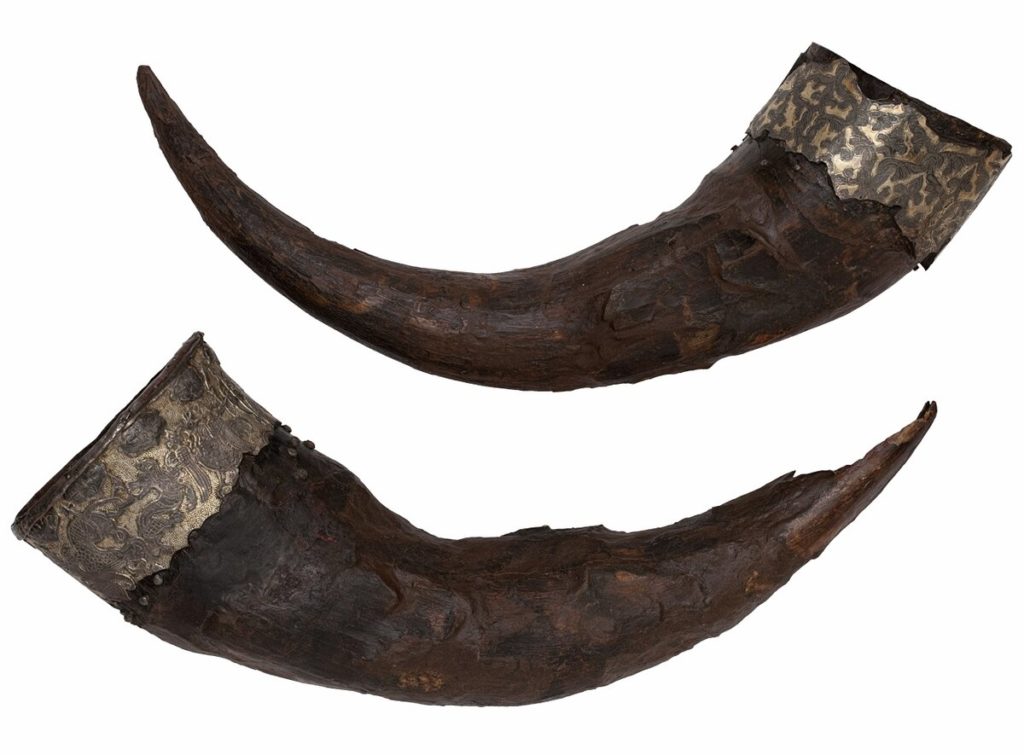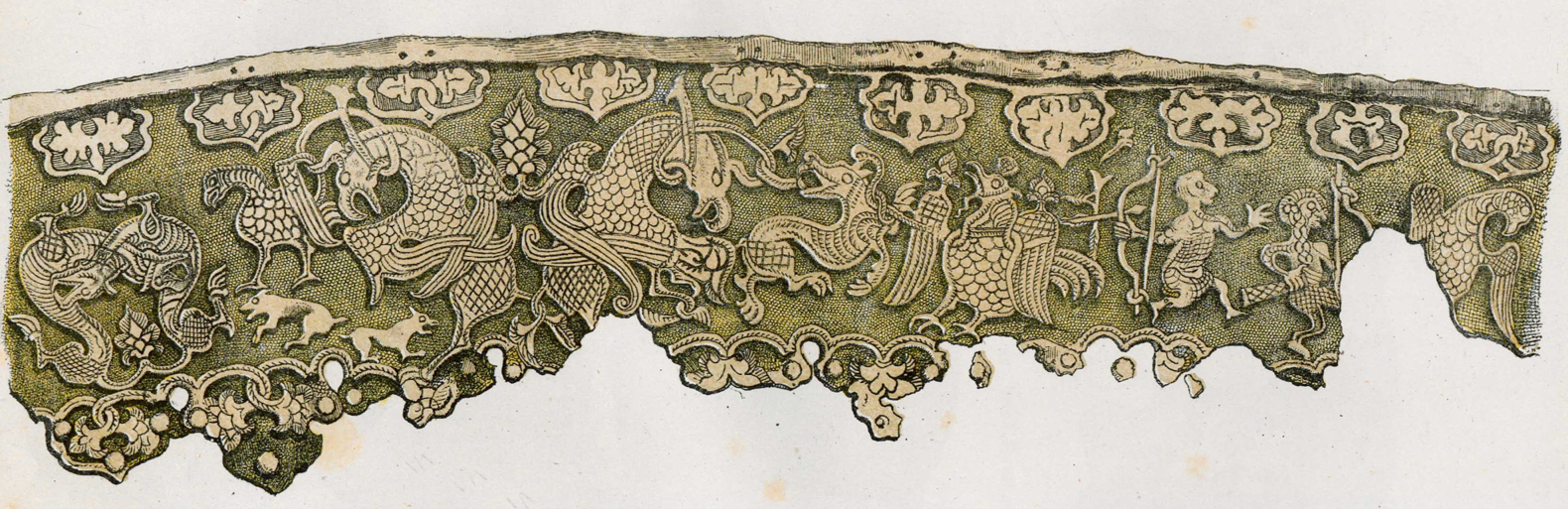
“The famous silver mounting of a bull’s horn from Chernaya Mogila [Black Barrow] is a magnificent example of flat embossing. A unique example of 10th-century Kyiv Rus’ jewelry, the mounting of this horn requires special consideration. The master initially forged a wide silver cylinder, equal in diameter to the horn. The cylinder was solid, seamless. Because of this, minting had to be done on a special round wooden blank. The background was cut with a small punch, producing a round impression approximately 0.5 mm in diameter. In total, the craftsman struck the surface of the fitting with the punch several thousand times.
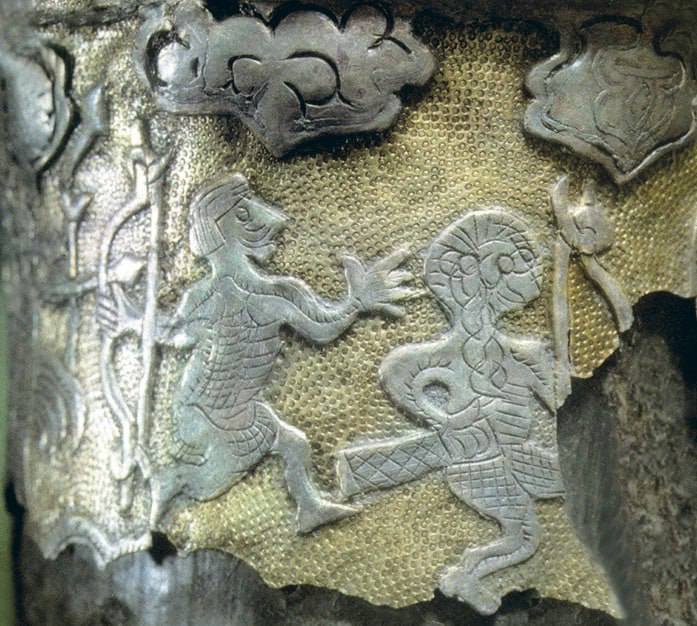
The remaining relief parts of the design were boldly and meticulously finished with a chisel. Along the upper edge ran a row of stamps of an oriental design with a background filled with niello. At the bottom, intricate festoons were carved (not fully preserved), also using niello. The central composition is located on a golden foyer, above which towered flat-relief figures of birds, people, and monsters, outlined with a chisel and, following the traces of the chisel, laid out in niello. The combination of a downward-facing background of tiny dots covered in gilding, silver relief figures, and the deep black contours of the drawing created a bright and unique play of colours and light and shadow.
The greatest interest, however, is not in the complex and rich technique, but in the exceptional artistic merit of the drawing, which has attracted the attention of art historians over the past sixty years. Nowadays, in addition to general references to the oriental style of plant ornamentation, one can directly point out some things that the master has learned in the process of creating his pattern.
The teratological composition is constructed by the master in such a way that on the back of the horn, there is a complex, but symmetrical knot of two winged monsters, connected by the stem of a wide palmetto leaf growing from their wings. This palmette is a kind of declination sign for the entire composition, from which the figures move to the left and right.
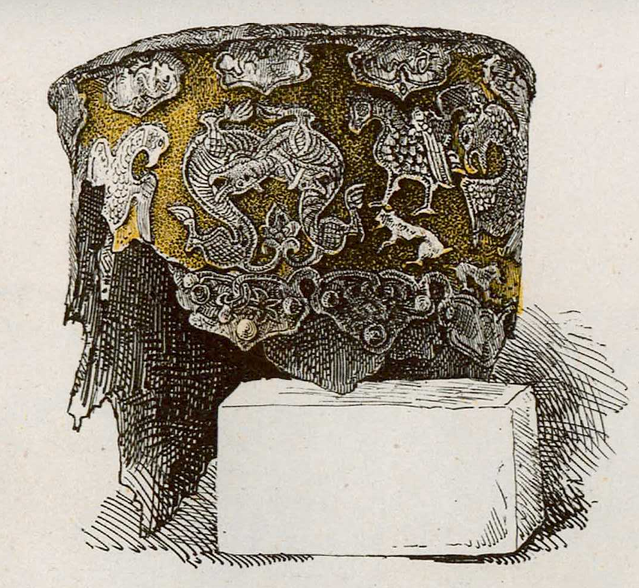
To the left is another ornamental knot of two vertically standing dragons biting each other. Their tails are fused and form a palmette in the same post-Sassanid style as the palmette of the first two monsters. The motif of two standing animals biting each other is well known in Sassanid art, but it is also known from Rus’ burial mound antiquities of the 10th-11th centuries. In a burial mound near the village of Belogorye, near Sudzha (on the southern edge of the Seversk land [Kursk region now]), a pendant was found for a necklace depicting two intertwined dragons extremely similar to the group on the auroch’s horn.
The character of the palmette has nothing in common with the Scandinavian ornament and points to the southeast, to the Iranian regions.
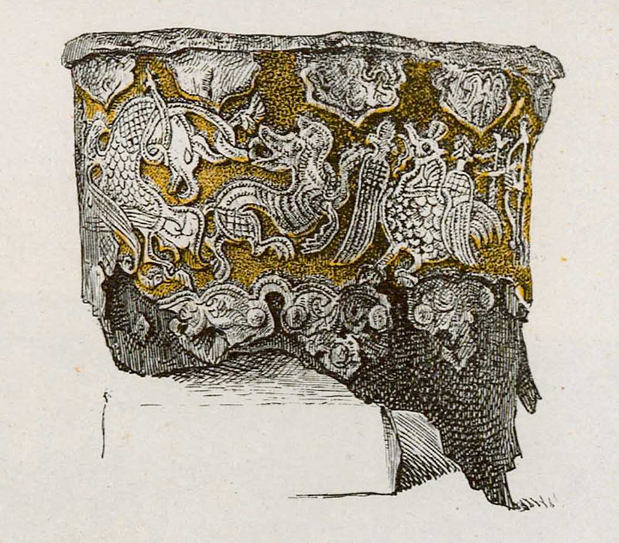
On either side of the dragons are two eagles symmetrically positioned, and under the feet of the right eagle, two small dogs are lost in the curls of the ornament, standing apart and not woven into the general teratological lace.
To the right of the dividing palmette between the first two monsters are a wolf and a rooster. This later depiction, unparalleled in Iranian or other Eastern antiquities, reflects some local Rus’ ornamental motifs. The rooster’s place in Kyiv Rus’ folklore, mythology, and folklore is well known. The same can be said of the wolf.
The central place in the frame’s ornamentation is given to a composition of two human figures and an eagle. This composition is located at the end of the frame opposite the dividing palmette; it faces the person drinking from the cup and is thus the central and primary element. Researchers have long been drawn to two small human figures, lost among the enormous monsters, flowers, and grasses covering the silver frame; they were sometimes thought to be hunters, sometimes children lost in the forest. Samokvasov calls the left figure a boy and the right a girl. Both figures are facing the right, toward the eagle, whose head is bowed.
The figure on the left depicts a man wearing some obscure clothing, like a long shirt, barefoot, and hatless. His left hand is extended forward, as if grasping something; in his right hand is a large bow of complex design, with a clearly marked bowstring. Behind the hunter, two whole arrows and one broken in half hang in the air. One arrow is diamond-shaped, the other a two-pronged “srezen” (cut), designed for shooting birds; both types of arrows are well known from Rus’ antiquities of the 10th century and were found in the same Black Barrow.
The figure on the right is wearing long trousers, with a quiver at his belt, and holds a bow in his left hand; his right arm is bent as if the hunter had just released the bowstring. This figure is distinguished by the parting of the hair and long braids descending from the right temple to the hip. You can even see what appears to be two temple rings where the hairstyle meets the braid.
The eagle is depicted disproportionately large; its head is tilted to the right, its wings are spread. It’s difficult to tell whether it’s holding anything in its talons, as the lower part of the image is broken off. A general view of the entire compositional group of two hunters and an eagle creates the following impression: the hunters are shooting at a bird of prey, but there are no arrows in the bird or near it; the arrows seem to be returning to the hunters and are depicted behind their backs, flying in disarray, plumage first and partially broken. The left hunter’s outstretched hand may be catching these returning arrows. This all recalls the plot of the Rus’ fairy tale of the Swan Princess, about a young man who kills a bird of prey and frees the girl from her spell.
The motif of arrows returning from a sorcerer-eagle is also well known in Russian folklore. A very close folkloric parallel is the Bylina About Ivan Godinovich, which features a man, a woman, a bird, and enchanted arrows. The action takes place in Chernihiv.
Having analyzed the content of the composition, I turn to those oriental objects that inspired the Chernihiv master to create such an image. In 1937, K. V. Trever published a post-Sassanid-style dish found in the Urals, dating to the 9th century. A large image of an eagle with outstretched wings is embossed in the center. In its talons, the eagle holds a woman, offering to the eagle a vase of fruit. Below are two small figures of half-naked, barefoot people without hats: the one on the left is depicted shooting an eagle with a bow, the one on the right is with an axe on his shoulder.
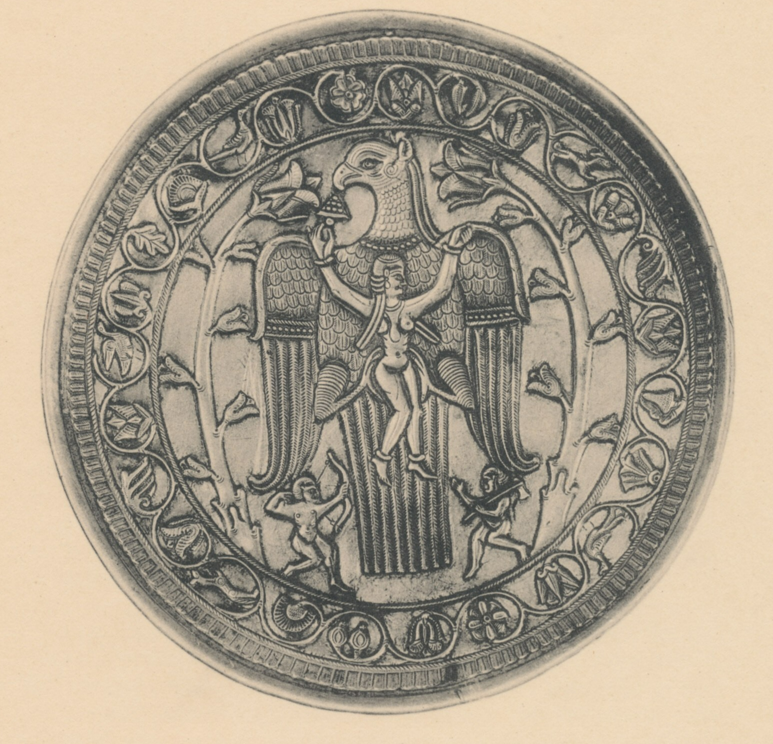
Unlike the aurochs horn, with its gradual narrative composition caused by the cylindrical shape of the frame, here the entire composition is subordinated to the circular shape of the dish. Allowing for the difference in form, we must admit an extremely close similarity between the two groups of images.
Here and there, a prominent role is played by a large eagle with outstretched wings and its head tilted to the side, and here and there, two small figures of hunters with a bow, shooting at the eagle.
The Chernihiv group lacks a woman, but details of her attire were transferred by a Rus’ master to one of the shooting figurines: the braid, secured at the top by two temple rings, completely matches the hairstyle of the woman on the Iranian dish.
The woman’s head is turned to the right, and round temple rings are visible on her temple, below which a braid hangs. The similarity between the two groups is further enhanced by the presence of two small dogs on the Iranian dish, hidden among the floral ornamental scrolls on the outer circle of the dish.
The similarity between the two groups is increased by the presence on the Iranian dish of two small dogs, lost among the floral ornamental curls on the outer circle of the dish. Among the large number of brands with flowers and birds, there are only two brands with dogs facing in different directions. The same two dogs, torn away from the central composition and also placed with their muzzles apart, are also found among the ornamental curls of the Chernihiv horn.
One conclusion follows from what has been said: the Chernihiv jeweler of the 10th century undoubtedly held in his hands and carefully examined an Iranian dish, similar in every detail to a specimen of the 9th century, found in the Urals near Cherdyn in 1936. But the Rus’ goldsmith did not copy the imported product or imitate it – he drew individual images from it and from them wove his own pattern, with his own, completely new meaning.
If, according to K. V. Trener’s interpretation, the dish depicts a scene from Iranian-Indian mythology (the Ashvin twins or the archer Krishna shooting at an eagle and Ishtar), then on the Chernihiv horn, we see a completely independent scene, only inspired by the design (but not the content) of the composition on the Iranian dish.
The Rus craftsman removed the woman from the eagle’s claws and transferred her attributes to the second twin, resulting in a completely different pair of figures with a different meaning. Not two twins, but a young man and a young woman, became the eagle’s opponents for the Chernihiv engraver; only the external duality of the figures was preserved…
So, before the eyes of a Chernihiv jeweler of the time of Igor or Svyatoslav, there was a silver dish of Iranian workmanship, which directed his thoughts to the image of some fairy tale, in which there is an eagle, and a young man in disguise, and a girl with temple rings (known to us from burial mounds), and returning arrows…
For the history of Kyiv Rus artistic crafts, this chasing work is of great importance, since, firstly, it indicates a creative reworking of Eastern artistic trends, and secondly, it testifies to the early and original development of the Rus’ version of the pan-European teratological style.
The foundation of this Rus’ teratology was the zoomorphic weaving on the brooches of the Middle Dnieper region of the 7th-8th centuries, enriched with a variety of patterns from Sassanid Iran, brought to Russian lands both on jewelry and on numerous fabrics.” (Academician B. Rybakov in 1948)
Read about B. Rybakov in the previous article:
Kyiv Radial Fibulae: Made by Rus people, not Goths >
Excavation and discoveries in Chernigiv’s Black Barrow are discussed in ‘Royal Scythia, Greece, Kyiv Rus’ book.
The ‘Craddle of Civilisations‘ book offers a new interpretation of the meaning of rhytons in the ancient world.