In 2025, an article by geneticists Lehti Saag, Olga Utevska, and a number of Ukrainian archaeologists was published ‘North Pontic crossroads: Mobility in Ukraine from the Bronze Age to the early modern period‘ in which DNA samples from different periods were sequenced, but most of them from the Scythian period: 29 individuals from the Scythian period of the Early Iron Age (UkrEIA; 700–300 BC).
Scythian-period individuals (nine of whom were radiocarbon-dated to 798 to 199 BC) were divided into groups based on their geographic location: right (i.e., west) or left (i.e., east) bank of the Dnipro and Siversky Donets basin in the forest-steppe, and Northern Black Sea region in the steppe. The groups were further divided on the basis of the sociocultural association inferred from archaeological context: Illirian-Thracian, local or nomad, agriculturalist or elite. The groups were named using the following structure, separated by underscores: time period, cultural association, geographic location, socio-cultural association, and genetic subgroup (where relevant).
Western Ukraine Scythians:
Most of the individuals associated with the Scythian culture from the western part of Ukraine (Illirian- Thracian basis) turned out to be genetically “local”:
“We modeled the groups of this study starting from the Scythian period using relevant groups from earlier periods as sources (proximal qpAdm modeling) (data S11). The analysis showed that groups from the “European” cluster in PCA (UkrEIA_Scythian_ RightDnipro_IllThr, UkrEIA_Scythian_SivDon_Nom_2, and UkrEIA_ Scythian_SivDon_NomEl_3) can be modeled as 100% UkrFBA/ EIA_Lusatian or UkrEIA_ThracianHallstatt_2 ancestry.”
Eastern Ukraine Scythians:
“Groups from the “Western Steppe” cluster in PCA (UkrEIA_Scythian_ RightDnipro_IllThr_2, UkrEIA_Scythian_SivDon_Nom, UkrEIA_ Scythian_SivDon_NomEl_2, and UkrEIA_Scythian_NBlaSea_Nom) show an additional input from Mongolia_SlabGrave (7 ± 3%, 7 ± 2%, 23 ± 6%, and 13 ± 2%, respectively).”
Elite Scythians:
Archaeologists have recently identified the burials of Scythians from the mounds in the village of Karavan in the Kharkiv region of Ukraine, who in the 7th century BC probably participated in the Asia Minor and Middle Eastern military campaigns, as artifacts of Assyrian origin were found in the necropolis.
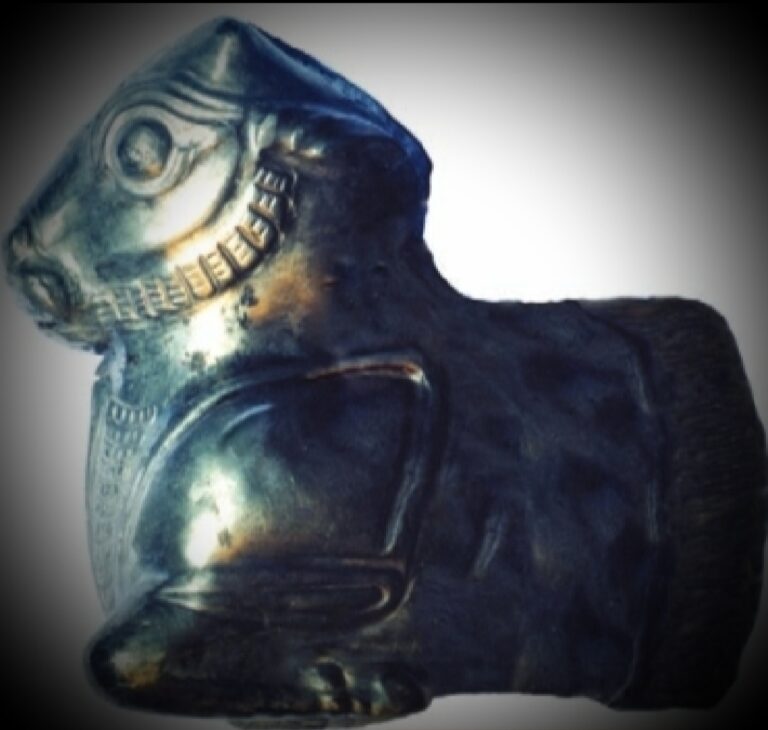
The elite Scythian (UkrEIA_Scythian_SivDon_NomEl_3) with Slavic-like genetic associations and haplogroup R1a-Z645 was from that burial in the village of Karavan, which is attributed to the nomadic elite. The mound was 5m high. Although the burial was looted, the remains of a Greek amphora, eight gold plaques decorated with ornaments, fragments of a silver rhyton decorated with a bull’s head, bronze vessels with gilding, and bronze arrowheads were found in it.
The most interesting thing is that the elite Scythian from the Karavan of the Siversky Donets Basin (UkrEIA_Scythian_SivDon_NomEl_3) did not reveal any Asian contribution at all — it was modeled: 71 ± 6% Ukraine_Yamna (Corded Pottery Culture) + 29 ± 6% Ukraine_Trypillya.
Summary:
All the groups of Slavic-like Scythians, based on autosomal genetic data (using distal qpAdm modeling), can be modeled as approximately 50 – 58% Ukraine_Yamna (Corded Ware culture) and 40 – 48% Ukraine_Trypillya, with a small amount of Mongolia_SlabGrave ancestors (1 to 4% on average).
It appears that all the articles that have been claiming Iranian ancestry of the Scythians, including the Wikipedia page, will have to be rewritten.
The book ‘Royal Scythia, Greece, Kyiv Rus’ was among the first to show the ‘Ukrainian’ origin of the Scythians. The book received harsh criticism based solely on outdated beliefs. The genetic studies debunked those beliefs, proving that the thesis of the book was correct.