Welcome to watch it on YouTube:
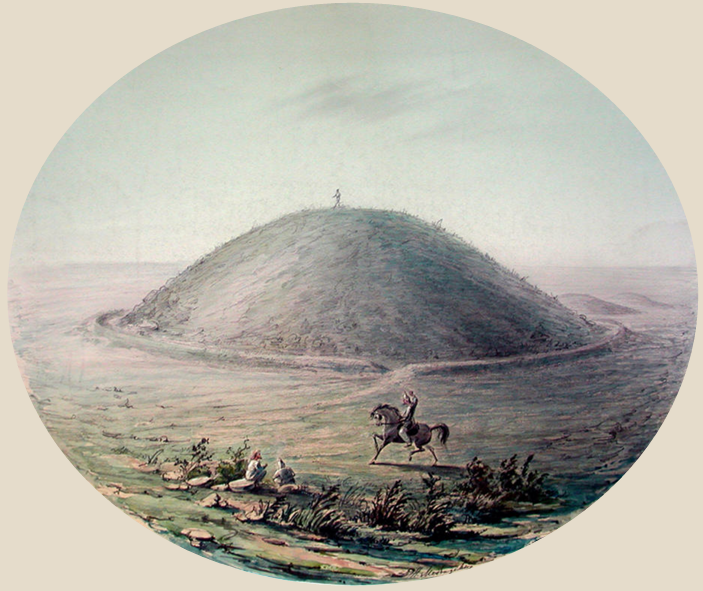
Alexandropol Kurgan, also previously known as the Lugova Mogyla or the Meadow Barrow, was recorded in the 19th century with a height of 21 m.
It was thus one of the four tallest Scythian royal kurgans located in the northern Black Sea area.
The others were Oguz with 20 meters, Chertomlyk with 19 meters, and Kurgan Solokha with 18 meters.
All of these kurgans were explored during the second half of the 19th and the beginning of the 20th century.
The four kurgans were all situated at the bend of the Dnieper River in the famous Gerrhus land of Scythia.
Around the edge of Alexandropol kurgan was a wall of huge stones, and its surface was originally also clad in stone.
The kurgan was encircled by a broad ditch, interrupted by two causeways on the eastern and western sides.
The Alexandropol kurgan became the first Scythian royal kurgan that was excavated specifically for research purposes.
The beginning of excavation in 1851 was prompted by a chance find among the rocks at the southern edge of the mound.
The find consisted of two crude iron plaques in gold and silver leaf, representing an oriental winged goddess holding two beasts.
It was followed by two bronze pole-tops with the figure of the same goddess with her hands on her hips.
And the bronze pole-top shaped like a trident, with its prongs ending in birds with bells in their beaks.
A.E. Liutsenko, Curator of the Kerch Museum of Antiquities, completely unearthed and levelled the Alexandropol mound in 1854 and 1855.
He established that the vertical stone revetment wall, standing over 4 m high, with a diameter of about 80 m, was constructed of huge slabs, and 11 types of stone were used in its construction.
As later studies would show, those stones were sourced from different deposits located 40–80 km from the kurgan as the crow flies, or up to 160 km by road.
The Alexandropol kurgan, like all Scythian burial mounds, was constructed from turf rather than earth.
To secure this building material in sufficient quantity to create the towering mound would have involved stripping a huge 66-hectare area of the surrounding steppe.
The kurgan was encased within a stone shell after the turf mound had been in place.
Horses
Olexander Liutsenko began uncovering the subterranean structures of the kurgan, and in the first chamber, he came across the remains of a fully harnessed horse that presumably belonged to the king.
The horse was buried in a posture resembling the favourite attitude of animals in Scythian art.
Its legs were pressed up against its body, and its head thrust forward, resting on a special shelf in the side of the shaft.
The horse’s bridle was decorated with four gold relief plaques representing an ox, a lion, a bird, and a hippo-campus.
Its forehead was adorned with a roundel taking the form of a sculptured horse head fixed on a strap.
The iron bits were decorated at the ends with gold rosettes; about the horse’s neck were five bronze plaques, six spherical bells, and five half-moon pendants, eight silver beads hanging down on chains, four buttons, and a silver ring with two plume-holders.
The remains of the saddle, consisting of the solid gold plaques that had adorned it, were on the horse’s back. A bronze-plated wooden quiver containing forty-five arrows was fastened at the right side of the saddle.
Near the southern wall, the second horse skeleton was found lying on its left side with its head toward the east. At the strap junctions of the bridle at the mouth and ears were four gold plaques with a design of a human head surrounded by seven ox heads.
The straps were adorned with alternating gold and silver ornamental plaques decorated with the figure of a mounted Scythian hunting a hare.
Yet another horse was discovered nearby. It had four bridle plaques showing designs of a galloping horseman, two of a griffin standing on its hind legs, and a round plate with an Athena head on its forehead, and, on the nose-piece, an oval plate with a full-length figure of Athena with an owl at her feet.
In all, there were no fewer than fourteen horses found in the Alexandropol Kurgan.
Funeral Waggons
During the summer of 1856, Liutzenko reported finding the remains of no less than two Scythian funeral carts.
Considering their closeness to the central chamber, the archaeologist conjectured that the carts were used to bring the bodies of the king and the queen to the place of their burials.
Although the wooden parts of the carts were in very poor condition, the painting that was made on the spot shows the metal rims of the carts’ wheels. Judging by their size, one can imagine how impressive the carts were during the ceremony.
Fragments of four pole-tops, two with the bird at the top and two others showing a griffin in a square frame with two bells suspended below it that were found nearby, were probably used as funeral carts’ decorations.
The second part of the video about the Alexandropol kurgan should be available on this channel shortly. Meanwhile, you are welcome to check the book Royal Scythia, Greece, Kyiv Rus. It provides unique insight into the Scythian realm and history.