Man’s Great Benefactor
“Throughout the ages, Cannabis has been extolled as one of man’s greatest benefactors and cursed as one of his greatest scourges. Cannabis is undoubtedly an herb that has been many things to many people. Armies and navies have used it to make war, men and women to make love. Hunters and fishermen have snared the most ferocious creatures, from the tiger to the shark, in its Herculean weave. Fashion designers have dressed the most elegant women in its supple knit. Hangmen have snapped the necks of thieves and murderers with its fiber. Obstetricians have eased the pain of childbirth with its leaves [female flowers]. Farmers have crushed its seeds and used the oil within to light their lamps. Mourners have thrown its seeds [inflorescences] into blazing fires and have had their sorrow transformed into blissful ecstasy by the fumes that filled the air.”
The passage just quoted was taken from the book by Ernest Lawrence Abel, Marijuana: The First Twelve Thousand Years.
Scythian Cannabis Steam Baths, Herodotus
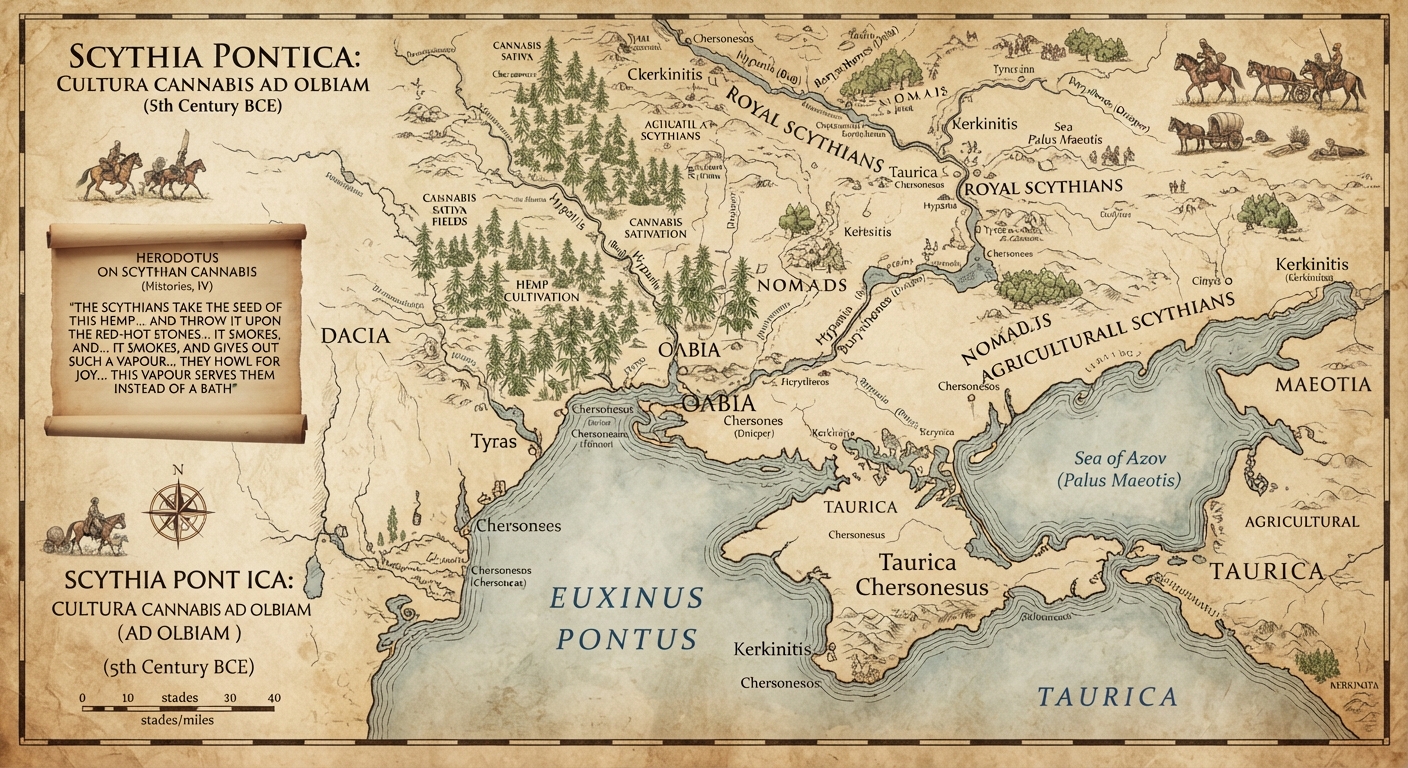
The oldest written record of cannabis usage is the Greek historian Herodotus‘s reference to the Scythians taking cannabis steam baths:
“After a burial, Scythians purify themselves by washing their heads and cleansing their bodies as follows: they first lean three stakes of wood against one another and then stretch woolen cloth around them, securing it as tightly as possible. Then they throw red-hot stones into a trough set in between the stakes…
The Scythians take the seeds of this cannabis, creep beneath the wool covering the stakes, and throw the seeds onto the blazing-hot stones within. When the seeds hit the stones, they produce smoke and give off a vapor such as no steam bath in Hellas could surpass. The Scythians howl, awed and elated by the vapor. (Histories, 4.73-74)
It should be stressed that the Scythians took those cannabis vapor baths not for the sake of intoxication alone. But it was a Scythian purification rite after a funeral.
Scythian Hemp in Ancient Ukraine
Here is another important quote from Herodotus.
“Now there is a plant called cannabis, which grows in their land and which most resembles flax, except that cannabis is far superior in its thickness and size. It grows both wild and cultivated, and from it the Thracians make clothing very much like garments of linen. Unless someone had real expertise, he would think they were made of linen and not cannabis; and if he had never seen cannabis at all, he would certainly think the cloth was linen.” (Histories, 4.73)
Several facts need to be highlighted in the text above.
Cannabis Unknown to Greeks
First, when Herodotus starts describing Cannabis he saw in Scythia, it sounds like it was the first time the historian saw the plant himself. Since the Greeks were not familiar with it as well, Herodotus introduced the plant to them.
That is the reason why he had to mention flax so that his compatriots could have an idea of how cannabis looked.
Although they are often confused because both produce useful fibers and nutritious seeds, flax and cannabis are distinct plants from completely different botanical families.
According to Herodotus, the Scythian cannabis was far superior in its thickness and size to flax.
Herodotus’ description of Scythian hemp leaves no doubt that he saw the plant personally. As a reminder, Herodotus travelled to Pontic Olbia, now in Ukraine’s Kherson region. It is in that region that the Greek historian recorded his observations.
Cultivated Cannabis
Secondly, Herodotus saw both wild and cultivated cannabis.
It is a significant fact that the Scythians living in the area of what is now Ukraine cultivated cannabis in the 5th century BC.
They most likely traded part of the cannabis crop to the neighboring Thracians who had the means and the skills to produce clothes of very high standard.
The Greek historian testified that the clothes made of cannabis were equal to the Greek linen clothes in quality.
Scythian Word Cannabis
Thirdly, Herodotus wrote that “there is a plant called cannabis, which grows in their land.” The question is who called the plant that name?
It is obvious that the Scythians called the plant cannabis and that Herodotus recorded the name for the Greeks.
Interestingly, the word Herodotus uses in his text is possibly the first occurrence of the word Cannabis.
The Greeks borrowed this Scythian word directly from Herodotus. Then, via Latin, it became the English word.
So, when people say Cannabis, they unknowingly use the Scythian word.
And it is worth keeping in mind that the Father of History first recorded that word in the area of present-day Ukraine.
As a matter of fact, the word canvas derives from cannabis because it originally referred to a strong, heavy hemp cloth.
Proto-Indo-European Origin
But where and who first started burning cannabis and discovered its properties?
Wikipedia quotes American Professor of Anthropology David Anthony:
“The oldest archeological evidence for the burning of cannabis was found in Romanian kurgans dated 3,500 BC, and scholars suggest that the drug was first used in ritual ceremonies by Proto-Indo-European tribes living in the Pontic-Caspian steppe during the Chalcolithic period, a custom they eventually spread throughout Western Eurasia during the Indo-European migrations.”
Wikipedia fails to mention where those migrants came from, though.
British Professor of Anthropology A. G. Sherratt suggested that people belonging to the Sredni Stog culture, which flourished from about 4300 to 3500 BC in the area of what is now present-day Ukraine, used Cannabis to make a “socially approved intoxicant.” They celebrated the significance of cannabis “by imprinting it on their pottery.” Sherratt argued that the ingestion of Cannabis was a fundamental aspect of Eastern European mysticism.
Scythian Origin
Ultimately, the word Cannabis is most likely of Indo-European etymology.
A previous video on this channel argues that the Scythians were the speakers of the Proto-Indo-European language, not of the Iranian language.
Scythians were local to the area around the Dnieper River, not migrants from the Near East.
They were descendants of the Yamna Culture, and this fact has been recently confirmed by DNA studies.
The book Royal Scythia, Greece, Kyiv Rus has more exciting facts about Scythian culture.
The Cradle of Civilizations takes a larger perspective that includes Trypillia and Yamna Cultures.