Muscovy-’Russia’ clings to Rurik with such ferocity as if this figure affects not only its history, but the very right to be called a country.
And all their support of Rurik’s very existence is a text created around 1110-1118 in Kyiv, in an environment where Nestor or those working on his behalf wrote political history in retrospect. So, even the event of 862 is recorded about 250 years after it had supposedly occurred.
Dmitry Ilovaysky (1832-1920) was a renowned Russian (!) historian. He first published his book Research on the Beginning of Rus in 1876, with several more editions following up until 1890. The book was republished in 2001. Here is a translation of a part of his argument about Rurik from the link above:
“We do not discuss Rurik, who [allegedly] came from Scandinavia, as he is not a historical figure, but a legendary one; therefore, his name dates back to the time when the legend was composed. Only two historical Ruriks are known from chronicles: one, Rurik Rostislavich, of the second half of the 11th century, and the other, Rurik Rostislavich, of the second half of the 12th century.
Consequently, this name is found quite late among the Rus’ princes, when, according to the Normanists, they had already become completely Slavic, and we do not see any need to recognize it as exclusively Scandinavian on the basis that Rorek (Grerekur) is found in the Scandinavian sagas...
The Icelandic sagas, which would most naturally speak of the extraordinary fortune of the Normans in Eastern Europe, know nothing of the Norman tribe of Rus, nor of Rurik, nor of the Norman voyage down the Dnieper. They don’t even use the name Rus, calling it the land of the Gards [Gardariki].”
There is yet another explanation. Since almost all Kyiv’s archives were stolen by Moscow already by Peter 1st, there are chances that interpolations have been made to forge history. Ilovaysky mentioned that even heavyweight proponents of the Norman theory, such as German-Russian historian, Academician of the Petersburg Academy of Science, Ernst Kunik (1814–99), doubted the chronology of Rurik’s arrival to Novgorod in 862 and considered it an “insertion by later copyists of Nestor”.
More about Ilovaysky and translations from his book are in the link:
Kyiv Rus was Slavic, not Scandinavian by Origin: Anti-Normanists’ arguments >
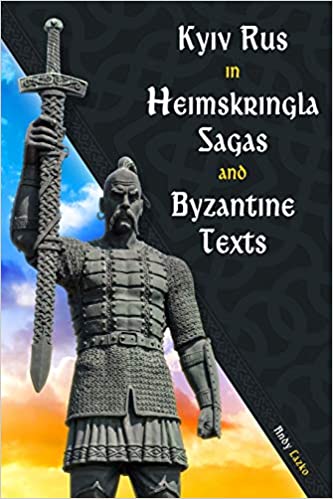
“Kyiv Rus in Heimskringla Sagas and Byzantine Texts” takes a closer look at the history of Rus as described in the Scandinavian Sagas.
“Gardariki, Ukraine” ebook is a shorter version of it.