Per Wikipedia, Academician Boris Rybakov (1908-2001) was a Soviet and Russian archeologist and historian. He is considered one of the greatest authorities on The Song of Igor’s Campaign. Below is a translation of his thoughts from his work published in 1972:
“Of all the characters in The Tale of Igor’s Campaign, the most controversial is undoubtedly the enigmatic Trojan. He does not appear as a person or a supernatural being; the poem only mentions adjectives derived from his name: Trojan’s Ages, the Seventh Century of Trojan, Trojan’s Land, Trojan’s Path.
The author speaks twice about the “ages” of Trajan/Troyan… The real historical emperor Trajan reigned for a shorter period than Yaroslav [the Wise] —19 years—and, of course, the author of the poem could not have described his reign as “ages of Trajan”.
In connection with the mysterious Trajan, not the singular, but the plural, “ages,” is used; therefore, we are not talking about the life of one Trajan, but about several generations or several centuries colored by the name of Trajan, that is, about some era, the beginning of which, in the imagination of the Rus’ medieval poet, is associated with Trajan. It is in this sense that we can speak of Emperor Marcus Ulpius Trajan, who ruled in Rome from 98 to 117.
In the history of the Slavic peoples, we know of eras when the names of outstanding individuals covered the lives of several generations. Thus, the name of Prince Vladimir [the Great of Kyiv], the first prince to defeat the steppe people, became an epic name, uniting the events of at least two and a half centuries. The name of Karl the Great [Charlemagne] entered all Slavic languages as a common noun, as a designation for a ruler, a king – “korol”.
The name of Emperor Trajan is associated with the first contact between the Slavs and the Roman Empire. Before Trajan, isolated Greek cities existed in the Black Sea region, with which the Slavs had very little contact. The Zarubintsy archaeological culture, which characterizes the state of the Eastern Slavs during the era of Tacitus and Pliny, when the Romans knew of the distant Slavs only by hearsay, confirms the disunity between the Greco-Roman world and the Slavs. We see no trade or cultural interaction between the Slavs and the southern cities; Slavic primitiveness remained untouched by the touch of civilization until the 1st century AD.
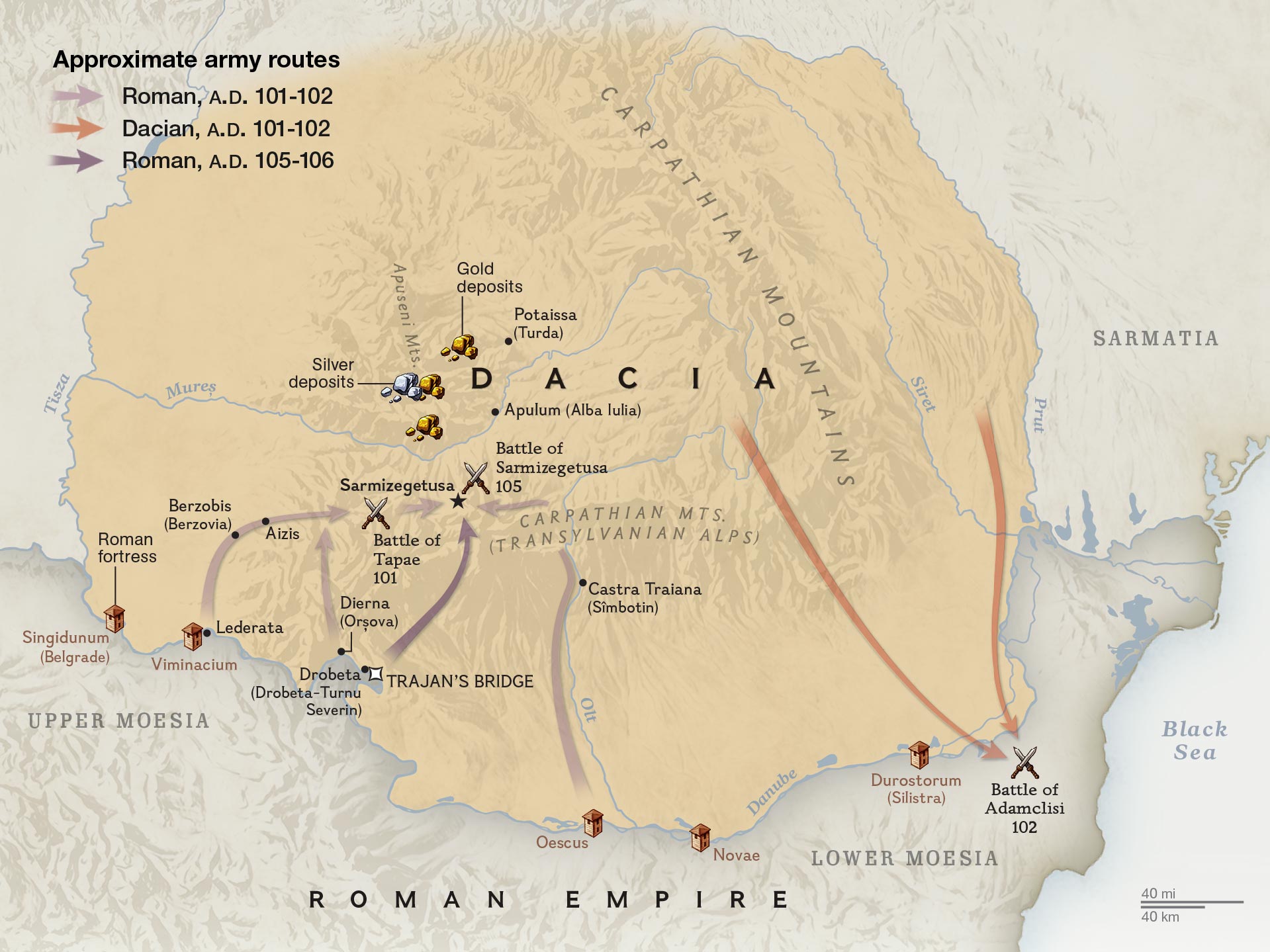
Under Emperor Trajan, the Roman Empire experienced its greatest period of prosperity and power. The empire’s eastern borders reached Armenia, Parthia, and Arabia. Trajan’s conquest of Dacia in 101–106 was particularly significant for the peoples of Central and Eastern Europe. Here, Trajan advanced the empire’s border 500 km north of the Danube; Rome became a neighbor of the Carpathian Slavs. Individual Roman cities, such as Calicia Claudia Ptolemaeus (modern-day Kalisz), perhaps connected to the amber route, were at this time located deep in the Slavic heartland.
As a result of Trajan’s victorious campaigns, Rome established control over the entire northwestern Black Sea region (Ister, Tyras, Olbia). The mouths of all the rivers flowing from Slavic lands (the Dniester, Southern Bug, and Dnieper) came under Trajan’s control.
The Slavic culture of the forest-steppe zone began to rapidly transform under the influence of trade with Rome: plow agriculture appeared, the population density and the size of settlements increased, Roman grain measures were adopted, and a huge amount of Roman silver coins appeared in the Slavic lands.
Scholars know of numerous hoards of Roman coins, which have generated an entire literature. Hoards from before the time of Trajan are unknown in the forest-steppe zone. “The massive influx of Roman coins… began approximately around the time of Trajan.” There are 132 known find sites for Trajan’s coins. After Trajan, for a whole century, until the Emperor Commodus, intensive trade between the Slavs of the forest-steppe and Rome continued, and a massive influx of Roman silver continued, amounting to tens of thousands of coins.
In the diagram of the number of Roman coins, the curve makes a sharp upward jump precisely during the era of Trajan (see inset). Geographically, the coin hoards of Trajan and his successors cover the entire Slavic forest-steppe, from the Vistula basin to the Seim, Vorskla, and Oskol (almost without entering the steppe).
At the end of the century, apparently due to the Hunnic invasion, the influx of Roman coins ceased. The last more or less significant finds date to the reigns of the emperors Constantine (337–361), Valentinian (364–375), and Theodosius the Great (379–395), i.e., to the “Busovo period.”
All this gives us the right to compare the “Age of Trojan” with that long era of peaceful and fruitful contact between the Dnieper and Volyn Slavs and the Roman centers of the Danube and Black Sea regions. Roman legionaries did not reach the Slavic forest-steppe in the 2nd-4th centuries; the Slavic nobility acquired Roman precious utensils, jewelry, accumulated monetary treasures from Roman denarii, and three centuries of connection with Rome were centuries of prosperity and well-being for the Slavic tribes of Kyiv and Volyn.
Behind these three centuries lay a primitive primordial state, the isolation of the Slavs from the pan-European civilized life, and after these “Trajan centuries” ended, a time of decline, heavy raids of the steppe dwellers, a time of unrest, instability and inevitable regression came again.
It’s no surprise that in the eyes of the Slavs themselves, this happy era, ushered in by the name of the divine Trajan, received the epic title of “the Ages of Trajan.” The juxtaposition of these two auspicious eras is entirely justified: “The Ages of Trajan were past, the years of Yaroslav have passed…” The reign of Yaroslav the Wise was also a time of prosperity and tranquility: external enemies had been defeated, civil strife had not yet flared up; cities flourished, and Europe sought connections with Kiev. Each of these eras contrasted with the difficult times that followed the happy ones: following the “Ages of Trajan,” came the dark “Time of Busovo,” years of defeat and rout. The “Yaroslav years” gave way to the disastrous years of “Oleg’s Regiments.”
We can determine the “seventh century from Trajan” only if we accept the assumption made above that the “Trajan centuries” are the 2nd–4th centuries AD, the centuries of Roman rule in the Black Sea region, the centuries of the adoption of elements of Roman culture by the Slavs of the Dnieper region.
Let’s do some basic arithmetic. The term “seven centuries” is used in connection with the accession of Vseslav of Polotsk to the throne in Kyiv. The liberation of Vseslav from the blockhouse by the rebellious Kyivans and his proclamation as Grand Prince of Kyiv took place, as is known, on September 14, 1068. Let us try, without any cleverness, to understand the word “century” as a century, and seven centuries as seven centuries, 700 years: 1068 – 700 = 368
Counting seven centuries from the date we know, we arrive at 368 AD, the reign of Emperor Valentinian (364-375). It was at this time that the Huns began to penetrate into the Black Sea region, defeating the Goths and subjugating the ancient cities. Soon after the death of this emperor, under his successor Valentinian II (375–392), the Goths defeated the Antes, crucified Boza-Bus, and the “time of Busovo” began.”
Academician B. Rybakov was one of the main proponents of anti-Normanist vision of Rus history.
Rus were Sarmatian Roxolani: They fought in Trajan’s Dacian Wars and are portrayed on Trajan Column >
“Kyiv Rus in Heimskrilngla Sagas and Byzantine Texts” book takes a closer look at the famous Kyiv dynasty and their true origin.