In January 1910, an ancient burial with gold jewellery was accidentally uncovered near the village of Untersiebenbrunn, to the north-east of Vienna, Austria. Unfortunately, the locals had managed to ransack part of the archaeological site before the specialists arrived at it. Luckily, at least some of the finds found their way to Austrian classical historian Professor Wilhelm Kubitschek (1858-1936).
In 1911, he published a report on the discovery, which stated that the skeletal material belonged to a woman in her early twenties who was 150cm tall. Her “skull was on the whole rather large, but decidedly narrow, and belonged in the category of dolichocephalic, or at least very close to it…. The face was narrow and long, orthognathic, but the chin was moderately prominent. The orbital entrances are large, elliptical, set obliquely; the nose structure is long and narrow.”
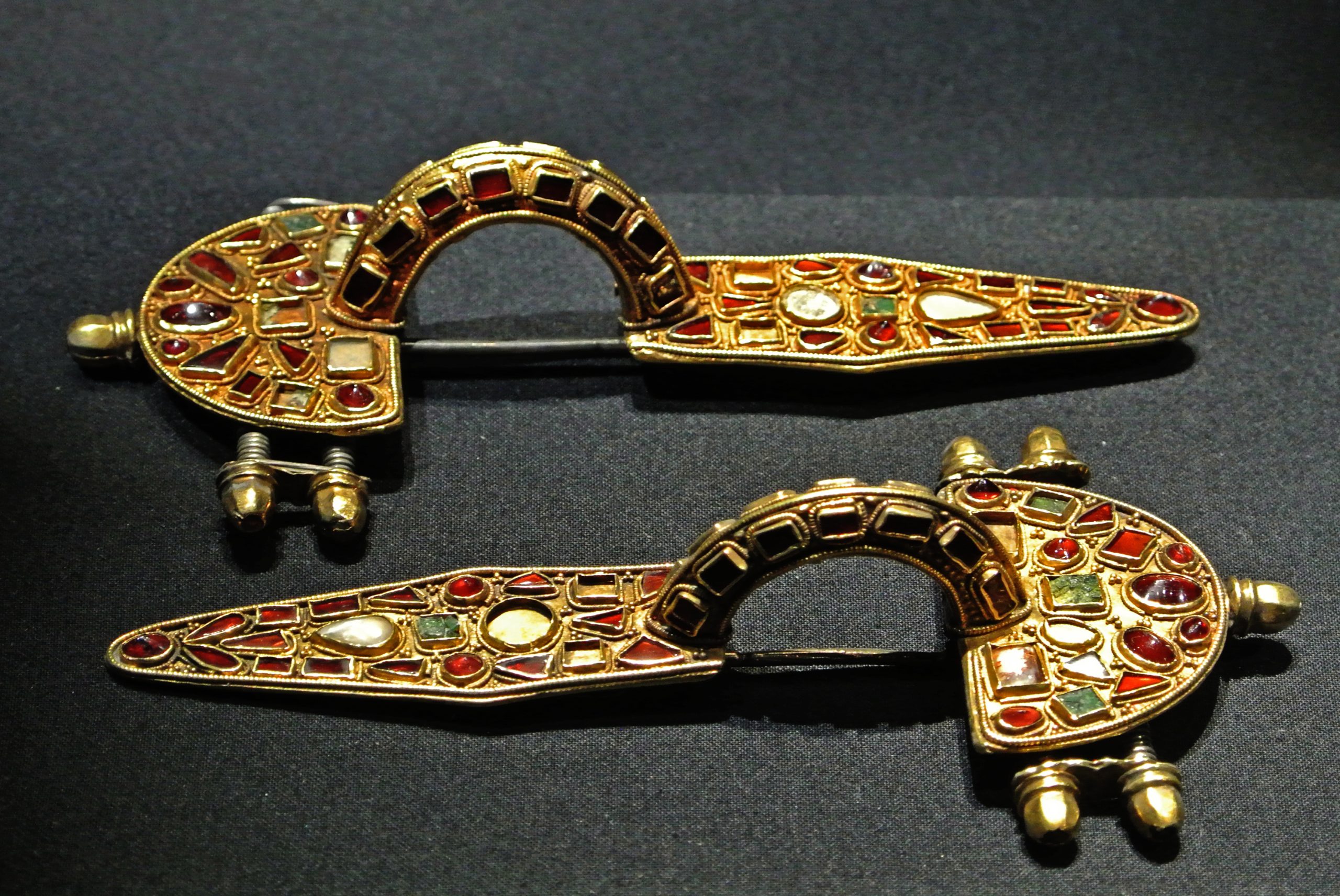
The jewellery that was saved by the archaeologists included two silver fibulae, gold earrings, gold bracelets, a gold necklace, two gold finger rings, and some other items. The most impressive of all the set were the two stunning fibulae made of silver, covered in gold foil, and in turn covered with red garnets, ‘glass paste’, and green enamel.
The Wikimedia page states now that “early fifth-century graves of an East Germanic or Alan-Sarmatian princess and a child were discovered in Untersiebenbrunn (Lower Austria). The East Germanic (Gepidic), Roman, and Alan-Sarmatian grave goods are held today in the Kunsthistorisches Museum in Vienna.”
But who made the fibulae? Where were they produced? Maybe answering those questions could bring us closer to finding out the princess’s ethnic identity?
Academician Borys Rybakov (1908-2001) was a prominent Soviet archaeologist and historian who represented the Soviet Academy of Sciences at the Columbia University Bicentennial in New York City in 1954. According to Wikipedia, “his first groundbreaking monograph, Handicrafts of Ancient Rus (1948), sought to demonstrate the economic superiority of Kyiv Rus to contemporary Western Europe.” Several chapters of the book are devoted to fibulae.
Speaking about the finger brooches,he commented: “Two terms are used to describe them: ‘fingered’ and ‘radial’ fibulae. Since the number of processes in them varies from 5 to 7 and they were carried with processes downwards, it is better to accept the second term – ‘radial’, by analogy with the radial temporal rings…
Kerch radial fibulae are made of silver and decorated with red stone inlays and relief cast scroll patterns. In some examples, the rays already transform into bird heads. They date back to the 5th century. It is very important for understanding the history of the Dnieper fibulae to note that in Kerch and its environs, where Bosporan brooches were common in the 5th century, radial fibulae completely disappear in the 6th century, i.e., exactly when they appear on the Dnieper. This circumstance forces us to take a particularly close look at the Kerch ray brooches and compare them with the Dnieper ones. It is clear that the somewhat later Dnieper brooches, copying the Kerch ones that preceded them in time, carefully reproduce both the general outline and the spiral ornament and individual details. But, despite the significant similarities, there are both obvious and subtle, but important differences:
1) The Dnieper radial fibulae lack red stones and gilding; instead of stones, there are corresponding protrusions, but they are cast together with the entire body of the fibula.
2) All Kerch brooches are cast from silver, all Dnieper ones are cast from bronze.
3) Both groups of brooches were made using the wax casting technique (therefore, even brooches from the same set are not identical), but they differ significantly in the technique used to create the model itself. Bosporan craftsmen worked on hard wax and cut the design with a burin, resulting in sharp edges on the relief design. The relief was achieved by deepening the background, removed with a chisel and spatula. The Dnieper fibulae’s makers processed the wax model in a less painstaking, simplified manner: the entire ornament was applied to the brooches with a point, which was used to press out, rather than cut, the indentations. To simplify the ornamentation process, two- and three-pronged dividers were used. As a result, instead of a spiral and E-shaped ornament, a less refined ornament of concentric circles was obtained, which at first glance was very similar to the Kerch one.
4) The last difference concerns the method of wearing: southern brooches were worn with the rays downwards, while Dnieper ones, judging by the evolution of anthropomorphic types, were worn with the rays upwards.
All these differences allow us to assert that the masters of the Dnieper brooches copied the Kerch models, but did not have all the technical methods of the Bosporan masters.
Copying of Kerch brooches on the Dnieper began in the 6th century; at the same time, radial fibulae disappeared in Kerch.”
A similar pair of fibulae from a c. 430–450 A.D. burial was unearthed in the Upper Don area. In 2016 scientific article ‘Prinsessque Women’s Burial at the Mukhino-2 of the Hunnic Period on the Upper Don”, the authors state:
“The Mukhino burial contains a distinctive set of grave goods: gold foil plaques of various shapes and gold beads; a metal lunula, mirror, toilet set, tweezers, and bracelet; an iron knife with a gold lining made of embossed gold foil; and glass and amber beads. A similar women’s headdress with gold appliqués has its origins in the northern Black Sea region. An anthropological study of the skeletal remains showed that they belonged to a woman aged 20–29 years. Atomic absorption analysis suggested that the buried woman had lived most of her life in relatively arid landscapes. To date, this is the only “princely” burial from the Hunnic period in the Upper Don region. It has significantly changed our understanding of the spread of the prestigious “chieftain” culture of the Untersiebenbrunn type…
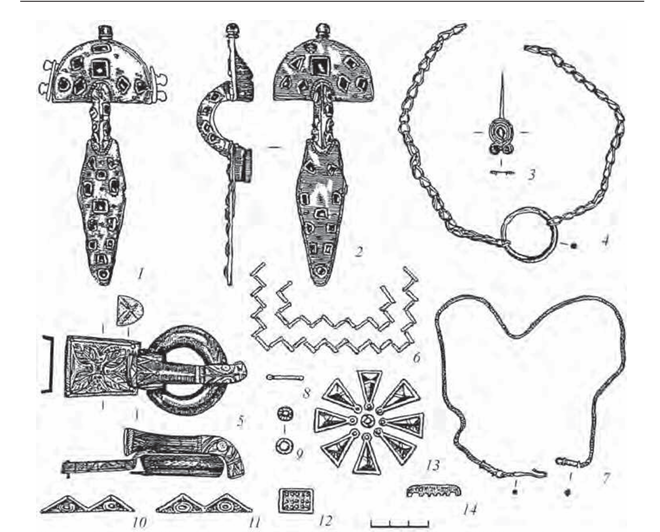
This hoard also contains a pendant typical of the Untersiebenbrunn horizon… At first glance, the presence of such “nomadic” objects as a metal mirror or sewn-on gold appliqués, and especially the absence of two-plate brooches, creates the impression that this burial belongs to the circle of steppe or, more specifically, Alan-Sarmatian. However, a closer examination of the burial goods reveals a different picture. Thus, the mirror, traditionally considered a Sarmatian element, is represented in the Mukhino burial by a specific type— Karpovka-Anke-4, which, as has already been emphasized, is widespread almost exclusively among the sedentary population, primarily in the Northern Black Sea region and the Western Ciscaucasia. The presence of sewn-on golden appliqués points to the North Pontic origin of the Mukhino attire rather than the Alanian-Sarmatian one, since, as has already been noted many times, such appliqués disappear from the steppe Sarmatian-Alanian complexes in the 3rd–4th centuries, but continue to exist in late Roman times only in the North Pontic prestige costume.
Significant is the absence in the Mukhino attire of a pair of two-plate fibulae, typical of East German costume. This also points to the cultural tradition of the sedentary population of the Northern Pontus, where parallels to headdresses without two-plate fibulae, but with gold overlays and beads, are known for the Hunnic period.”
Bosporan/ Taurian Fibulae Origin
Adding the information in the two quotes above, it is safe to assume that the two fibulae were manufactured in Kerch in Taurica, what is now Crimea.
Two Young Princesses
If the archaeologists are correct, we see two young women of most likely noble descent belonging to the same or similar culture buried far away from their homes. And almost at the same time – around 450 A.D.! What event could make them leave their homes?
Tauric Culture in Kyiv?
B. Rybakov observed that copying of Kerch brooches on the Dnieper began in the 6th century, and at the same time, radial fibulae disappeared in Kerch.
482 A.D. is considered the foundation year of Kyiv. What if the people who founded it came not from the north, as some want us to believe, but from the south? And not just fibulae support such a thesis.
Chainmail Armor of Kyiv Rus: Ahead of Western Europe and Vikings by centuries >
Read the book “Kyiv Rus in Heimskringla Sagas and Byzantine Texts” to learn new facts about the country the Vikings called Gardariki.