According to Wikipedia, St. Cyril’s Church was founded in 1140 by Vsevolod Olgovich, the Kniaz’ (prince) of Chernigiv, in the Dorohozhychi neighbourhood of Kyiv and named after his heavenly protector, Cyril of Alexandria. In the second half of the 12th century, Princess Maria, Vsevolod’s widow, built the stone church of St. Cyril, which served as an ancestral burial place of the Olgovichi family.
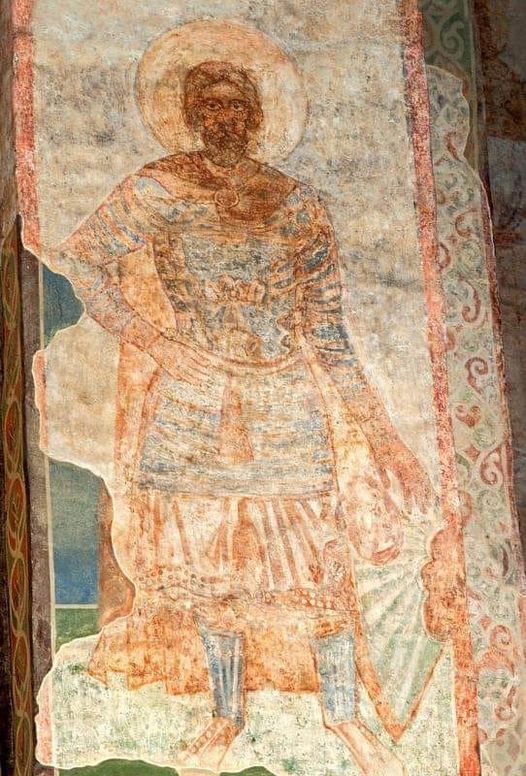
In the 2020 book ‘History of Antique Arms’, Iryna Marholina describes the images of Holy Warriors on the sacral frescos of the Cyril church, paying special attention to the dress and armaments of the Saints. Here is what she wrote about the fresco discussed:
“Among the five fresco images of warriors from the 12th century in St. Cyril’s Church, one fundamental figure on the southern plane of the central northern pillar in the second row attracts particular attention. He has thick hair, large eyes, and a long nose; on his shoulders is a cloak-korzno (a cape with a large fibula-fastener), as well as a long coat of mail, worn over a shirt trimmed with ornamentation; one hand rests on his side, and the other on a huge shield. The proud, imposing posture, clothing, and accessories, reminiscent of Ancient Rus’ princely military attire, supposedly indicate that this is not an ordinary warrior, but a Prince-commander.
Behind the belt of the depicted warrior, a weapon resembling a small battle axe with a hammer is clearly visible, which served as an element of military equipment and was a sign of an Ancient Rus’ warrior. The warrior is most likely wearing plate armor, which consists of rectangular plates, and a bandage on his chest, under which a round shield [breastplate] is possibly hidden. So this Warrior-Prince is dressed in full, expensive military gear. In some facial features and in the figure, one can even guess a hint of the appearance of the founder of the Cyrillic Church, Vsevolod Olgovich, as described by the 19th-century historians – tall, stout, large eyes, long nose, wide beard.
The type of holy warrior depicted in the fresco still did not have a headdress though, mandatory for princely majesty as a sign of superiority and officialdom (straight-hairedness had the opposite characteristics). In any case, we do not identify him as the founder of the temple of Prince Vsevolod, because he was not a saint, and there is a halo around the head of this character. This is some kind of holy warrior, whose image may hint at the appearance of the founder of the cathedral, Prince Vsevolod.”
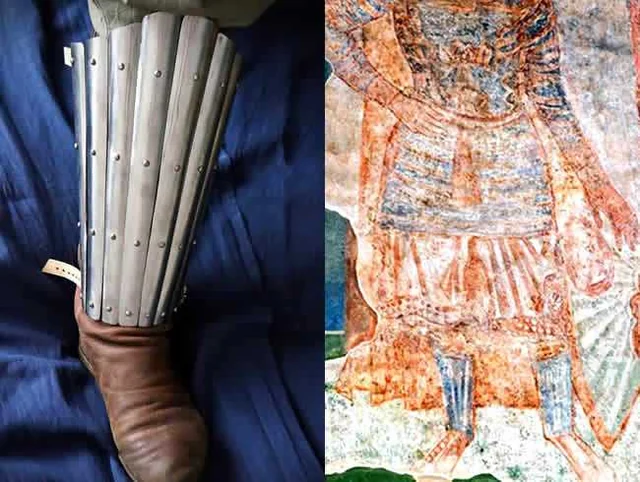
There is yet another part of military gear the warrior appears to be wearing – the splint greaves.
Read more about Kyiv Rus’ armor:
Chainmail Armor of Kyiv Rus: Ahead of Western Europe and Vikings by centuries >
Vsevolod Olgovich was the father of Sviatoslav III Vsevolodovich, Grand Prince of Kyiv since 1181, and a key figure in the most famous Kyiv Rus’ epic ‘The Song of Igor’s Campaign’.
The book “Kyiv Rus in Heimskringla Sagas and Byzantine Texts” has little-known facts about Kyiv Rus’ interactions with the Vikings and the barbarians to the north-east which now call themselves ‘russians’.

By the way, maybe it is just a coincidence, but the Warrior on the fresco is positioned in such a way as if he is looking towards the rotunda described in the link above. With his back facing Chernigiv. So, maybe it is Vsevolod II after all?
Looking at Kyiv rulers of that period, it is hard not to feel that they were the type of men who still represent the nation nowadays such as boxers Usyk and the Klitschko brothers.