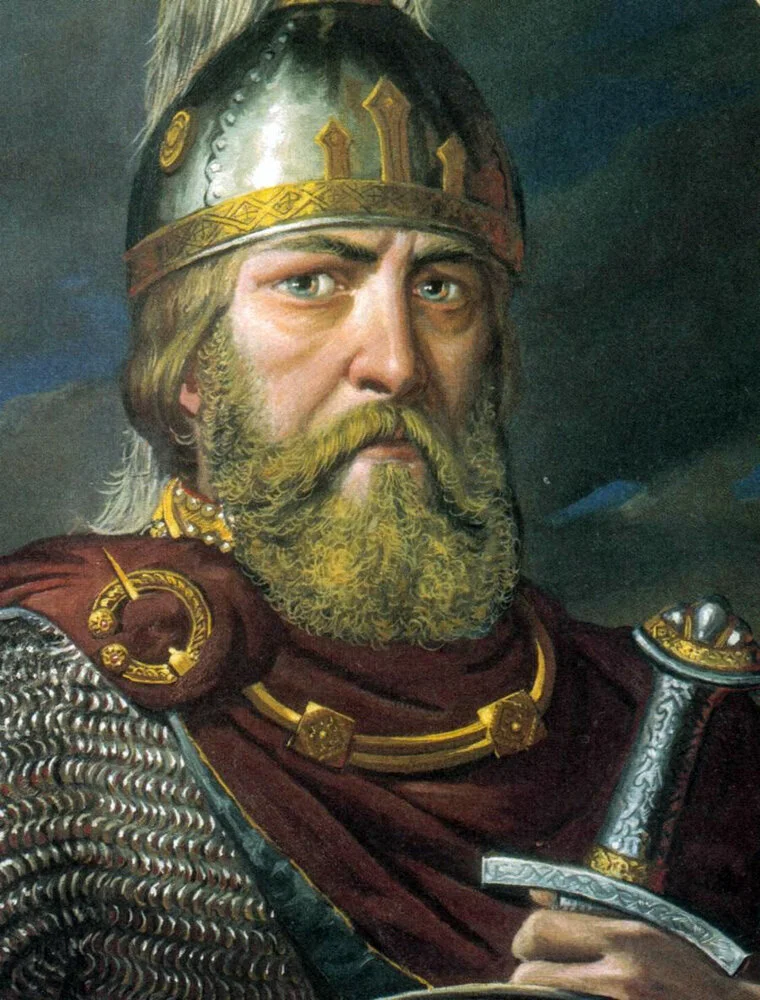
The first known ruler of Kyiv, Dir, is mentioned in both the Primary Chronicle and a Redaction of the Novgorod First Chronicle. Although the Wikipedia page states that Dir was of Varangian/Viking origin, it also notes that “there has been controversy over what these records mean for the historicity, origins, status, and identity of Dir.”
Dir and his brother Askold were allegedly killed by Oleg from Novgorod in 882. Wikipedia again makes allowance that “dating is tentative, as the annalistic legend was written in one and a half or two centuries after the event.” There is too much controversy and inconsistency in the available local sources.
The only foreign source to mention that name is the Arab historian Al-Masudi. According to him, “King al-Dir [Dayr] was the first among the kings of the Slavs.”
Academician B. Rybakov wrote in his 1948 monograph ‘Handicraft of Ancient Rus”:
“In 1900, near the Golden Gate in Kyiv, a curious burial was discovered of a mounted warrior with a sword, a battle axe, and a dagger with a handle decorated with carved flowers.
The warrior wore a magnificent suit of armour with silver plaques. A glass dice and a checker were also found. The overall appearance of the burial is similar to other princely-squad burial mounds in Kyiv and Chernihiv…
Of particular interest is the sword, which has been preserved entirely except for the tip. The hilt is covered with a chased silver band riveted with silver studs. The embossed and engraved pattern features an interweaving of lush, rich, stylized plants, intertwined with knots. A completely similar pattern is found on the second bull horn from the Black Barrow. Not only is the nature of the pattern on both pieces the same, but also the technique of execution: the design was outlined with a double contour, and the interior was shaded and covered with gilding.
The good state of preservation of the items and the depth of their burial indicate that they were buried in a log tomb of the Shestovitsa type.”
More research and excavations were done since B. Rybakov’s writing, and just recently historian V. G. Ivakin in his scientific paper ‘Kyiv’s burial monuments of the Xth century’, stated:
“The burial of a warrior with a horse was discovered in the spring of 1900 during construction work on the corner of today’s Reitarska and Olesya Gonchara streets…
Three chamber-burials of a warrior with a horse have been investigated in Kyiv burial grounds. These chambers differ significantly from ordinary chamber burials – the rectangular space of the chamber is divided by a wooden partition into two sections: a warrior was buried in one, and a horse in the other…
In total, there are about 20 chamber burials with a horse in ancient Rus’ burial grounds…
Only the knyaz/king and his closest entourage—the noble warriors—had horses. This fact further confirms the elite status of the Rus’ chamber burials. According to K. Mikhailov, among the Rus, the horse serves as a magical carrier to the other world, and this explains the custom of burying horses with their owner.
K. Mikhailov also attempted to calculate the value of some burial sets from ancient Rus burial chambers. The burial goods from one of the richest chamber burials at the Shestovitsky burial ground could have cost between 309 and 515 silver Byzantine milliarisii. This amount is equal to the value of the gifts that Queen Olga of Kyiv received from Emperor Constantine Porphyrogenitus during her visits to Constantinople. Apparently, the Kyiv chamber burials were accompanied by no less rich an inventory, which disappeared as a result of burial robberies and during the period of city development…
… In 1909-1910, at the corner of Reitarskaya and Streletskaya Streets, D. Mileev discovered the foundations of an ancient Kyiv church, which some researchers identify with the Cathedral of St. Irene. It is possible that the grave of Dir “behind Saint Arina” mentioned in the chronicles belonged to this very burial mound group.”
What if the grave discovered in 1900 was the grave of Dir? The only obstacle appears to be the coins that were found in the burial. There were several dozen dirhams of Ismail ibn Ahmed from AD 900 found in the burial meaning that the burial took place some time after 900 AD. But how trustworthy is the story of Oleg coming from Novgorod and killing ‘the first King among the Slavs’?
It is better to read what Academician B. Rybakov had to say about Kyiv of that period:
Kyiv Was Powerful Capital City in the 9th Century Already: Vikings came to serve and trade in it >
< The Rus are a Great Nation living on the coast of the Black Sea also known as the Sea of the Rus, – wrote Al-Masudi around 920 AD
The book ‘Kyiv Rus in Heimskringla Sagas and Byzantine Texts‘ shows how Kyiv was presented in Scandinavian sagas and contemporary history accounts of the Byzantine Empire.