Soviet Academician Borys Rybakov, in his monograph ‘Handicraft of Ancient Rus’, wrote in 1948:
“Funeral rites of the Middle Dnieper region in the 9th-10th centuries resurrect the old Scythian rite of burial in a large log structure under a burial mound. The appearance of burial mounds is in no way connected with the Normans, as the burial mound ritual emerged almost simultaneously among all Slavic tribes, including those that had never encountered the Normans (for example, the Czechs, Moravians, etc.)…
More than a thousand years separate the Scythian burial mounds from the Slavic ones: it is therefore difficult to establish a direct connection between them, but it is necessary to note that the type of Scythian log tombs of the Kyiv and Poltava regions is resurrected later, precisely within these same geographical boundaries.
To avoid any possible ambiguity, I consider it necessary to stipulate that comparing various eras with the era of the existence of Slavic tribes does not imply a complete identification of the population of Eastern Europe throughout all times with the later Slavs.
I believe that the formation of the Slavic tribes was an autochthonous process, without significant migrations or colonization (except in the steppe region). In a biological sense, the Slavs of the 8th-9th centuries may indeed be descendants of the Scythians and the population of the Dyakovo settlements (this explains the continuity of some cultural elements).
The establishment of the unity of Slavic culture was preceded by many different internal shifts in the development of Eastern European tribes, which ultimately led to the emergence of the Slavic stage, first in the Dnieper region (3rd-4th centuries), and then in the north-eastern regions (6th-8th centuries)…”
I believe that the formation of the Slavic tribes was an autochthonous process, without significant migrations or colonization (except in the steppe region). In a biological sense, the Slavs of the 8th-9th centuries may indeed be descendants of the Scythians and the population of the Dyakovo settlements (this explains the continuity of some cultural elements).
The establishment of the unity of Slavic culture was preceded by many different internal shifts in the development of Eastern European tribes, which ultimately led to the emergence of the Slavic stage, first in the Dnieper region (3rd-4th centuries), and then in the north-eastern regions (6th-8th centuries).”
Four decades later, in his other monograph, ‘Paganism of Ancient Rus’, published in 1987, Academician Rybakov supported his previous view with more details:
“The search for the ancestors of Rus, which revealed a continuous chain of successive archaeological cultures, led us to the distant but brilliant Scythian era. Archaeological cultures reflected periods of growth and times of decline associated with the invasions of the steppe people, but in all cases, the historical center of the Dnieper region remained unchanged, which eventually became the core of Kyiv Rus – a relatively small region along the Dnieper-Boristhenes-(River Ros-Kyiv). The role of the Scythians in the history of the Slavs and Rus’ has long interested historians. Even the chronicler Nestor, as already mentioned, mentioned the Slavic tribes between the Dnieper and Danube, adding, based on a Greek source, that they inhabited a land called Great Scythia.
Scythologists have forgotten the very important position of Lubor Niederle, a Slavic historian, archaeologist, ethnographer and linguist, author of the eleven-volume encyclopedia “Slavic Antiquities”, expressed by him at the beginning of our century: “I do not hesitate to assert that among the northern neighbors of the Scythians mentioned by Herodotus, not only the Neuri… but also the Scythians called ploughmen and farmers… were undoubtedly Slavs who were influenced by the Greco-Scythian culture.” (Niederle L. Slovanské Starožitnosti. Praha, 1906—1925). Such forgetfulness is all the more unforgivable since the entire northern half of Herodotus’s Scythian Square overlaps the eastern regions of the Slavic homeland, outlined based on linguistic and archaeological data and confirmed by the brilliant coincidence of the area of archaic Slavic hydronyms (O. N. Trubachev) with the area of the Chornoles archaeological culture of the 10th-8th centuries BC…
… Describing Scythia in the 5th century BC, Herodotus famously outlined a vast square measuring 700 x 700 km in Eastern Europe. The southern side of the “Scythian Tetragon” was the Black Sea coast from the mouth of the Danube to the Kerch Strait.
The western side went approximately to the middle reaches of the Pripyat River, and the eastern side approximately to the River Oskol.
The northern side of the Scythian Square, least known to the traveller, was lost in the forest zone, somewhere north of the Seim River and the lower reaches of the Pripyat…
Of extreme importance for understanding the ethnic situation within the Scythian square is Herodotus’s well-known detailed account of the Scythian agricultural festival: “He (Targitai, the son of Zeus and the daughter of Borysthenes/Dnieper River) had three sons: Lipoxai and Arpoxai, and the youngest, Kolaxai. During their reign, golden objects fell from the sky onto the Scythian land: a plough with a yoke, a double-edged axe and a cup…”
The Greek historian considers it erroneous to classify the plough worshippers as the true steppe Scythians (about whom Herodotus very firmly states that they had neither crops nor settlements), and points to the self-designation “Skoloti,” after the common king of all tribes, Kolaksai. According to local myths, the Skoloti are the descendants of Zeus and the daughter of the river deity Borysthenes; therefore, the terms “Skoloti” and “Borysthenes” are interchangeable…
Herodotus knew about the Borysthenites beyond the Dnieper and, leading his description from south to north, began it precisely from the Vorskla-Pantikapa River, counting from there the distances to the northern limits of the land of the Dnieper ploughmen…
Almost half of the agricultural tribes within the Scythian square lived on the territory of the ancient Slavic homeland. The Middle Dnieper forest-steppe region that interests us was inhabited not by nomadic pastoralists, but by sedentary agricultural peoples, the heirs of the local tribes of the Chernoles period, with the addition of the Gelonians, related to the Scythians.
The compact region of the forest-steppe Right Bank (eastern bank of the Dnieper River), compared above with Herodotus’s Scythians-Borysthenites, differed from the steppe, purely Scythian, regions not only in economic but also in religious terms. The Scythians worshipped the sword, and the Borysthenites – a plough with a yoke, an axe and a cup; the animal style is distinctive, reflecting the sacred symbolism: among the Scythians, the predominance of birds and fantastic animals, and among the forest-steppe Skolots, the real northern elk predominates, the ancient symbol of the main celestial constellation: “Elk” – Ursa Major…
The region of the Ros River and the triangle formed by the Ros, the Dnieper and the line from the upper reaches of the Ros to Kyiv has always been the main, most significant and vibrant culturally. Moreover, archaeological material allows us to establish a continuity between cultures: the late Scythian culture is “genetically” linked to the early Zarubintsy Culture…
Unlike the forested north, where small settlements of 5-15 households predominated for a long time, in the south, huge settlements arose early, the cemeteries of which contained 1,000 or more burial mounds. The Polyans (Slavic tribe) had at their disposal both Scythian fortification systems (the “Snake Walls”) and large Scythian settlements. Some of these were inhabited in the 6th–8th centuries (e.g., the Pastersky settlement and others). The transition of the southern agricultural population to urban life was facilitated by the presence of ready-made earthen fortifications located among the black soil forest-steppe on the banks of the Dnieper, Ros, Vorskla and their tributaries.
The territorial coincidence of the Scythian farmers’ region, the Dnieper region of burial fields, hoards of local and imported items from the Antique period and the most important principalities of Rus – Kyiv, Chernigov and Pereyaslav – is especially noteworthy because each of the mentioned regions of the Dnieper farmers was at one time the most cultured in comparison with its northern, western and eastern neighbors. The Scythian linguistic heritage in East Slavic dialects and in modern toponymy was traced by A. I. Sobolevsky.”
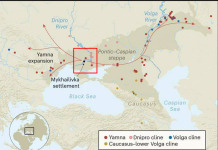
Was B. Rybakov right about the Slavs and their original adobe in the area of the Pripyat River?
< What does the most recent DNA data tells us about the origin of the Slavs?
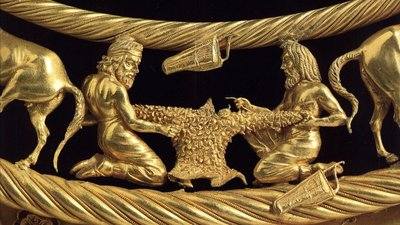
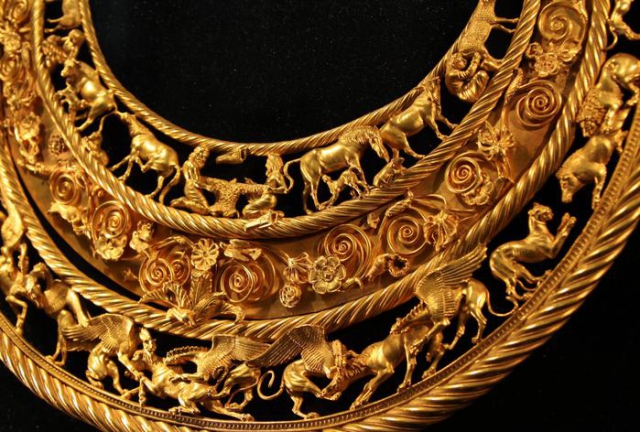
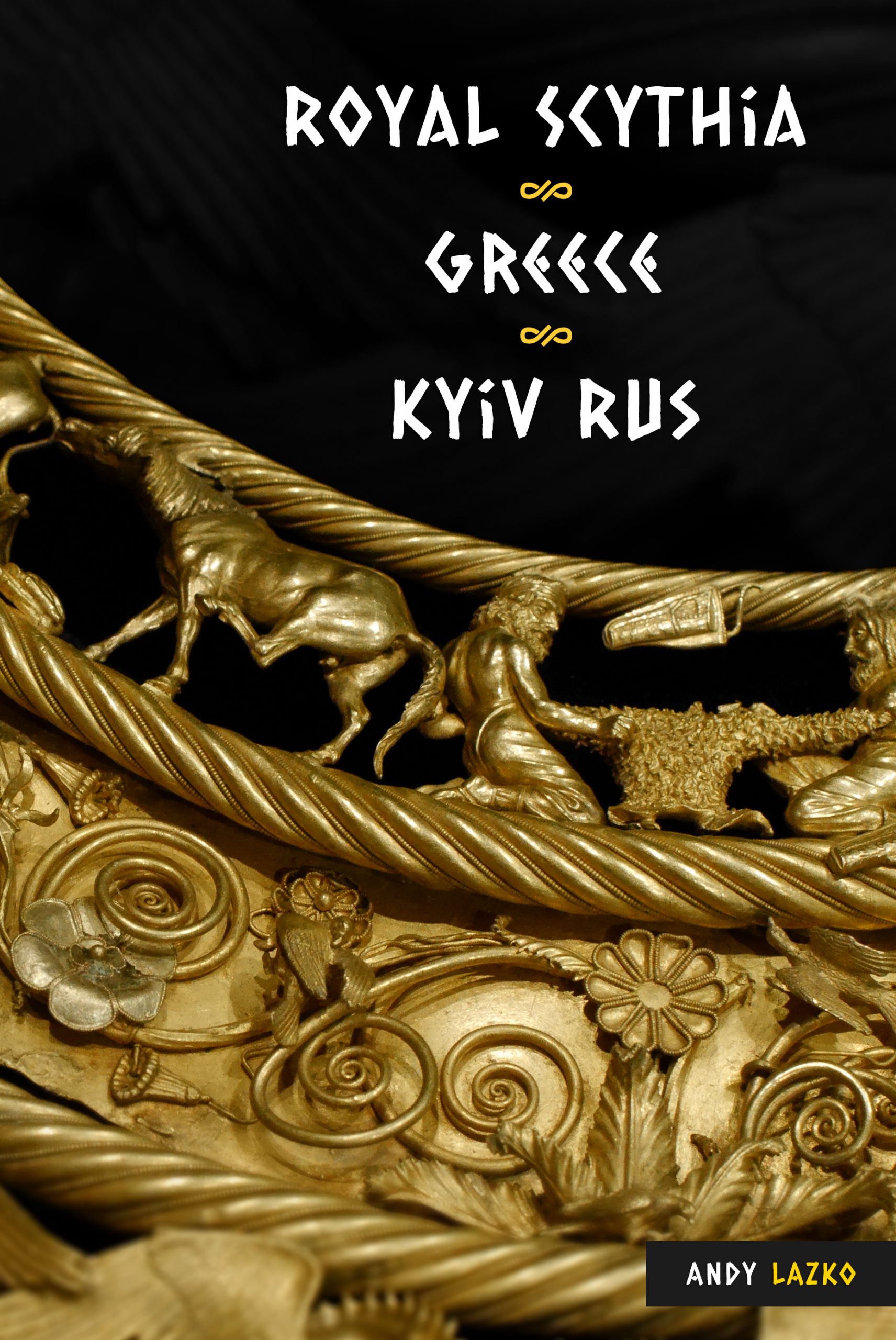
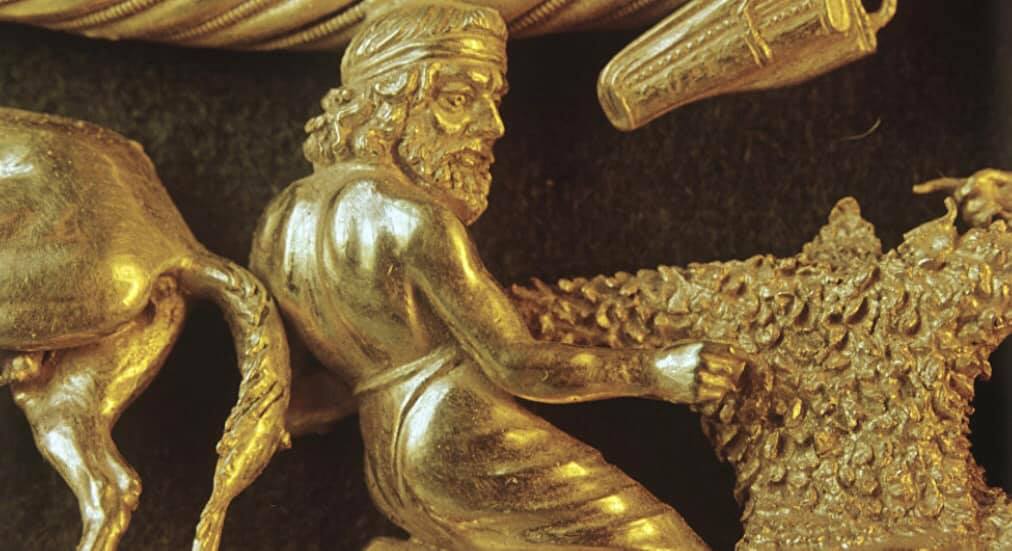
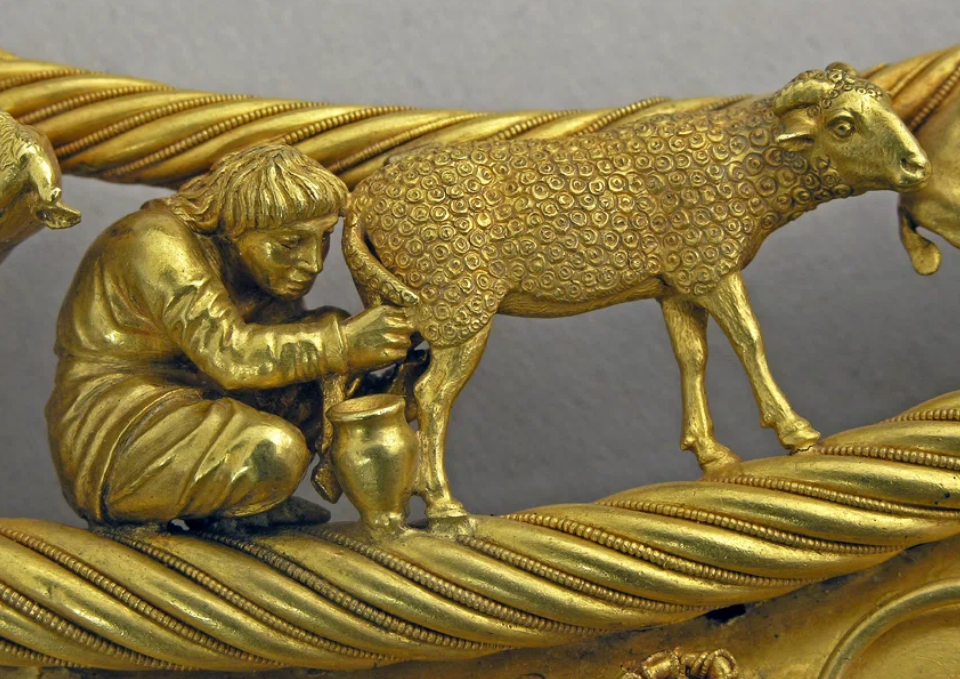
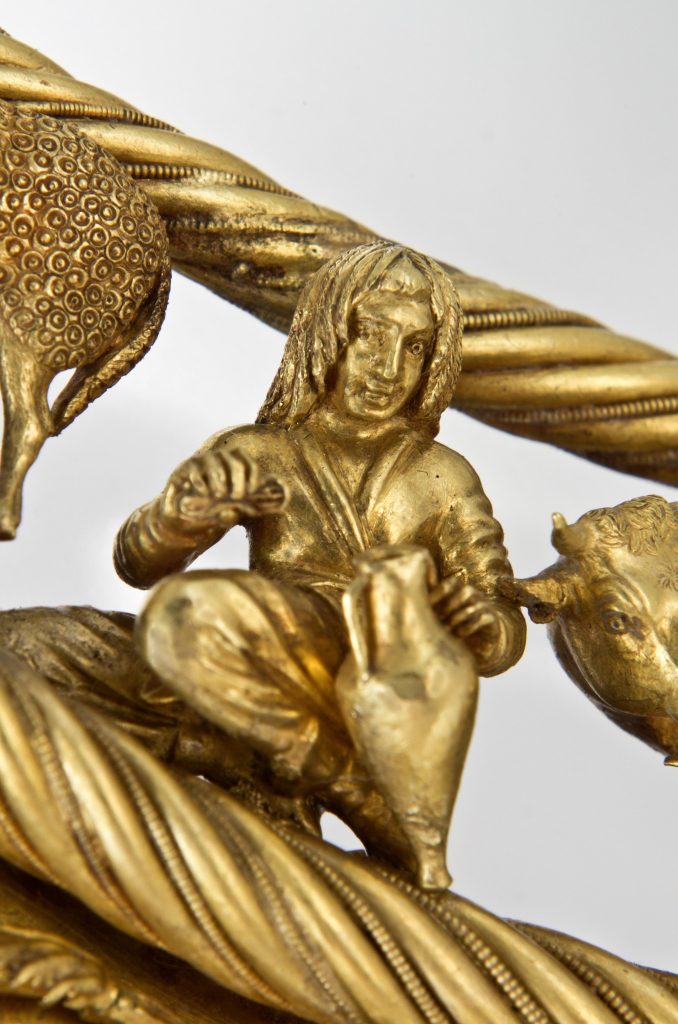
The book ‘Royal Scythia, Greece, Kyiv Rus‘ takes closer look at the ties between Scythia and Rus. It also offers new perspective on the central scene of the famous Golden Pectoral found in Tovsta Mogyla barrow in Ukraine:
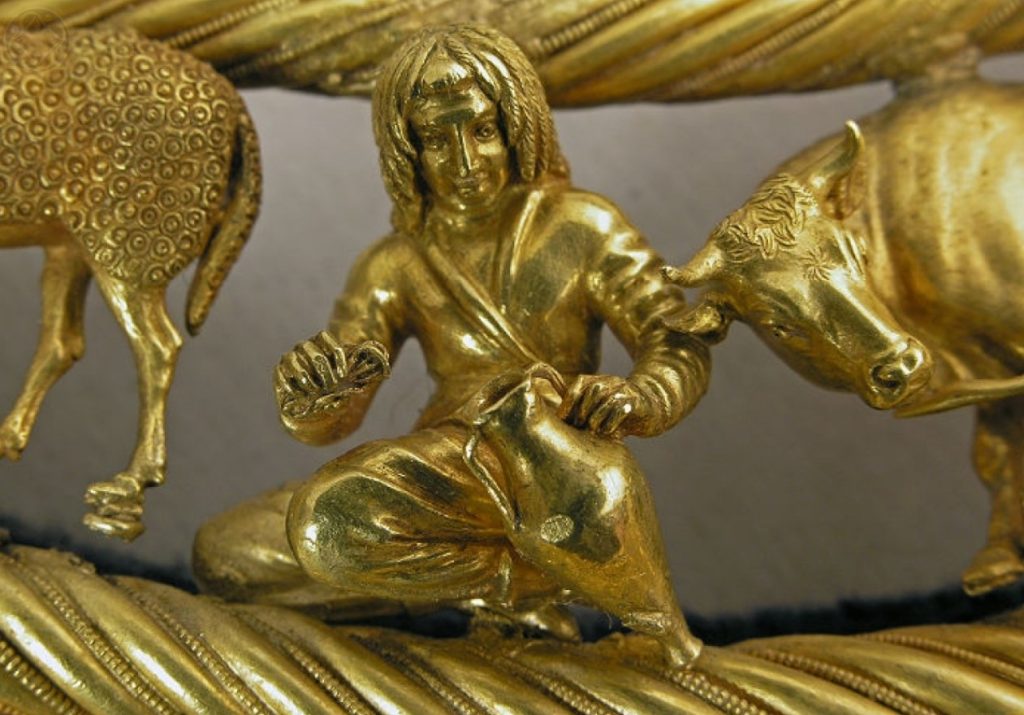
Scythian Golden Pectoral from Tovsta Mogila, Ukraine >