Priscus of Panium was an Eastern Roman diplomat and Greek historian who, in 448/449 AD, accompanied Maximinus, the head of the Byzantine embassy representing Emperor Theodosius II (r. 402–450), on a diplomatic mission to the court of Attila the Hun.
Below are several quotes from his eyewitness account with some comments by the author of this article. The full version of the text is available on the site of Georgetown University.
“The next day, we proceeded from the district of Naissus towards the Danube; we entered a covered valley with many bends and windings and circuitous paths. We thought we were travelling due west, but when the day dawned, the sun rose in front, and some of us unacquainted with the topography cried out that the sun was going the wrong way, and portending unusual events. The fact was that that part of the road faced the east, owing to the irregularity of the ground. Having passed these rough places, we arrived at a plain which was also well wooded. At the river, we were received by barbarian ferrymen, who rowed us across the river in boats made by themselves out of single trees hewn and hollowed. These preparations had not been made for our sake, but to convey across a company of Huns; for Attila pretended that he wished to hunt in Roman territory, but his intent was really hostile, because all the deserters had not been given up to him.
Having crossed the Danube and proceeded with the barbarians about seventy stadia, we were compelled to wait in a certain plain, that Edecon and his party might go on in front and inform Attila of our arrival. As we were dining in the evening, we heard the sound of horses approaching, and two Scythians arrived with directions that we were to set out to Attila. We asked them first to partake of our meal, and they dismounted and made good cheer.
The next day, under their guidance, we arrived at the tents of Attila, which were numerous, about three o’clock, and when we wished to pitch our tent on a hill, the barbarians who met us prevented us, because the tent of Attila was on low ground, so we halted where the Scythians desired….”
Comment. It is interesting that Priscus, in his narrative, calls the population of Scythia Scythians, barbarians, and Huns. It is an important fact that in his History, Priscus never once mentioned that the Hun state was of Asian origin. On the contrary, he emphasizes that it had local roots and constantly calls it Scythia.
“When it was day, we expected a gentle and courteous message from the barbarian, but he again bade us depart if we had no further mandates beyond what he already knew. We made no reply and prepared to set out, though Bigilas insisted that we should feign to have some other communication to make. When I saw that Maximin was very dejected, I went to Scottas (one of the Hun nobles, brother of Onegesius), taking with me Rusticius, who understood the Hun language. He had come with us to Scythia, not as a member of the embassy, but on business with Constantius…”
Comment: The names of the Hun nobles, Scottas and Onegesius, have nothing Asiatic in them.
“… we remained one day in that place, and then set out with Attila for the northern parts of the country. We accompanied the barbarian for a time, but when we reached a certain point, we took another route by the command of the Scythians who conducted us, as Attila was proceeding to a village where he intended to marry the daughter of Eskam, though he had many other wives, for the Scythians practise polygamy.”
Comment: This is another testimony of Priscus that neither Attila nor the Huns were Asians, who did not have villages, but had kibitzes and yurts. Another remark. And when did it happen that Turkic or Mongol khans went to their provinces to woo or marry their subjects? They brought their wives, like sheep, to their palaces or to their horde. And among the Ukrainians, there has been such a custom for a long time that the wedding took place in the bride’s house; therefore, the groom himself was obliged to go to her. Thus, Priscus of Panium testified that even the all-powerful Scythian rulers adhered to this custom.
“We proceeded along a level road in a plain and met with navigable rivers–of which the greatest, next to the Danube, are the Drecon, Tigas, and Tiphesas–which we crossed in the Monoxyles, boats made of one piece, used by the dwellers on the banks: the smaller rivers we traversed on rafts which the barbarians carry about with them on carts, for the purpose of crossing morasses. In the villages, we were supplied with food–millet instead of corn, and mead, as the natives call it, instead of wine. The attendants who followed us received millet and a drink made of barley, which the barbarians call kam.”
Comment: Another extremely important piece of evidence is Priscus, which says that the Huns were engaged in agriculture, beekeeping, and fishing, and were not nomads. What the local population grew, produced, and consumed was given to the embassy: instead of wheat, millet, and instead of wine, honey (medovuha), or mead (which is of the Indo-European origin and is present in the Ukrainian language in that form).
Another interesting Slavic word is “kam” – an intoxicating drink that was given to servants accompanying the embassy. It is beer, which, of course, was made from barley. The word “kam” fell out of use in Ukraine in the Middle Ages, replaced by the word “pyvo.” Kam survived in the languages of the South Slavs in the Balkans.
“in the evening, having travelled a long distance, we pitched our tents on the banks of a fresh-water lake, used for water by the inhabitants of the neighbouring village. But a wind and storm, accompanied by thunder and lightning and heavy rain, arose, and almost threw down our tents; all our utensils were rolled into the waters of the lake. Terrified by the mishap and the atmospheric disturbance, we left the place and lost one another in the dark and the rain, each following the road that seemed easiest. But we all reached the village in different ways, and raised an alarm to obtain what we lacked.
The Scythians of the village sprang out of their huts at the noise, and, lighting the reeds which they use for kindling fires, asked what we wanted. Our conductors replied that the storm had alarmed us; so they invited us to their huts and provided warmth for us by lighting large fires of reeds. The lady who governed the village– -she had been one of Bleda’s wives–sent us provisions and good-looking girls to console us (this is a Scythian compliment). We treated the young women to a share in the eatables, but declined to take any further advantage of their presence. We remained in the huts till day dawned and then went to look for our lost utensils, which we found partly in the place where we had pitched the tent, partly on the bank of the lake, and partly in the water. We spent that day in the village drying our things, for the storm had ceased and the sun was bright. Having looked after our horses and cattle, we directed our steps to the princess, to whom we paid our respects and presented gifts in return for her courtesy. The gifts consisted of things which are esteemed by the barbarians as not produced in the country–three silver phials, red skins, Indian pepper, palm fruit, and other delicacies.”
Comment: If the Huns had been Asiatic nomads, they would have hardly appreciated Indian pepper as a gift, would not they?
“Having advanced a distance of seven days farther, we halted at a village; for as the rest of the route was the same for us and Attila, it behoved us to wait, so that he might go in front… Having waited for some time until Attila advanced in front of us, we proceeded, and having crossed some rivers, we arrived at a large village, where Attila’s house was said to be more splendid than his residences in other places. It was made of polished boards and surrounded with a wooden enclosure, designed not for protection, but for appearance. The house of Onegesius was second to the king’s in splendour, and was also encircled with a wooden enclosure, but it was not adorned with towers like that of the king. Not far from the enclosure was a large bath which Onegesius–who was the second in power among the Scythians— built, having transported the stones from Pannonia; for the barbarians in this district had no stones or trees, but used imported material. The builder of the bath was a captive from Sirmium, who expected to win his freedom as payment for making the bath. But he was disappointed, and greater trouble befell him than mere captivity among the Scythians, for Onegesius appointed him bathman, and he used to minister to him and his family when they bathed.”
Comment: Where was this village? If we take into account that the embassy had already crossed three rivers before, including the Tiras (Dniester), and that Priscus measures distance in days of crossing, and at that time the embassy covered 30-40 km per day of crossing, then the seven-day crossing is approximately 250 km. And this is after it had reached the three rivers named by Priscus, which were obviously large, so the total length of the road that the embassy traveled after crossing the Ister (Danube) cannot be less than 1000 km. Considering that Priscus mentions that the capital of Attila was located in a place where there was neither stone nor trees, that is, in the steppe and surrounded on all sides by rivers and natural obstacles, the most likely location would be a large Scythian settlement with an area of 150 hectares in the modern Vinnytsia region, not far from Nemyriv.
“When Attila entered the village, he was met by girls advancing in rows, under thin white canopies of linen, which were held up by the outside women who stood under them, and were so large that seven or more girls walked beneath each. There were many lines of damsels thus canopied, and they sang Scythian songs. When he came near the house of Onegesius, which lay on his way, the wife of Onegesius issued from the door, with a number of servants, bearing meat and wine, and saluted him and begged him to partake of her hospitality. This is the highest honour that can be shown among the Scythians. To gratify the wife of his friend, he ate, just as he sat on his horse, his attendants raising the tray to his saddlebow; and having tasted the wine, he went on to the palace, which was higher than the other houses and built on an elevated site. But we remained in the house of Onegesius, at his invitation, for he had returned from his expedition with Attila’s son.”
Comment: Reading this excerpt from the solemn meeting of the Atilla, one can forget that the event took place in the middle of the 5th century, and not much later. Songs, bread and salt, a glass of wine – this is how they still welcome dear guests in Ukraine even nowadays.
“When I arrived at the house, along with the attendants who carried the gifts, I found the doors closed, and had to wait until some one should come out and announce our arrival. As I waited and walked up and down in front of the enclosure which surrounded the house, a man, whom from his Scythian dress I took for a barbarian, came up and addressed me in Greek, with the word Xaire, “Hail!” I was surprised at a Scythian speaking Greek. For the subjects of the Huns, swept together from various lands, speak, besides their own barbarous tongues, either Hunnic or Gothic, or–as many as have commercial dealings with the western Romans–Latin; but none of them easily speak Greek, except captives from the Thracian or Illyrian sea-coast; and these last are easily known to any stranger by their torn garments and the squalor of their heads, as men who have met with a reverse. This man, on the contrary, resembled a well-to-do Scythian, being well dressed and having his hair cut in a circle after Scythian fashion. Having returned his salutation, I asked him who he was and whence he had come into a foreign land and adopted Scythian life. When he asked me why I wanted to know, I told him that his Hellenic speech had prompted my curiosity. Then he smiled and said that he was born a Greek and had gone as a merchant to Viminacium, on the Danube, where he had stayed a long time, and married a very rich wife. But the city fell a prey to the barbarians, and he was stript of his prosperity, and on account of his riches was allotted to Onegesius in the division of the spoil, as it was the custom among the Scythians for the chiefs to reserve for themselves the rich prisoners. Having fought bravely against the Romans and the Acatiri, he had paid the spoils he won to his master and so obtained freedom. He then married a barbarian wife and had children, and had the privilege of eating at the table of Onegesius.”
Comment: Priscus’ confusing a Greek with the Scythain can mean that people around him looked European.
“The next day, I entered the enclosure of Attila’s palace, bearing gifts to his wife, whose name was Kreka. She had three sons, of whom the eldest governed the Acatiri and the other nations who dwell in Pontic Scythia. Within the enclosure were numerous buildings, some of carved boards beautifully fitted together, others of straight, fastened on round wooden blocks which rose to a moderate height from the ground. Attila’s wife lived here, and, having been admitted by the barbarians at the door, I found her reclining on a soft couch. The floor of the room was covered with woollen mats for walking on. A number of servants stood round her, and maids sitting on the floor in front of her embroidered with colours linen cloths intended to be placed over the Scythian dress for ornament.”
Comment: Anyone in the world not familiar with Ukrainian embroidered dress/ vyshyvanka?
The Feast with Attila
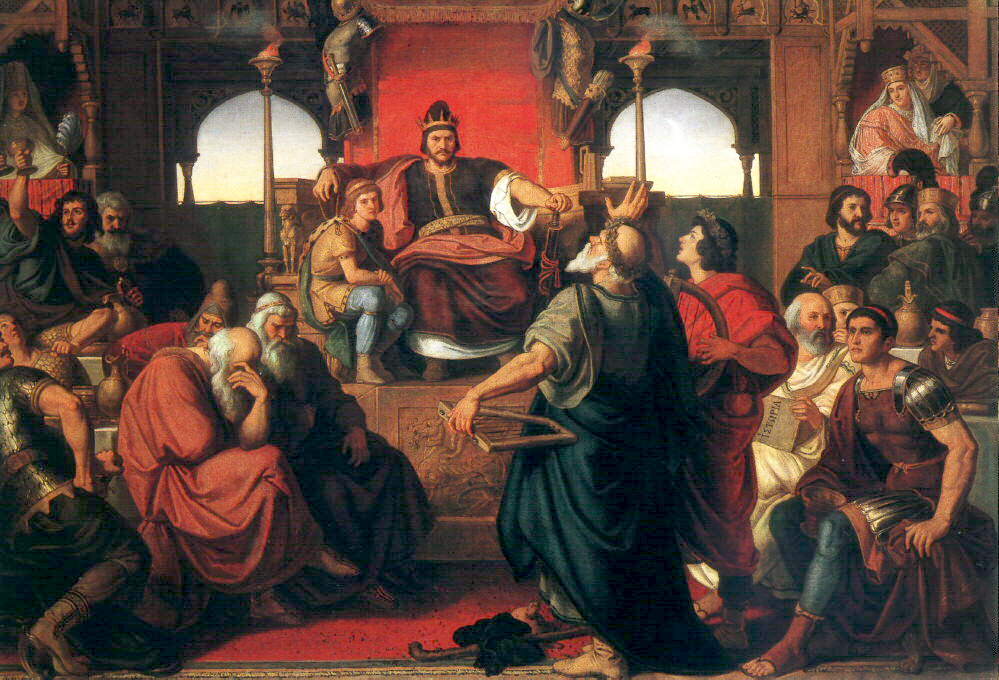
“When we returned to our tent, the father of Orestes came with an invitation from Attila for both of us to a banquet at three o’clock. When the hour arrived, we went to the palace, along with the embassy from the western Romans, and stood on the threshold of the hall in the presence of Attila. The cup-bearers gave us a cup, according to the national custom, that we might pray before we sat down. Having tasted the cup, we proceeded to take our seats; all the chairs were ranged along the walls of the room on either side. Attila sat in the middle on a couch; a second couch was set behind him, and from it steps led up to his bed, which was covered with linen sheets and wrought coverlets for ornament, such as Greeks and Romans use to deck bridal beds. The places on the right of Attila were held chief in honour, those on the left, where we sat, were only second. Berichus, a noble among the Scythians, sat on our side, but had the precedence of us. Onegesius sat on a chair on the right of Attila’s couch, and over against Onegesius on a chair sat two of Attila’s sons; his eldest son sat on his couch, not near him, but at the extreme end, with his eyes fixed on the ground, in shy respect for his father. When all were arranged, a cup-bearer came and handed Attila a wooden cup of wine. He took it, and saluted the first in precedence, who, honoured by the salutation, stood up, and might not sit down until the king, having tasted or drained the wine, returned the cup to the attendant. All the guests then honoured Attila in the same way, saluting him, and then tasting the cups, but he did not stand up.
Each of us had a special cupbearer, who would come forward in order to present the wine, when the cup-bearer of Attila retired. When the second in precedence and those next to him had been honoured in like manner, Attila toasted us in the same way according to the order of the seats. When this ceremony was over the cup-bearers retired, and tables, large enough for three or four, or even more, to sit at, were placed next to the table of Attila, so that each could take of the food on the dishes without leaving his seat. The attendant of Attila first entered with a dish full of meat, and behind him came the other attendants with bread and viands, which they laid on the tables.
A luxurious meal, served on silver plate, had been made ready for us and the barbarian guests, but Attila ate nothing but meat on a wooden trencher. In everything else, too, he showed himself temperate; his cup was of wood, while to the guests were given goblets of gold and silver. His dress, too, was quite simple, affecting only to be clean. The sword he carried at his side, the latchets of his Scythian shoes, and the bridle of his horse were not adorned, like those of the other Scythians, with gold or gems or anything costly.”
Comment: This is a striking analogy with the description of Sviatoslav the Brave of Kyiv in the 10th century!
The book “Royal Scythia, Greece, Kyiv Rus” quotes a Byzantine historian’s impression of Sviatoslav after a personal encounter.
< Scythian Farmers, Skoloti, Proto-Slavs, Rus-Ukraine