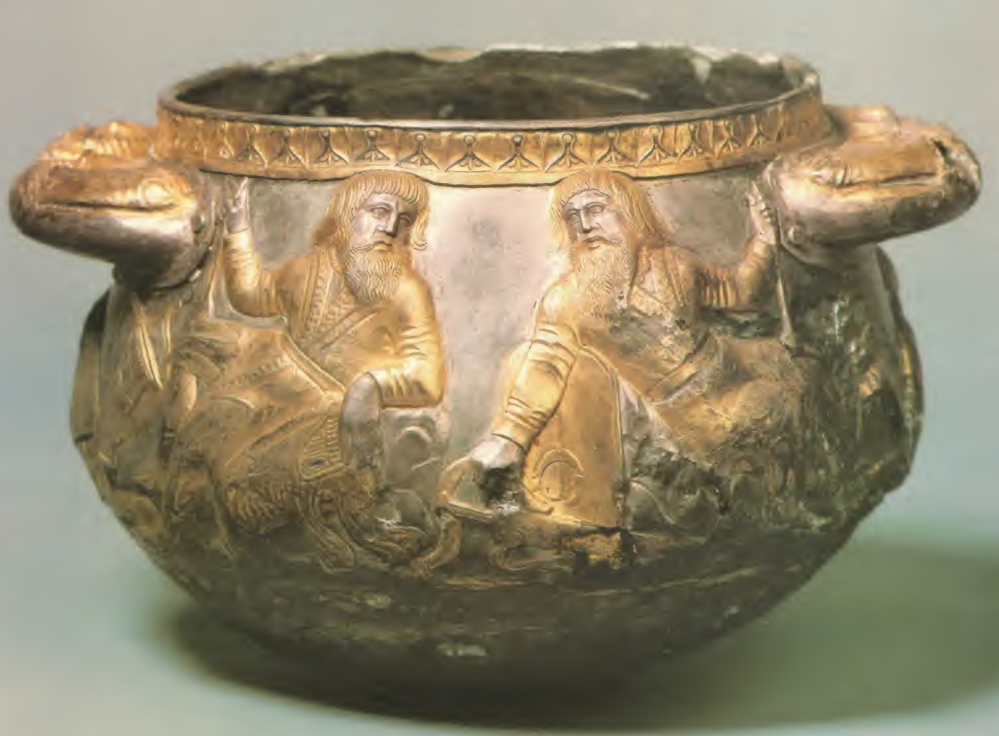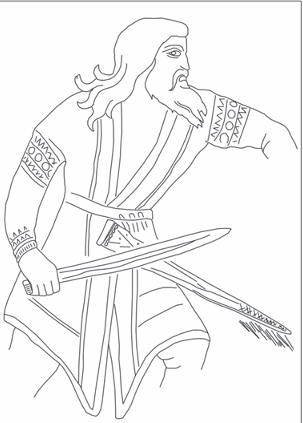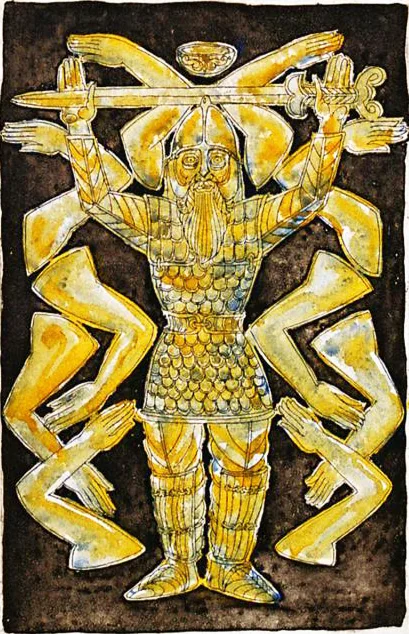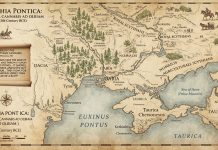
Herodotus gave the most detailed description of Scythia in his work written about 480–420 BC. Most likely, the Greek historian made a visit to the Greek colony of Pontic Olbia, which is currently in Ukraine. Here is a well-known narrative about the Scythian rite in honour of god Ares (Herod. IV, 62):
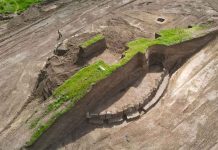
““Every district in each of the governments has a structure sacred to Ares; namely, a pile of bundles of sticks three eighths of a mile wide and long, but of a lesser height, on the top of which there is a flattened four-sided surface; three of its sides are sheer, but the fourth can be ascended.
Every year, a hundred and fifty wagon-loads of sticks are heaped upon this; for the storms of winter always make it sink down. On this sacred pile, an ancient scimitar of iron is set for each people: their image of Ares. They bring yearly sacrifice of sheep and goats and horses to this scimitar, offering to these symbols even more than they do to the other gods.
Of enemies that they take alive, they sacrifice one man in every hundred, not as they sacrifice sheep and goats, but differently. They pour wine on the men’s heads and cut their throats over a bowl; then they carry the blood up on to the pile of sticks and pour it on the scimitar.
They carry the blood up above, but down below by the sacred pile they cut off all the slain men’s right arms and hands and throw these into the air, and depart when they have sacrificed the rest of the victims; the arm lies where it has fallen, and the body apart from it.”
In 330 A.D., some 750 years after Herodotus and 100 years before Attila, the Roman soldier and historian Ammianus Marcellinus, also mentions the worship of swords in the area that was part of Scythia as defined by Herodotus:
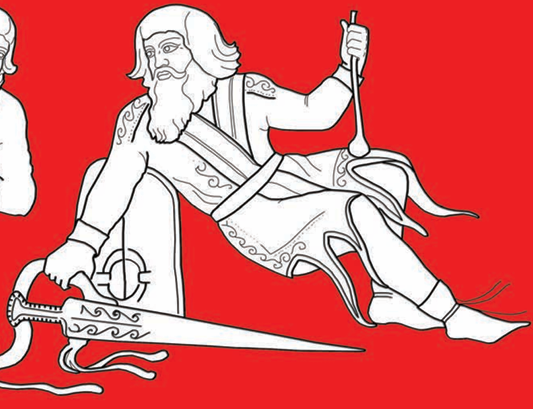
“… Almost all the Alani are tall and handsome, their hair inclines to blond, by the ferocity of their glance they inspire dread, subdued though it is. They are light and active in the use of arms. In all respects they are somewhat like the Huns, but in their manner of life and their habits, they are less savage. In their plundering and hunting expeditions, they roam here and there as far as the Maeotic Sea [Sea of Azov] and the Cimmerian Bosporus [Kerch Straight], and also to Armenia and Media. Just as quiet and peaceful men find pleasure in rest, so the Halani delight in danger and warfare. There the man is judged happy who has sacrificed his life in battle, while those who grow old and depart from the world by a natural death they assail with bitter reproaches, as degenerate and cowardly; and there is nothing in which they take more pride than in killing any man whatever: as glorious spoils of the slain they tear off their heads, then strip off their skins? and hang them upon their war-horses as trappings. No temple or sacred place is to be seen in their country, not even a hut thatched with straw can be discerned anywhere, but after the manner of barbarians, a naked sword is fixed in the ground and they reverently worship it as their god of war, the presiding deity of those lands over which they range.” (Res Gestae, Book 31.2)
Interestingly, Ammianus Marcellinus places the Huns in the same area as the Alans, making them neighbors: “The people of the Huns, but little known from ancient records, dwelling beyond the Maeotic Sea [Azov Sea]…” Although he portrays the Huns in a very unfavourable light as people who “have compact, strong limbs and thick necks, and are so monstrously ugly and misshapen, that one might take them for two-legged beasts or for the stumps,” he never ascribes them Asiatic features or origin.
The Roman historian Jordanes, quoting the work of the historian Priscus, gave the story of how the Sword of Ares got to the hands of Attila:
“When a certain shepherd beheld one heifer of his flock limping and could find no cause for this wound, he anxiously followed the trail of blood and at length came to a sword it had unwittingly trampled while nibbling the grass. He dug it up and took it straight to Attila. He rejoiced at this gift and, being ambitious, thought he had been appointed ruler of the whole world, and that through the sword of Mars [Ares], supremacy in all wars was assured to him.”
Importantly, Priscus of Panium, who met Attila and his retinue in person, does not mention any of the features Amminnaus Marcellinos ascribed to the Huns. The question arises of whether Amminnaus met the Huns in person or did he just retell other people’s impressions (or fantasies)?
The very fact that Attila accepted the Sword of Ares with such reverence should indicate that Attila considered himself a part of Scythian descent and a follower of Scythian religion. It appears that in the religious system of the Scythians, the ritual Sword in the center of the worship was the embodiment of the god of war, Ares himself. Thus, for Attila, having the Sword of Ares in his possession was equal to having the God of War on his side.
Read more on the subject:
The book “Royal Scythia, Greece, Kyiv Rus” has more little-known facts about Scythia as seen by Herodotus and other contemporary historians.