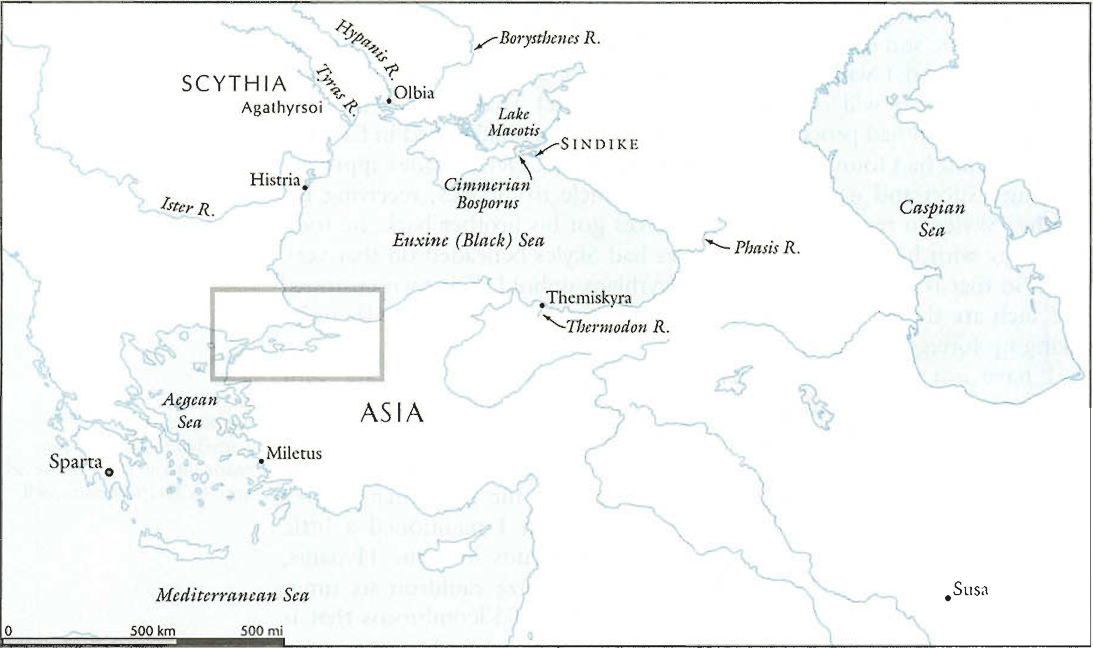
“What was Herodotus’ goal in undertaking a journey to the northern shore of Pontus [Black Sea]? What cities known to us does he mention? Where in his descriptions can we discern not a rendition of someone else’s words, but rather a “presence effect”?
As for the purpose of Herodotus’s journey, we can confidently assume that he undertook the trip to gather information about the Thracian-Scythian campaign of Darius Hystaspes in 512 BC. All the information he collected assesses events not from a Persian, but from a Scythian point of view, and could have been based on stories from the Scythians themselves (epic legends) or from local Black Sea Hellenes.
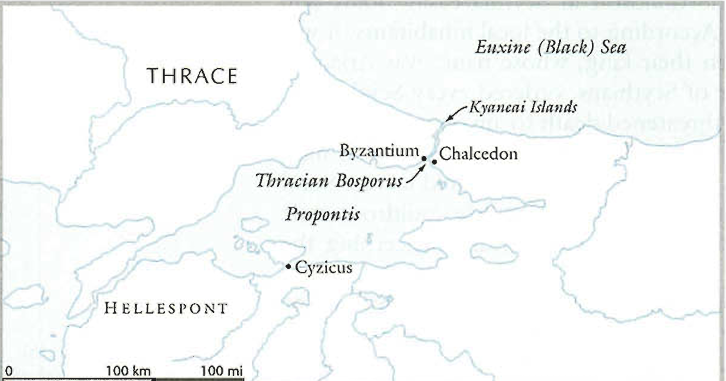
Herodotus’s plan may have been to follow in Darius’s footsteps from the Thracian Bosporus to Meotis [Azov Sea]. This hypothesis must be verified, but it is expressed now, at the beginning of the quest, because it, to a certain extent, organizes this quest.
The cities mentioned by Herodotus do not at first glance clarify our main question; their list seems random and very incomplete.
By the time Herodotus wrote his “Histories,” the Northern Black Sea region boasted a large number of long-established and flourishing cities, such as Thera, Olbia, Theodosia, Panticapaeum, Phanagoria, Gorgippia, and many others.
However, oddly enough, Herodotus is silent about all these cities except Olbia. Of all the other famous cities, Herodotus speaks summarily: “…other markets in Pontus” (§ 24). Even when it comes to places where Greek colonies were known to have existed, Herodotus passes them over in silence. Thus, speaking about the mouth of the river Tyras, he mentions “the foot of Heracles in the rock, which is shown to visitors” (§ 82), writes about the Tirite Greeks, but does not say that these Tirites built themselves a city.
He does the same with regard to the Bosporus [Kerch Strait]: he speaks only of the strait, of the crossing on the ice in winter, but is silent about the numerous cities on the shores of the Cimmerian Bosporus.
All this once again convinces us that Herodotus did not set himself the task of a purely geographical description. As a historian, he was interested in those Scythians who were able to resist Darius and put his 700,000-strong army to flight.
A description of Greek cities was not part of his plans, since it did not present anything new or interesting to his listeners and readers.
From this systematic silence about the Greek colonies of the Northern Black Sea region, scattered almost along the entire route of the Persian troops, we can conclude about the neutrality of the cities, or rather, about a friendly neutrality in relation to the Persians, on whose side were the Greek tyrants of the southwestern Black Sea region and the Propontis.
In light of all this, the dozen cities mentioned by Herodotus are of particular interest.
The first five cities (starting from the west) are directly connected with the Persian invasion of Thrace. These are Chalcedon and Byzantium, on opposite sides of the Thracian Bosporus, near which the architect Mandrocles built a bridge connecting Asia with Europe (§§ 85–88).
Further mention is made of coastal cities such as Salmydes, Apollonia, and Mesembria, which surrendered to Darius, in connection with Persian victories (§ 93). Other more northern cities on the western coast of Pontus are not named.” (Soviet Academician B. Rybakov in his ‘Scythia of Herodotus’ book).
Pioneering Pontoon Bridge Across Bosporus
Greek engineer Mandrocles of Samos built a pioneering pontoon bridge across the Bosphorus Strait around 513 BC, enabling the Persian army of Darius the Great to cross from Asia into Europe for the Scythian campaign. This engineering feat involved lashing together 600 ships and was necessary to move a colossal army numbering 700,000 infantry and cavalry across 13.6 km of water. It was constructed at the narrowest point of the Bosphorus, near Chalcedon, modern-day Istanbul.
The sole historical account of this engineering marvel comes from Herodotus. According to the historian, for his ingenuity and quality of work, the Persian king rewarded Mandrocles with the lavish gifts, including ten pieces of every valuable possession Darius owned—from horses to ships.
“Next, Darius expressed his delight with the bridge of boats by giving the engineer Mandrokles of Samos a multitude of gifts. Mandrokles reserved the first fruits of these and had a picture painted to portray the entire bridge over the Bosporus with King Darius sitting on his chair of state and the army crossing over the bridge. He dedicated it in the sanctuary of Hera, with the following inscription engraved on it:
After spanning the Bosporus teeming with fish, To Hera Mandrokles dedicated this To commemorate his work on the bridge of boats, Winning a crown for himself, and glory for Samos, By fulfilling the will of Darius the King. (Herodotus, 4.88)
The book “Royal Scythia, Greece, Kyiv Rus” has the story of the Persian King Darius the Great’s campaign into Scythia with more insights.