Renown Scythologyst Dr. Dmitry Raevsky (1941-2004) observed:
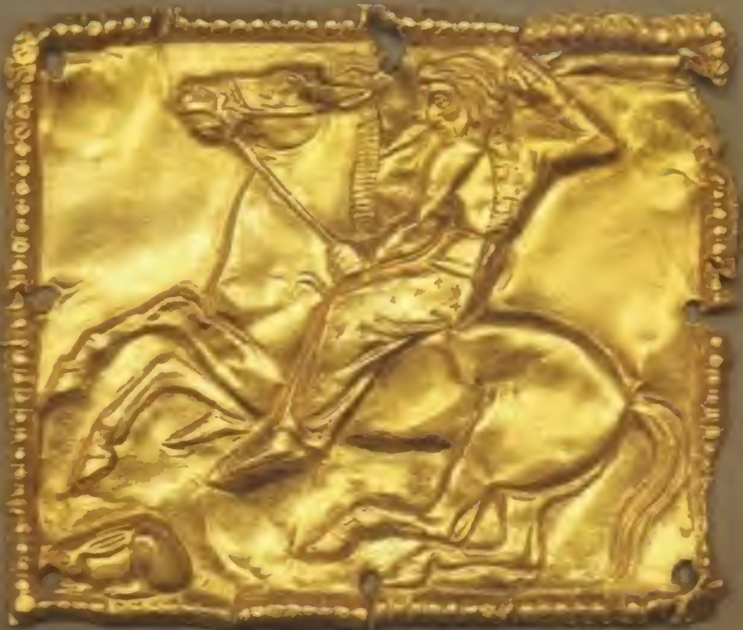
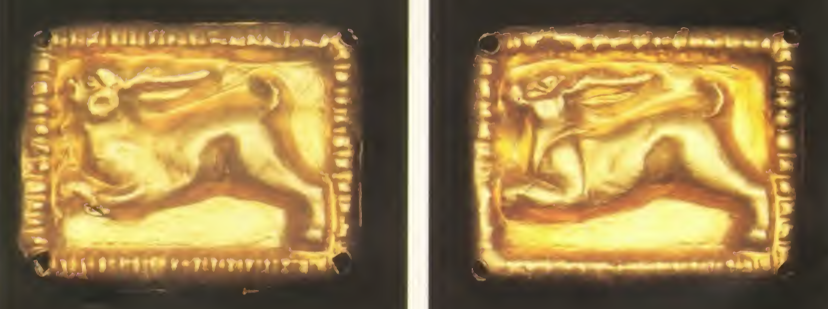
“There is a curious motif on the gold appliques from Kul-Oba and on the silver appliques from the Alexandropol barrow: a Scythian horseman is slaying a hare with a spear. Most scholars turn for the interpretation of the scene to the episode from the Scythian-Persian War described by Herodotus (IV, 134), assuming that it was the scene depicted on the cited appliques.
According to that story, at the moment when the troops of the two enemy forces were lined facing one another for the decisive battle, a hare ran in the direction of the Scythian soldiers. All Scythian warriors who saw the hare forgot about their enemy and ran after the hare. Darius saw in this the greatest disrespect for his might; therefore, without accepting the fight, he hastened to leave Scythia.
The content of this episode indeed demonstrates a striking coincidence with the cited images. However, the interpretation of the latter precisely as a rendering of that story is prevented by the circumstance that the motif of a horseman pursuing a hare is also found in the pictorial art of those regions of the Eurasian world that spoke the Iranian language, where the story about the Scythian-Persian War could not be popular and was probably hardly known at all. For example, a similar scene appears on the silver disc from the famous treasure from Oxus found on the territory of ancient Bactria, but there, it is combined with hunting scenes of stags and mountain goats, which, at any rate, are totally unrelated to the narrative about the Scythian-Persian War.
E.E.Kuzmina compared the scene of interest to us on the disc from Oxus with an episode from the Ossetic Nartic epic tradition, in which one of the heroes persecuted a magnificent white hare. This hare proved to be the daughter of the water-god. One of the principal figures in the Nartic epic tradition, the already familiar Batraz, was born from the hero’s marriage to that water queen. The similarity between this story and Scythian mythology is beyond any doubt: let us recall only the daughter of the water-god- the progenitress of the Scythians- in the numerous versions of the Scythian genealogical myth.
A general explanation can be found for all motifs cited above: the episode of the Scythian-Persian War, the story about the birth of Balraz, and even the fact that the scene of the hare hunt was popular in the art of Scythia and of the areas that were culturally close to it, ensuing from the symbolism of the hare image, inherent to a large range of Indo-European peoples, including the Iranians. Here, the hare stood for fertility, for the fruit-bearing forces in Nature. On this basis, it is easy to reconstruct the existing notion among the Scythians about the offering of a hare as a sacrifice, as a means of acquiring wealth and all kinds of prosperity.
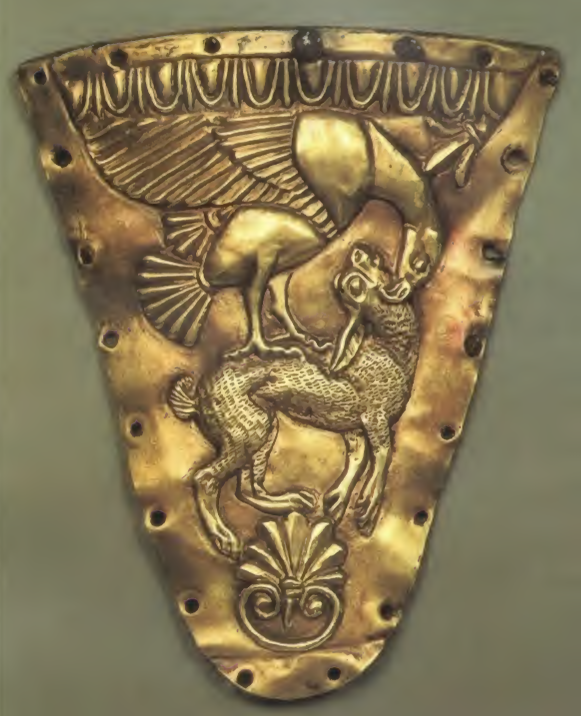
Therefore, it was the Scythians who started running after the hare before the eyes of the enemy troops, because if they caught it, this would have guaranteed a good omen for the forthcoming battle. Incidentally, according to the evidence in Xenophon (Cyropaedia, II. 4), that was how the Persian king Cyrus II assessed the fact that an eagle was devouring a hare before the eyes of his troops, while they were starting on their march. This is the reason for the popularity in Scythia of the motif of the hare hunt or the chasing of a hare by a dog or its devouring by a bird of prey; the latter two scenes, as we became convinced earlier, are a symbolic equivalent of the offering of sacrifices.
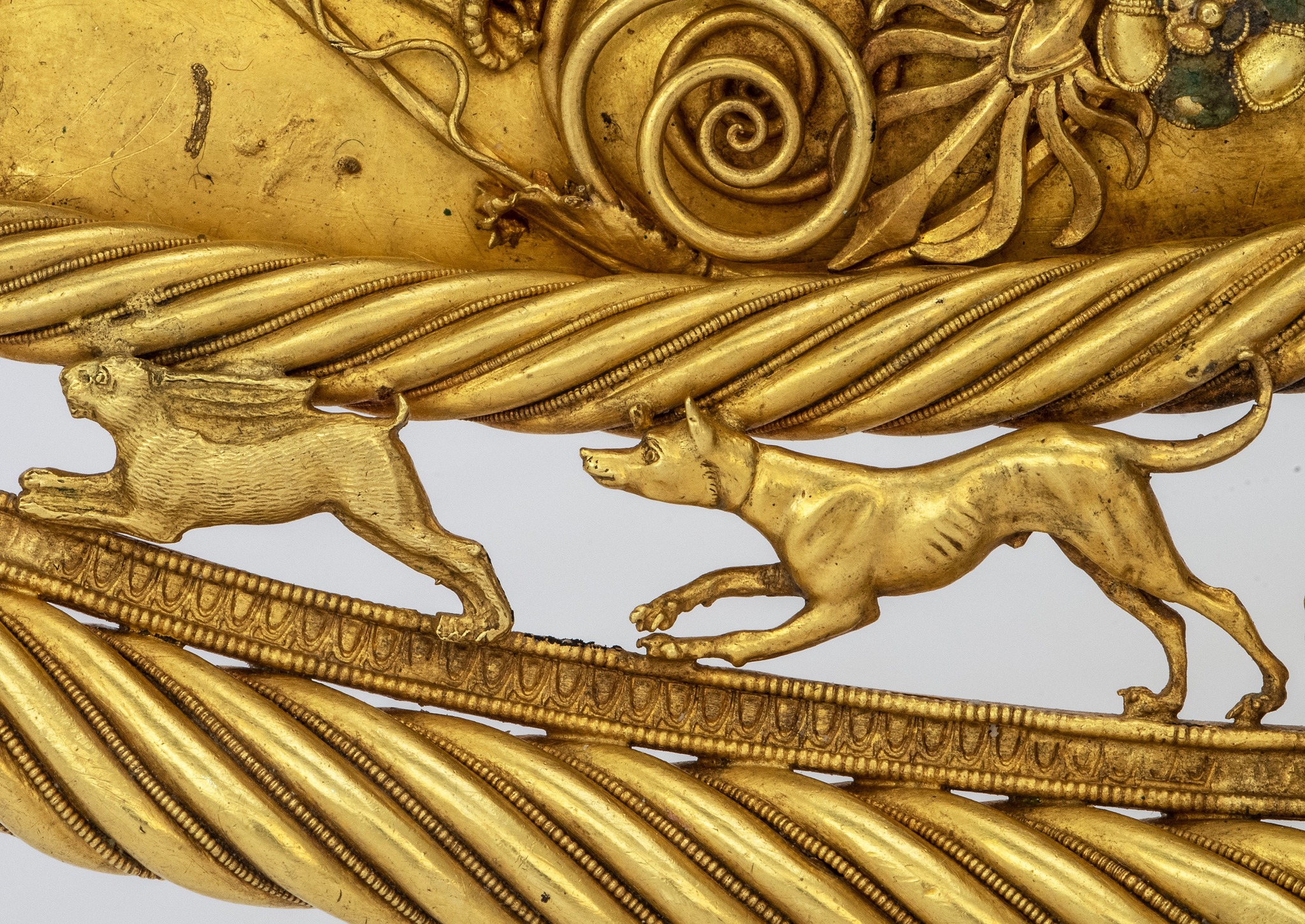
The title image to the article is a part of the famous Golden Pectoral. Closer to the ends of the Pectoral frieze, on both sides, one can perceive a dog chasing a hare.
The book “Royal Scythia, Greece, Kyiv Rus” describes the Golden Pectoral in greater detail together with other famous Scythian artifacts found in Ukraine.