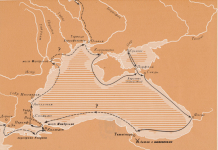
“On his return journey [from Scythia], besides Colchis, we can note another region whose narrative conveys a “presence effect.” Herodotus several times mentions the city of Themiscyra on the Thermodon River. The Thermodon (modern Terme) is a small river on the southern coast, flowing into the Black Sea 170 km east of Sinope and 30 km east of the ancient Iris (modern Yeşil-Irmak River).
The town of Themiscyra was located near the mouth of the Thermodon. These geographical points in themselves were too insignificant to serve as landmarks, but Herodotus, in determining the width of Pontus, chooses not Trebizond or the well-known Sinope, firmly linked by trade operations with the Northern Black Sea region, but rather the insignificant Themiscyra, located away from the main routes and not even a seaport:
“To Themiscyra, which is on the river Thermodon, from Sindica [Anapa] (at this place Pontus is widest) it is three days and two nights’ sailing, which is 3,300 stadia” (§ 86).
Herodotus is well informed about the peoples around the Thermodon… He names the Macron tribe (south of Trebizond) and mentions “Syrians” living near the Thermodon and further west to the Parthenia River. All this indicates a thorough knowledge of the southern bank on both sides of the Thermodon.
It’s not hard to guess what exactly drew the attention of the “father of history” to those two points in the southeastern section of the Black Sea, about which he provided so much detail—Colchis and Themiscyra on Thermodon.
Colchis is the legendary land of the Golden Fleece, the final destination of Theseus and the Argonauts. Themiscyra is the setting for another legend, telling of the Greeks’ victory over the Amazons:
“At the River Thermodon, the Greeks gained the upper hand (over the Amazons) and sailed home on three ships with captured Amazons. However, on the open sea, the Amazons attacked the Greeks and slaughtered them.
But the Amazons were unfamiliar with navigation and did not know how to handle a rudder, sails, or oars. After destroying the men, they were tossed about by the waves and, driven by the wind, finally landed at Cremnae on Lake Maeotis [Azov Sea]…” (§ 110).
Herodotus, as suggested above, had already visited Kremny, fulfilling his primary task—collecting information about Darius’s campaign deep into Scythia. It is possible that some part of the legend about the Scythians, the Sauromatians, and the Amazons (§§ 110–116) was written down by him in the very place where, according to legend, the Amazon ships stopped – in the Azov “Kruchi” – Kremny.
Therefore, it is entirely natural that, returning from his “scientific mission,” he chose to sail home not along the old, well-known route through Olbia, but along a new one that promised him new information and legends about the Argonauts and Amazons…
The Scythian youths, who wished to take the Amazons as wives, agreed to their proposal to find a new land for themselves outside Scythia:
“Let us leave here, cross to the other side of the Tanais River, and settle there (§ 115).
The young men agreed to this, crossed the Tanais, and traveled three days’ journey east of this river and the same distance north of Lake Meotis. They thus arrived at that very area they occupy now, and they settled there” (§ 116).
What is very important for us is, firstly, that numerical calculations are provided, and secondly, that these calculations determine the place of the Sauromatians specifically in Herodotus’ time, and not just in the mythological period.
Sarmatian archaeological sites also exist to the northeast of the Siversky Donets River, confirming Herodotus’s words that “beyond the Tanais River there is no longer Scythia; but the first landholdings there belong to the Sauromatians” (§ 21)…
The Tanais River is the eastern border of Scythia; beyond the Tanais is Sauromatia.
Analysis of disparate data led me to the conviction that the Tanais River is not the Don, but the Siversky Donets and the lower reaches of the Don, and that the Sauromatian lands began beyond the Donets, to the east of it, and to the southeast (beyond the Don).” (Academician B. Rybakov, Scythia of Herodotus).
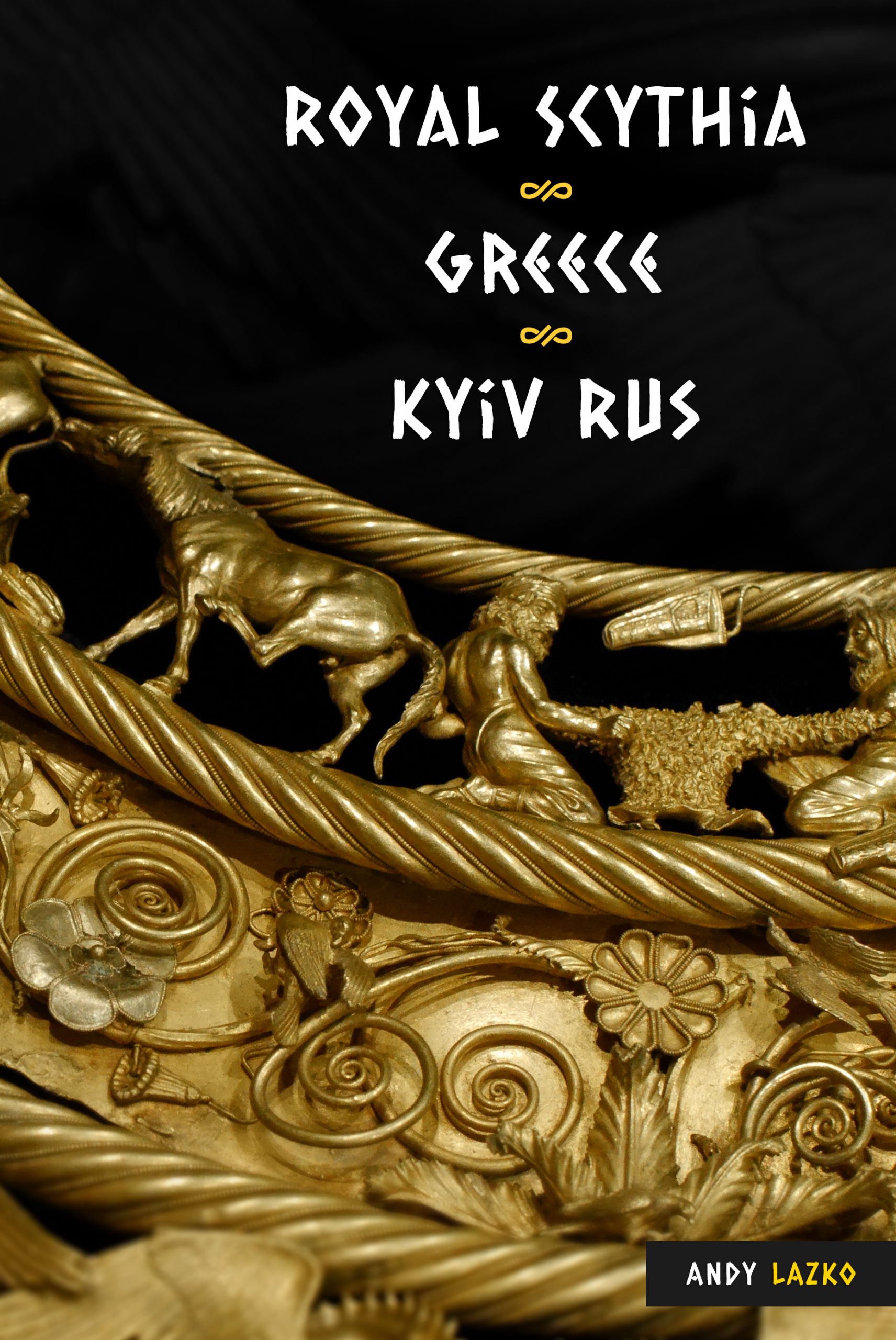
The book ‘Royal Scythia, Greece, Kyiv Rus’ has more stories about the Amazons and their origin.
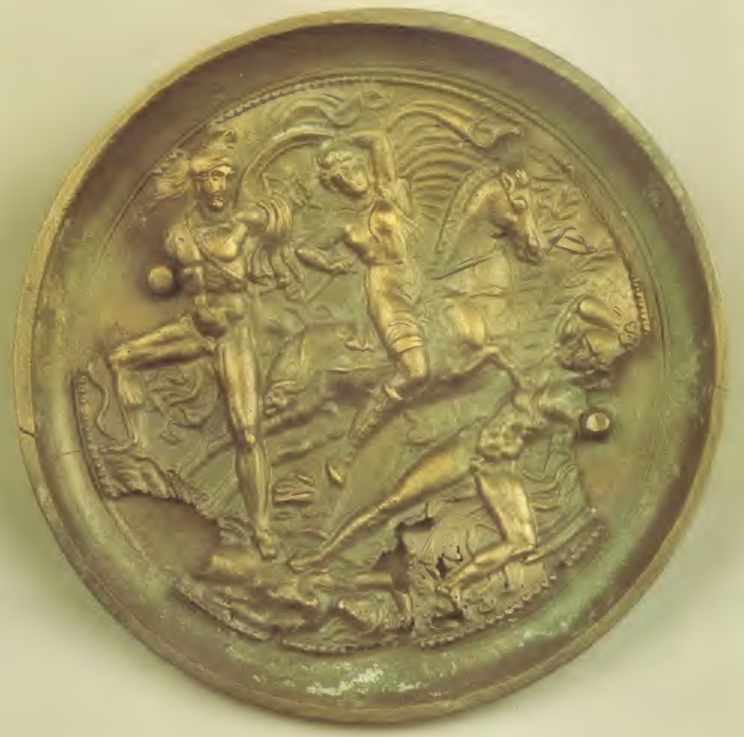
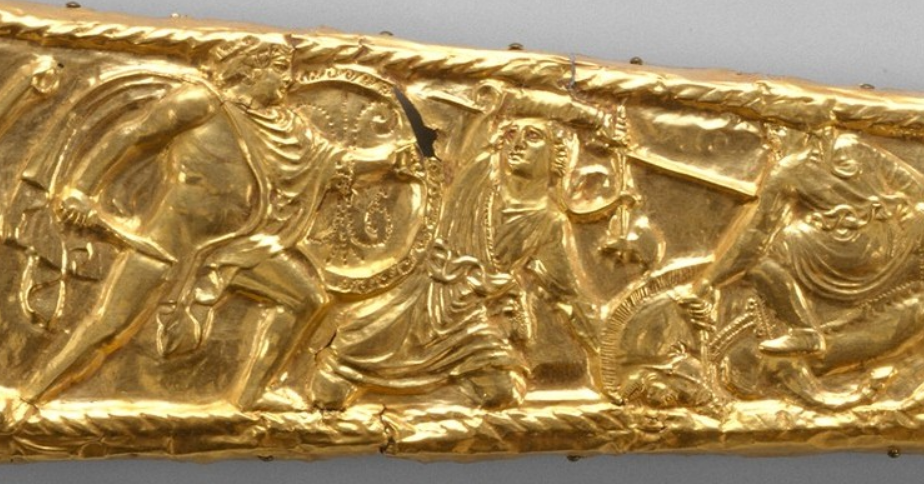
The ‘Cradle of Civilisations’ offers a new perspective on the battle depicted on the Solokha sheath (the title image to this article). It also described other discoveries in the barrow where the phalera below was found.