Academician Borys Rybakov (1908-2001) was a prominent Soviet archaeologist and historian who represented the Soviet Academy of Sciences at the Columbia University Bicentennial in New York in 1954. According to Wikipedia, “his first groundbreaking monograph, Handicrafts of Ancient Rus (1948), sought to demonstrate the economic superiority of Kyiv Rus to contemporary Western Europe.”
The text below is a translation of an excerpt from that work.
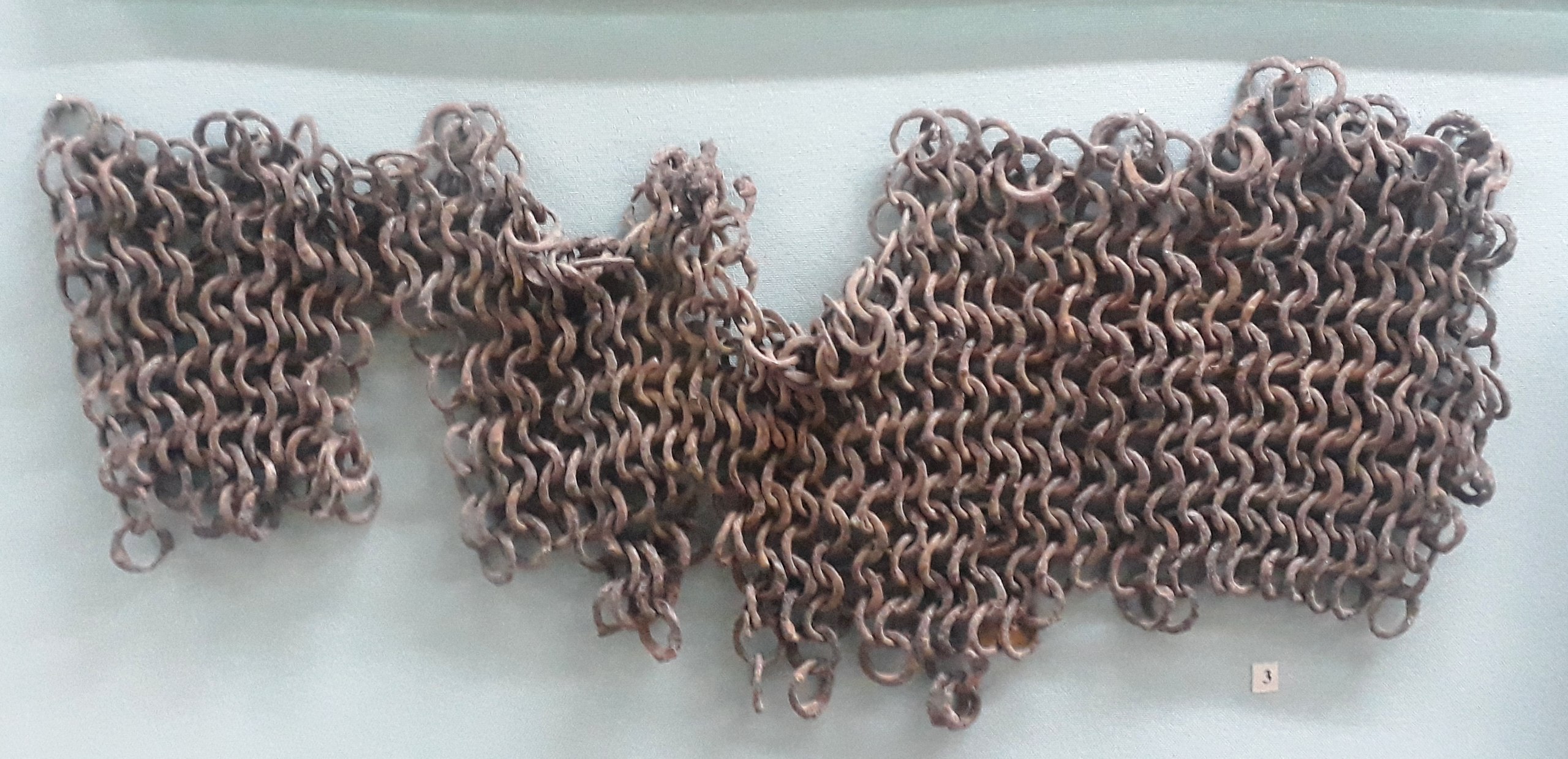
“The burial of a 10th-century chainmail master from Gnezdovo sheds some light on the origins of chainmail. Western Europe had not known chainmail until the Crusades, when the Arabs showed the knights the advantages of light and flexible armor.
The Varangian/Viking troops used leather armor with stripes on it and were also not familiar with chain mail, so in this matter, the Normanists could not attribute the introduction of chain mail to the Slavs by the Varangians.
Chain mail, known in the Kyiv Rus’ steppes even in Sarmatian times, had been forgotten for a long time and reappeared only in the 7th-8th centuries, along with the Iranian form of helmet, Iranian stirrups, and the “post-Sassanid” style in applied art.
In Rus’ burial mounds of the 9th-10th centuries, chain mail was found in Kyiv, Chernigiv, Smolensk, Ladoga, and a number of other places. Chainmail became an essential part of Rus’ armor, influencing the tactics of the army, allowing for the allocation of light cavalry units, which were essential in clashes with the mobile cavalry of the Pechenegs and Polovtsians.
In this regard, ancient Rus’ was two centuries ahead of Western Europe. The ancient name for chainmail – bronia (armor) – is often found on the pages of the chronicles.
Regarding the question of the origin of Rus’ chainmail, the opinion has always been expressed that it was obtained either from nomads or from the countries of the East. Meanwhile, Arab authors, speaking about the Slavs, note that they had chain mail, but do not mention their import from outside, which they would not have failed to do if the chain mail had been imported from the Caliphate.
The chronicle story about the reconciliation of the voivode Pretich with the Pecheneg khan stands alone.
[Context by the author of the article. According to the Primary Chronicle, in 968 AD, while Svyatoslav the Brave was at Pereyaslavets in Bulgaria, the Pechenegs invaded Rus’ for the first time. Olga of Kyiv shut herself up in the city of Kyiv with her grandsons, Yaropolk, Oleg, and Vladimir. The nomads besieged the city with a great force. General Pretich saved the city by deceiving the Pechenegs into believing that his small troops were the large forces of Sviatoslav the Brave returning from their campaign.
“The Prince of the Pechenegs inquired whether Pretich was the Prince himself. The general then replied that he was the Prince’s vassal, and that he had come as a vanguard, but that a countless force was on the way under the Prince’s command. He made this statement simply to frighten the Pechenegs. So the Prince of the Pechenegs invited Pretich to become his friend, to which request Pretich assented. The two shook hands on it, and the Prince of the Pechenegs gave Pretich his spear, sabre, and arrows, while the latter gave his own breastplate, shield, and sword.” According to Rybakov, it was bronia/ chainmail in the original.)
Here, chainmail armor appears as a Rus’ gift to the steppe dweller, and not the other way around, as one would expect if one assumes that Rus’ received chainmail from its nomadic neighbors.
The abundance of chain mail in the squad burial mounds indicates that the armorer from Gnezdovo was not alone and that chain mail craftsmen were working hard in other Kyiv Rus’ cities.”
The book “Kyiv Rus in Heimskringla Sagas and Byzantine Texts” provides little-known facts about Rus and the reason it was called Gardariki. It also has an eyewitess account of a Byzantine historian of a battle in Bulgaria in which Sviatoslav the Brave was saved by his armor (most likely the chainmail).