

Swedish academic and Professor of archaeology Anne-Sofie Gräslund (b. 1940) in her 1980 book ‘The Burial Customs. A study of the graves on Björkö’ concluded that “the chamber-graves, lacking indigenous prototypes, were presumably associated with the international character of Birka, and with the merchants in particular.” At that time, the scholar held the opinion that the origins of the chamber-graves were likely to be found in Western Europe. Was she correct about the place of origin? Where did those merchants come to Birka from?


Soviet Academician Rybakov, in his monograph ‘Handicraft of Ancient Rus’, wrote already in 1948:
“Funeral rites of the Middle Dnieper region in the 9th-10th centuries resurrect the old Scythian rite of burial in a large log structure under a burial mound.
The appearance of burial mounds is in no way connected with the Normans, as the burial mound ritual emerged almost simultaneously among all Slavic tribes, including those that had never encountered the Normans (for example, the Czechs, Moravians, etc.)…
More than a thousand years separate the Scythian burial mounds from the Slavic ones: it is therefore difficult to establish a direct connection between them, but it is necessary to note that the type of Scythian log tombs of the Kyiv and Poltava regions is resurrected later, precisely within these same geographical boundaries…”
Four decades later, in his other monograph, ‘Paganism of Ancient Rus’, published in 1987, Academician Rybakov supported his previous view with more details:
“… Describing Scythia in the 5th century BC, Herodotus famously outlined a vast square measuring 700 x 700 km in Eastern Europe. The southern side of the “Scythian Tetragon” was the Black Sea coast from the mouth of the Danube to the Kerch Strait.
The western side went approximately to the middle reaches of the Pripyat River, and the eastern side approximately to the River Oskol.
The northern side of the Scythian Square, least known to the traveller, was lost in the forest zone, somewhere north of the Seim River and the lower reaches of the Pripyat…
Of extreme importance for understanding the ethnic situation within the Scythian square is Herodotus’s well-known detailed account of the Scythian agricultural festival: “He (Targitai, the son of Zeus and the daughter of Borysthenes/Dnieper River) had three sons: Lipoxai and Arpoxai, and the youngest, Kolaxai. During their reign, golden objects fell from the sky onto the Scythian land: a plough with a yoke, a double-edged axe and a cup…”
The Greek historian considers it erroneous to classify the plough worshippers as the true steppe Scythians (about whom Herodotus very firmly states that they had neither crops nor settlements), and points to the self-designation “Skoloti,” after the common king of all tribes, Kolaksai. According to local myths, the Skoloti are the descendants of Zeus and the daughter of the river deity Borysthenes; therefore, the terms “Skoloti” and “Borysthenes” are interchangeable…
Herodotus knew about the Borysthenites beyond the Dnieper and, leading his description from south to north, began it precisely from the Vorskla-Pantikapa River, counting from there the distances to the northern limits of the land of the Dnieper ploughmen…
Almost half of the agricultural tribes within the Scythian square lived on the territory of the ancient Slavic homeland. The Middle Dnieper forest-steppe region that interests us was inhabited not by nomadic pastoralists, but by sedentary agricultural peoples, the heirs of the local tribes of the Chernoles period, with the addition of the Gelonians, related to the Scythians…
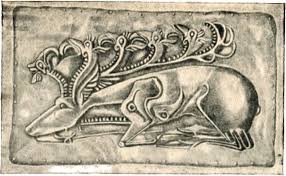
The compact region of the forest-steppe Right Bank (eastern bank of the Dnieper River), compared above with Herodotus’s Scythians-Borysthenites, differed from the steppe, purely Scythian, regions not only in economic but also in religious terms. The Scythians worshipped the sword, and the Borysthenites – a plough with a yoke, an axe and a cup; the animal style is distinctive, reflecting the sacred symbolism: among the Scythians, the predominance of birds and fantastic animals, and among the forest-steppe Skolots, the real northern elk predominates, the ancient symbol of the main celestial constellation: “Elk” – Ursa Major.

The burial rite of the land of the Skoloti also differed significantly from the rite of the Royal Scythians, well known from numerous excavations in the “Gerrus”, a vast area of sacred burial mounds in the Middle Dnieper region.
In the Dnieper region (Middle and Lower), two types of burials with inhumation have been identified, to which the tribal nobility began to move back in the pre-Scythian period: burials in catacombs and burials in wooden tombs. Catacombs are typical of true nomadic Scythians (including the Royal ones), while wooden tombs are typical of the forest-steppe right-bank Skoloti (“Scythian ploughmen”) and the Gelons-Budins-Skoloti of the forest-steppe left bank.
The areas of two different types of burials are separated by a wide, hundred-kilometre-long empty expanse of steppe. Scythian burial mounds with catacombs are concentrated mainly in a vast rectangle measuring 120×160 km, in the core of which is the main burial area of the Scythians – Gerros (below the Dnieper rapids), with such famous Royal burial mounds as Chertomlyk, Solokha, Gaimanova Mogyla, and the Alexandropol burial mound. The centre of this entire rectangle is the only Scythian city—the Kamenskoye settlement at the Konka tributary of the Dnieper, where one can see the Metropolis of Claudius Ptolemy…

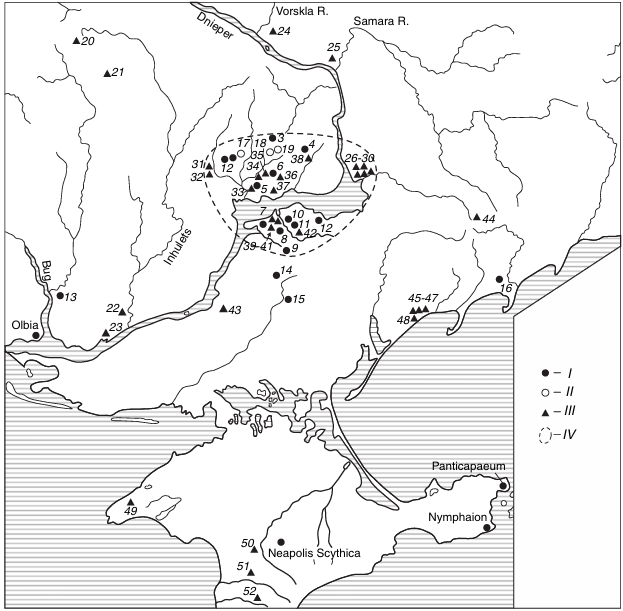
The burial rite, as we see, draws a sharp line of demarcation between the nomadic Scythians and the forest-steppe farmers. To characterise the right-bank burial mounds of the 7th-3rd centuries BC, I will use the description by the renowned Scythologist B.N. Grakov. I cite a description of the wooden tombs of the Borysthenite Slavs by B.N. Grakov, which is very important for our topic:
“There are many burial mounds around the fortified settlements, sometimes over 10 meters high. The burial mounds along the Tyasmin and Ros Rivers have been studied in particular detail. They cover the period from the mid-7th century to the mid-3rd century BC, i.e., the entire Scythian era. Under these mounds, structures in the form of simple quadrangular pits with an area of 6-16 m2 with a flat wooden ceiling are common…
Burials in mounds under a conical wooden roof, similar to the roofs of the dugouts of the Nemirovsky settlement, excavated near the villages of Zhabotin and Konstantinovka on the Tyasmina, date back to the 7th century BC.

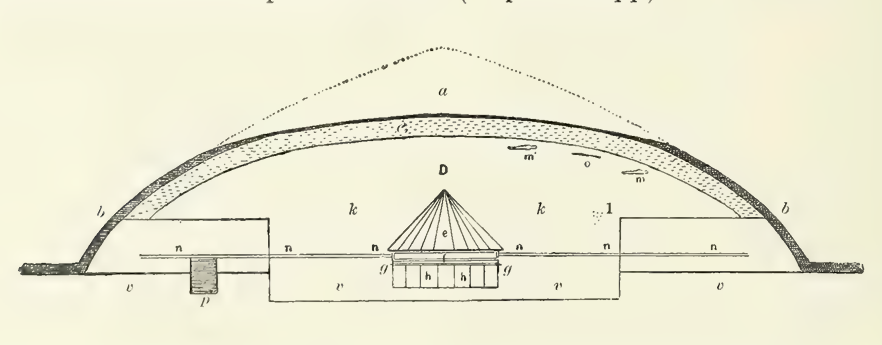
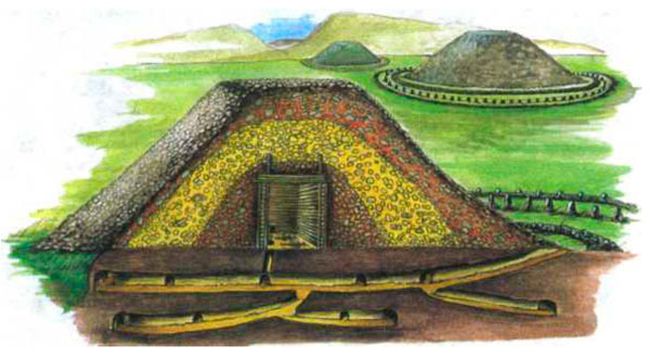
In addition to these simple structures, there are also real wooden houses either built on the ancient soil surface and then covered with a mound, or built in a deep rectangular pit. Their walls are either lined horizontally with thick logs, held at the corners and in the middle of the walls by thick pillars, or lined vertically with planks placed in grooves with pillars at the corners and in the middle of the walls. Sometimes the central pillar supports a gently sloping gable roof… All these structures date back to the dugouts of the settlements and hillforts of the Chornoles culture, lined with wood or furnished with vertical pillars. Mounds with such structures are concentrated from the mouth of the Pripyat to the outskirts of Kirovograd [now Kropyvnytskyi].
Not only the sub-mound structures in the form of dwellings, but also the burial rite in the mounds of the middle Dnieper Right Bank retained forms from the Chornoles era throughout the Scythian period. Along with elongated and occasionally twisted skeletons, cremation was quite widely used, both in urns and in the form of urnless burial of burnt bones…”
Of crucial importance for determining the ethnic origin of the tomb-burning ritual is its geographical distribution within the “Scythian square.” The tomb-burning ritual is known from the Glevakha burial mound near Kyiv (the mound is 12 meters high).
There are burial mounds with such burnings near Kanev in the Ros River basin (Ositnyazhka, Berestnyagi, etc.). They are also known in Podillia.
The northernmost burial mound with a similar rite is located on the Pripyat River, near the mouth of the Goryn River, in the thicket of Milograd Neuri culture sites. Burnt coffins were found both in pits and at ground level. It is here, at the mouths of the Goryn and Styr rivers, that the northwestern edge of the range of archaic Slavic hydronyms extends. The southernmost points of the dominion burning ritual are: Litaya Mogila (Melgunov burial mound of 1763, located in the Black Forest, which gave its name to the Chornoles culture) and the burial mound in Mederovo near Kirovograd.
In Mederovo, the coffin was built directly on the ground and covered like a tent with long logs, which, after the fire was burned, formed a huge fire pit 20 meters in diameter. The layer of scorched earth reached two meters in thickness.
The Melgunov Barrow belonged to some early prince of the Skolot tribe of the Avkhats. In confirmation of the words of Valerius Flaccus about the “Cimmerian riches” of King Avhat, the Melgunov burial mound gives us items of Assyrian manufacture.
[The Melgunov burial mound is located 130 km north of the nearest Scythian burial mound. The burial mounds in the upper reaches of the Ingul and Ingulets rivers indicate a Borysthenite outpost in this strategically important point for grain exporters: from here the shortest route to Olbia led (bypassing the land of the warlike Royal Scythians, – B. Rybakov’s comment.]
The decisive factor in determining the ethnicity of the creators of the burnt coffins is the presence of this rite on the left bank of the Dnieper, specifically on the Vorskla River. This is the same Vorskla River where Proto-Slavic colonists arrived in the 8th and 7th centuries, where archaic Slavic hydronyms have been traced. On the Vorskla River, burnt coffins are known near the ancient city of Gelon (Bilsk settlement) and in Bitovaya Mogila (near the village of Likhachevka). In the latter case, there is, so to speak, a double burning: the deceased himself was first burned, and his ashes were poured into an urn placed in the corner of the coffin, and after this, the upper part of the coffin itself was burned according to the right-bank rite.
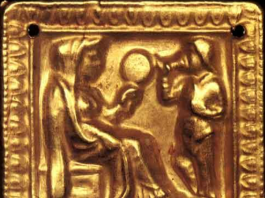
All the above-mentioned burial mounds with burnt coffins are burials of Proto-Slavic tribal nobility. These are substantial mounds, the height of which ranges from 4-5 m to 9-12 m (the Glevakha burial mound near Kyiv is 12 m). These burial mounds contain numerous weapons of common Scythian types, military armour, and horsemen’s equipment. A large number of bridles are found, apparently belonging to the deceased’s personal horses. Weapons and clothing are decorated with gold patterned plates.
The Right Bank animal style differs from the steppe style, particularly in its forest motifs such as the elk.
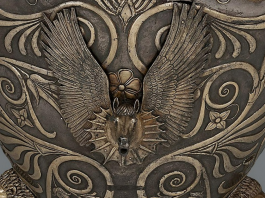
Bone plaques from Zhabotin (Tyasmin) depict a symbolic scene: a herd of elk defending itself from attacking birds of prey; such birds were often symbols of the Scythian nomads, and their images adorned the tops of banners. The warrior who owned the saddle decorated with this scene was buried in the border zone, on the edge of the Slavic lands, where neighbouring fortresses resisted the attacks of the Royal Scythians with their eagles, gyrfalcons and griffins on bunchuks. There is no doubt that the burial mounds with burnt coffins belonged to representatives of the highest nobility.
An examination of the burial rite of the Proto-Slavs in the Scythian period leads to the following conclusions: in this era, the original cremation of corpses in all its variants (in urns or in pits, without burial mounds and under burial mounds) continued to exist. The closer one gets to the steppe of Scythia, the less noticeable the cremation is. The Slavic nobility of the 7th-3rd centuries BC, influenced by the Scythians, switched to cremation in an extended position. Accompanying slaves are still sometimes buried crouched. The burial mounds of nobles are distinguished by their size, the number of “co-dead” and the richness of their grave goods. The difference between the Skoloti-Slavs and the real steppe Scythians consists in the tangible remnants of cremation, expressed in solemn and majestic (as in real cremation) funeral pyres over wooden coffins, imitating a dwelling.”
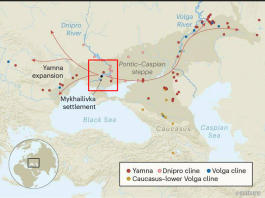
The book “Craddle of Civilisations” had shown what became proven by DNA just recently: