

“Having transported his army across the Thracian Bosporus via a bridge built by Mandrocles, Darius easily conquered the Thracian tribes and port cities of the western shore of the Black Sea (Salmydes, Apollonia, etc.) The second bridge was built across the Danube at its “neck,” above its delta. Beyond the Danube, Scythia began.


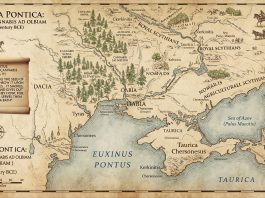
Darius brought here, according to Herodotus, 700,000 warriors and a squadron of 600 ships under the command of Ionian tyrants. The squadron in the Danube mouths was strategically placed very successfully: its direct purpose was to guard the Danube bridge, but it could very quickly provide assistance to Darius on Scythian soil. According to Herodotus (§ 86), a ship could travel 230 km per day (1,300 stadia) at sea; a ship could sail from the middle mouth of the Danube to Olbia in less than one day; to Panticapaeum [Kerch] on the Cimmerian Bosporus [Kerch Strait] — in two days and one night. Darius’s fortified region on the Oarus and Lycus rivers could be reached by the Danube squadron in just four days of continuous sailing. Perhaps this was the purpose of organizing fortifications close to the sea near the port city of Kremny.
Leaving the allied Greeks to guard the Danube bridge, “the king tied 60 knots on the belt, called the Ionian tyrants to a meeting, and said to them…: starting from the time when I go against the Scythians, untie one knot on the belt every day. If I do not return within this period of time and the number of days indicated by the knots has passed, sail back to your homeland, and until then guard the bridge…” (§ 98).
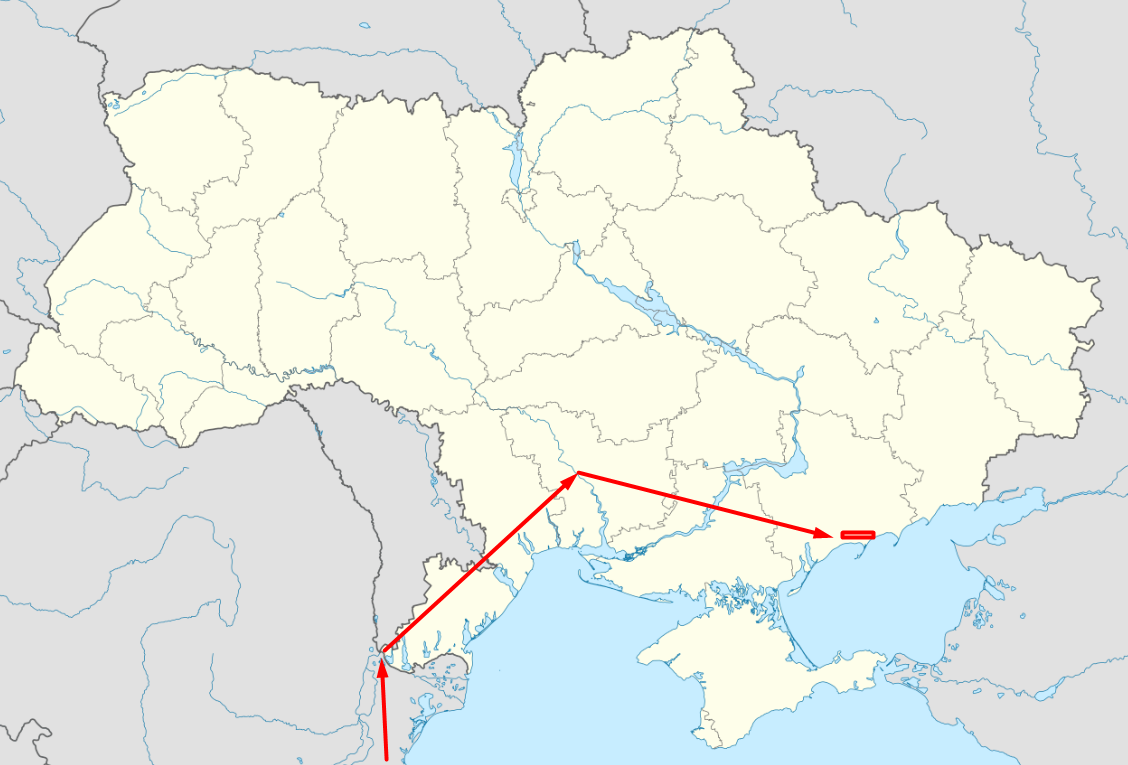
By the time the Persian army reached the southwestern border of Scythia, it had already traveled approximately 2,800 km. Judging by the 60-knot belt, Darius intended to penetrate 800–1,000 km into Scythia. Before examining the course of the Scythian war itself, we need to find out what one knot on the royal belt was worth, and how long a day’s journey was…
“A day’s journey” is, of course, a relative value, depending on the type of transport, the objectives, the ease of access to roads and crossings, and the degree of urgency of the movement (march, pursuit, flight).
Herodotus defines a day’s journey three times, each time differently: the typical day’s journey in the Scythian wilderness is 200 stadia (§ 101); a day’s journey in the mountainous terrain from Ephesus to Sardis is 180 stadia (V, § 54); and a day’s journey during a long march along the Persian “royal road” is 150 stadia (V, § 53)…
For the movement of the Persian army through Scythia, an average speed of at least 30 km per day should be adopted: 7-8 hours of movement at 4 km per hour.
Furthermore, we know that Darius began his campaign at a rapid pace: “Darius marched with his army very quickly” (§ 125). This forces us to rely on the greatest distances for the troop routes given by Herodotus and Xenophon (31.9 and 30.65 km, respectively).
For the march of cavalry units not burdened with baggage trains and infantry, the speed of movement must be significantly increased. Medieval cavalry could make advances that covered distances of up to 90 km per day, but such speeds were impossible for long-distance marches. A multi-day march could be accomplished at an average speed of 45-50 km per day.
Herodotus’s text forces us to calculate the speed of the army’s movement in two ways: first, for the main forces, always designated in the text by the name of the king himself (“Darius walked quickly,” “Darius stopped,” etc.), and secondly, for the cavalry corps that swiftly pursued the Scythian cavalry, always designated only by the word “Persians” (“the Persians attacked,” “the Persians pursued,” “the Persians crossed,” etc.).” (Academician B. Rybakov, ‘Scythia of Herodotus’).
Scythian Strategy
The movement of the Persian troops through Scythia was determined not by Darius’s plans, but by the strategic calculations of the Scythians, who sought to lure the Persians as far as possible into the depths of their steppes…
The Scythians’ strategic plan is clearly outlined by Herodotus:
“The Scythians… decided not to give a real open battle, but, dividing into two detachments, to retreat with their herds, filling up wells and springs they came across, and destroying the vegetation…
One of the detachments led by King Scopasis was joined by the Sauromatians. They were to flee, if the Persian king turned on them, straight to the Tanais River [Siversky Donets] along Lake Meotida [Azov Sea]” (§ 120).
As we know, it was to the banks of the Meotian Lake [Azov Sea], to the Oarus and Lycus rivers, that the Scythians lured the main forces of the Persian army.
“The Persians, noticing the appearance of the Scythian cavalry, attacked them and pursued them incessantly, while they continued to retreat. The Persians pursued one of the three parts toward the east and the Tanais…” (§ 122).
… Darius moved east, with the sea on his right hand, the two Scythian armies of Idanthyrsus and Taxakis on his left, and the army of Scopasis directly in front of him…
He stopped at the Oar (Korsak?) River. By this time, the Persian troops had already traveled over 600 km through Scythia, taking 21 days. Darius’ camp at the Oar (Korsak?) River on the shore of the Sea of Azov was essentially a huge fortified area:
“When Darius reached this uninhabited region, he stopped the chase and encamped his army by the Oaros River. He then began to build eight huge forts, at equal intervals from each other, about six and a half miles’ apart, whose remains were still standing in my time. But while he was working on these, the Scythians he had been chasing went inland on a round about course and turned back to Scythia. Since they had completely vanished and no trace of them could be found by Darius, he left his forts half finished and turned back toward the west, assuming that those he had pursued were all of the Scythians and that they had fled.” (§ 124).
The defensive line of eight fortresses would have stretched for more than 70 km, as each interval between fortresses was 10.65 km. The entire unwieldy Persian army, with its baggage train and herds, could have been sheltered in this area, protected from the south by the Azov Sea.
If necessary, a squadron of 600 ships could quickly arrive at Kremny, the seaport adjacent to the camp. A third of the time allocated by Darius for the entire Scythian campaign had already passed. Another 21 days still needed to be reserved for the return journey from the camp to Ister.
For the last time, we feel Herodotus’s “presence” in the places he describes. Herodotus knows of a small river called Oar (Korsak?), on which the Persian army built fortifications, knows the neighboring, also insignificant, river Lik (Obitochnaya?), knows the desert, which actually came right up to the sea.
In this steppe “in a waterless field,” Igor’s army [Tale of Igor’s Campaign epic] was defeated in 1185; on 18th-century maps, the area north of the Sea of Azov was called exactly the same: “Déserte sans eaux.”
“As there seemed to be no end to this pursuit, which had gone on for a long time, Darius sent a horseman to Idanthyrsos king of the Scythians with this message: “You extraordinary man! Why do you keep fleeing when you certainly could do otherwise? If you think you are able to challenge my power, then stop your wandering and stand to fight it out. Or, if you acknowledge that you are too weak for that course, then you should stop running away, bring gifts of earth and water to your master; and enter into negotiations with him.” (§ 126)
“To this, Idanthyrsos king of the Scythians responded, “This is my situation, Persian. I have never yet fled from anyone out of fear before, and I am not fleeing from you now. What I have been doing is in fact no different from what I am accustomed to do in times of peace. I will tell you why I do not engage you now: it is because we have neither towns nor cultivated land to worry about being captured or razed, which might induce us to engage you in battle sooner. But if you really must come to battle without further delay, know that we do have ancestral graves. So come on, then; find them and try to destroy them, and you will know whether or not we shall fight for the graves. But before that, we shall not engage you in battle unless we see fit to do so. So much for talk of battle, but as to my masters, the only ones I recognize are Zeus, my forefather, and Hestia queen of the Scythians. Instead of gifts of earth and water, I shall send you the kind of tokens you really merit. And in response to your claim to be my master, I tell you, ‘Weep.’ That is your answer from the Scythians.” The herald returned and announced this reply to Darius, while the Scythian kings became enraged when they heard the word “slavery.” (§ 127)
Finding himself in the deserted areas of the Azov region, Darius Hystaspes, obviously, realized the futility of his hopes for the defeat of the Scythian troops and the difficulty of moving his entire seven-hundred-thousand-strong force with infantry and the royal court.
Herodotus knew the dimensions of the fortifications and, most importantly, noted the approximate nature of the figure he provided. 60 stadia is a significant distance (10 km 950 m), and there was no need to measure it precisely. The fortifications were unfinished:
“Darius abandoned the half-erected walls, turned back, and headed west.” The unfinished camp was a turning point in the entire Scythian campaign.
The book ‘Royal Scythia, Greece, Kyiv Rus’ has more insights into Scythia and other amazing events that took place in its realm.