

“A third of the time allocated by Darius for the entire Scythian campaign had already passed. Another 21 days were still needed to be reserved for the return journey from the camp to Ister [Danube].


Could the Persians, in the remaining 18 days, have made a campaign beyond the Tanais into the land of the Sauromatae and passed through the land of the Budini (or Budino-Geloni), as Herodotus writes?
“When the Scythians crossed the Tanais River, the Persians immediately followed in pursuit, until they finally passed through the land of the Sauromatians and reached the territory of the Budini” (§ 122).
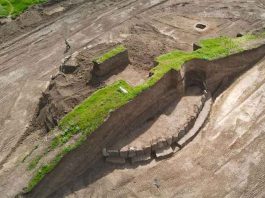
“…Having invaded the land of the Budini, the Persians attacked on the wooden fortification, which was completely abandoned by the Budins, and burned it” (§ 123).
First, we must note that the pursuit of the Scythian cavalry was not carried out by the entire mass of the Persian army: “While Darius was busy with the construction, the pursued Scythians circled these lands from above and returned to Scythia” (§ 124).
This means that the pursuit was carried out only by the Persian cavalry corps, freed from donkeys, mules, infantry, and the royal retinue—all of which, as we know from §§ 129–135, remained in Darius’s fortified region. Taking this into account, we must adopt a different calculation of the spatial length of a day’s journey and calculate it not at 30 km, as for combined arms movement, but at 45-50 km, as should be calculated for cavalry raids.
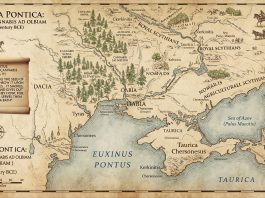
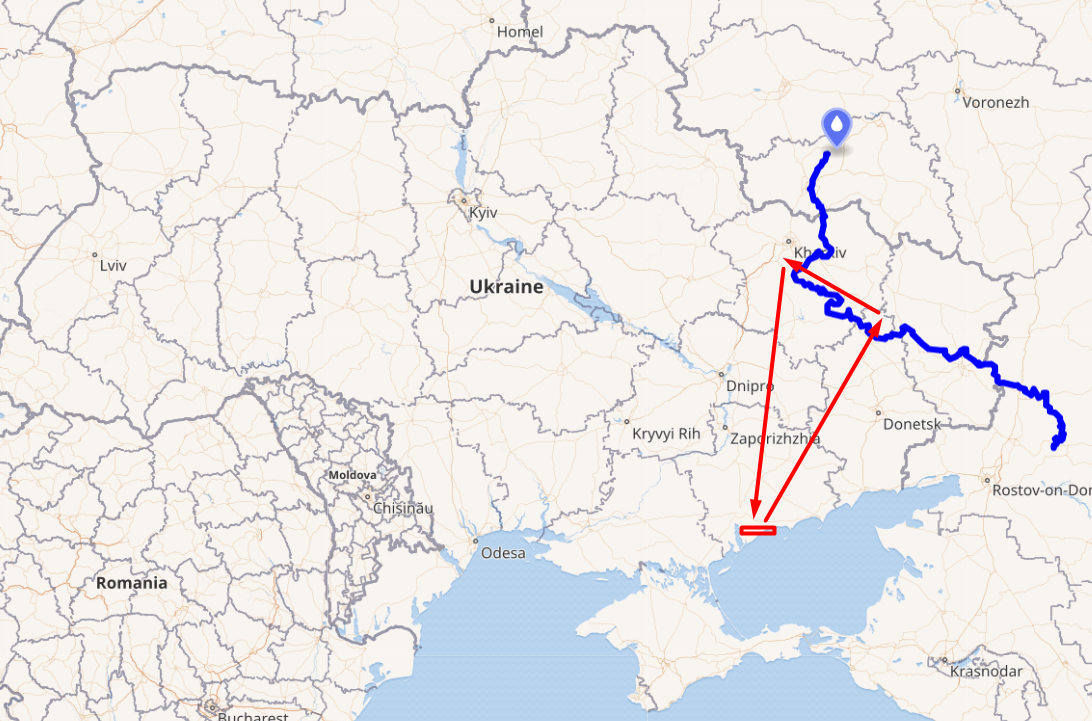
Let’s take a smaller value for caution – 45 km per day (6 – 7 hours of trotting). Secondly, we should outline the parts of the land of the Sauromatians and Budini closest to the Persian camp at Azov, not forgetting Herodotus’s warning about the confusion that existed in his time between the names of the Budini and the Gelonians. The closest route from Darius’s camp at the Oar River to the Tanais-Seversky Donets River is in the direction of modern-day Kramatorsk and Slovyansk. In days’ journey, this distance would be equal to seven days. After three days’ journey northwest through the Savromatian lands beyond the Donets River, the horsemen could reach the border settlements of the Budino-Geloni on the upper Donets, and, having passed along the southern edge of the Budino-Gelonian land, after 8-9 days, they could return to the deserted shores of the Azov region. Thus, the calculation of the minimum route completely matches the text of Herodotus.
Darius’s strategic calculation, expressed in his belt with 60 knots, was quite realistic and could be carried out with an accuracy of one day.
It should be remembered, however, that the Persian king somewhat delayed the time he had himself set for guarding the bridge over the Ister. The Scythians repeatedly visited the Danube bridge and tried to persuade the Ionian guards not to linger longer than the agreed-upon 60 days (§ 133).
While the Persian army was still retreating from Scythia, the deadline had already passed, and all 60 knots on Darius’s belt had been untied. The Scythians again sent messengers to the Danube squadron:
“The number of days assigned to you, Ionians, has passed, and you are acting unwisely by remaining here… remove the bridge, return quickly to your homeland and enjoy freedom, for which you thank the gods and the Scythians…” (§ 136).
Therefore, to the two months estimated for the campaign, we must add a few more days beyond the timeframe Darius had planned. This means that the route of the Persian cavalry raid (without Darius) could have been somewhat longer.
Here, the question of the city of Gelon arises. Herodotus does not mention Gelon when describing the Persian invasion of the Budini; he simply speaks of the Persians burning a “wooden fortification” (§ 123), which could refer to any fortified settlement…
The cavalry route, in all likelihood, had the shape of a triangle, one corner of which was the camp on the Oar River, another the edge of the Savromatian land beyond the Seversky Donets, and the third corner, in one case, could have been the Budino-Gelonian settlements near Kharkiv, and in another case, the city of Gelon. The route from this third corner (in any of its variants) lay south, to the Sea of Azov, to the “desert” near which Darius stopped.
The three-week Persian cavalry raid across the Left Bank steppes proved decisive for the entire campaign—the Persians suffered a strategic defeat, as all their attempts to destroy the Scythian army were fruitless. Darius’s camp at Meotis was, apparently, tightly blockaded by the Scythians:
“The Scythians decided not to lure the Persians any further, but to attack them every time they went out in search of food… The Scythian cavalry constantly put the Persians to flight. The Persian horsemen fled until they overtook their own infantry, which then reinforced them… The Scythians also carried out similar attacks at night” (§ 128).
Sometimes the Scythians lured the Persians out of the camp by leaving small herds nearby (§ 130).
The Persian king “found himself in a difficult situation” (§ 13Π. So much so that even the Scythians noticed this and sent Darius symbolic “gifts”: a bird, a mouse, a frog, and five arrows; the Persian sages interpreted these gifts thus:
“Unless you, Persians, fly away like birds into the sky, or hide in the earth like mice, or hop like frogs into the lakes, you will not return and will fall under the blows of these arrows” (§ 132).’ (Translation of parts of Academician B. Rybakov’s ‘Scythia of Herodotus’).
The book ‘Royal Scythia, Greece, Kyiv Rus’ has more little-known facts about Scythia of that period.