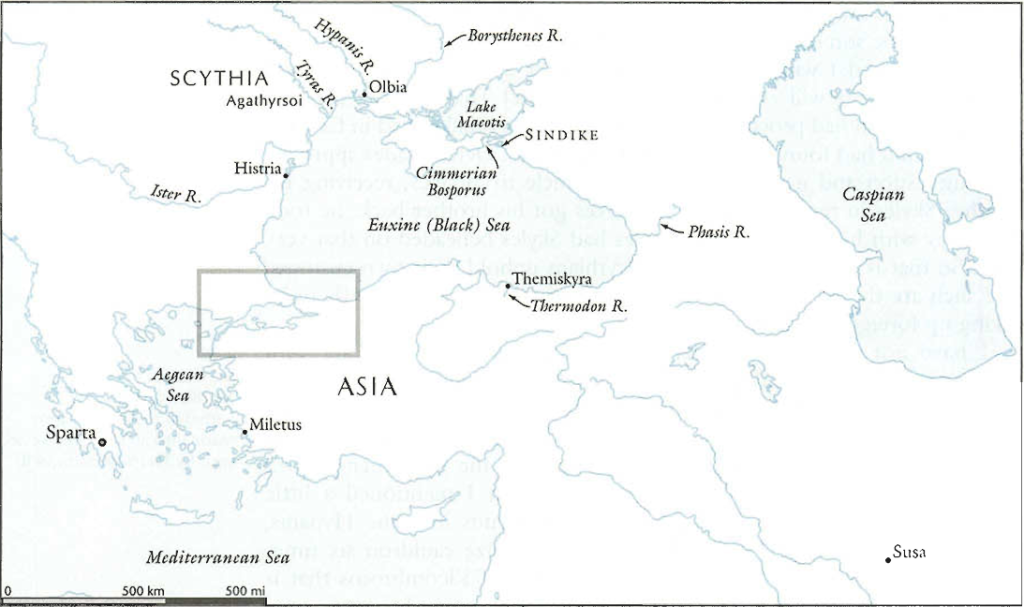


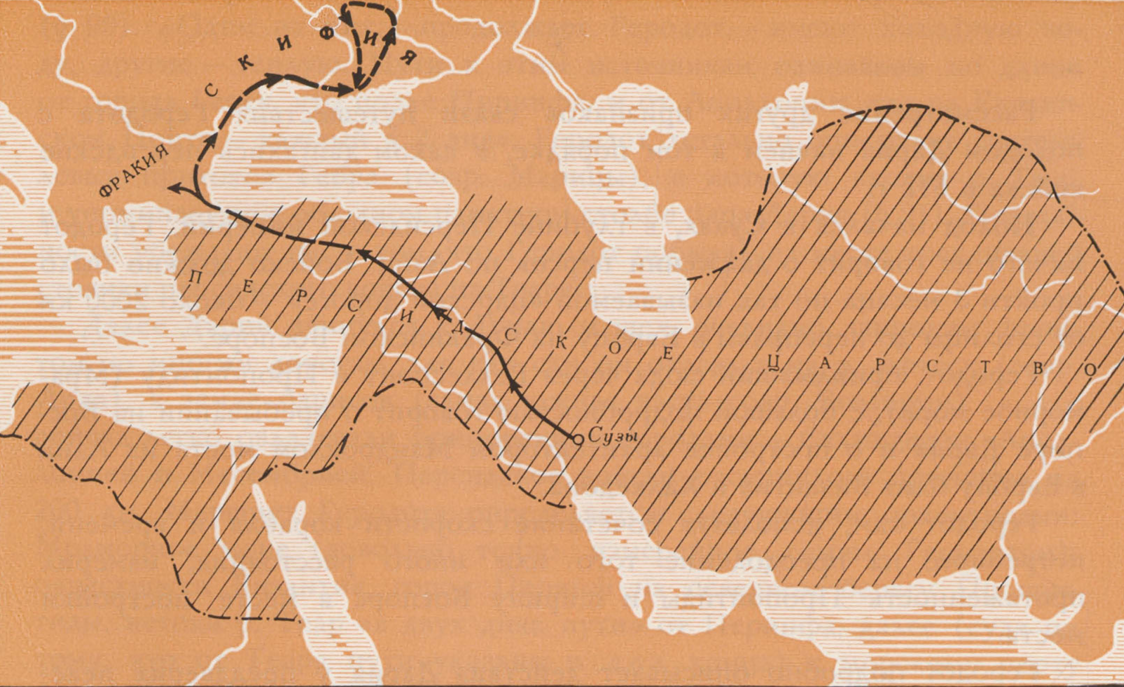
“The campaign began in Susa, deep in the Persian Empire. Herodotus says nothing about the Persians’ movement through Asia. The army was supposed to travel for three months along the so-called “royal road”—about 2,000 km from the capital to the crossing point into Europe on the Thracian Bosporus.


Herodotus, who sailed here via the Hellespont and Propontis (Sea of Marmara), speaks in great detail about Darius’s stay on the Bosporus and the construction of a bridge from Asia to Europe by the architect Mandrocles near Byzantium and Chalcedon.
Herodotus himself, using a combination of ship speed and the time required to cover a given distance, measured the length of the Propontis and the width of the Bosporus at the site of the bridge’s construction.
Herodotus describes in detail Darius’s actions at the threshold of an unknown Europe, and when he speaks of how the king admired the view of the Black Sea, he adds that Pontus “truly could be admired” (§ 85).
Herodotus knew not only that Darius commemorated his crossing of the Bosphorus by erecting two stone pillars with Assyrian and Greek inscriptions about the multi-tribal composition of his army, but also that the inhabitants of Byzantium subsequently transported these pillars to their city and used them as an altar to Artemis Orphosia. An attentive historian even knows that one stone (the one with the Assyrian inscription) was thrown by the Byzantines near the Temple of Dionysus. He also knew the local legends about the construction of Byzantium and Chalcedon and the related assessment of the Chalcedonians (who chose the worst place for settlement) by the Persian commander Megabazus (§ 144). The sum total of the details reported leaves no doubt that Herodotus began his historical journey here, on the Bosphorus, where Darius had once crossed to the European shore.
The Persian army invaded Thrace; the king stopped at the source of the Tearus River. Herodotus, “according to the local inhabitants,” reports the healing properties of the Tearus’s sources and adds that “there are 38 sources of this river. They all flow from the same rock” (§ 90). “Some of them,” Herodotus continues, “have cold water, others warm. The routes to these springs are equal in length—from the city of Heraea, near Pyrinthus, and from Apollonia, on the Euxine [Black] Sea—each in two days.”
Herodotus describes in detail the system of the left tributaries of the Hebrus (modern Maritsa), which includes the Tearus River, and mentions another memorial pillar of King Darius (§ 91). These details convince us that Herodotus visited the site of the three-day Persian army encampment on the Tearus.
Darius then moved toward the Danube and apparently marched on a broad front along many roads, since he himself found himself on the Artescus River (modern-day Arda), in the land of the Odrysians (the southernmost part of modern-day Bulgaria), and his troops easily captured the coastal cities of Salmydes, Apollonia, and Mesembria.
The Persian army stretched for approximately 200 km. Herodotus’ route is determined by the following landmarks: the Sea of Marmara (measured quite accurately by Herodotus himself), the environs of Byzantium, the city of Perinthus on the northern shore of the Propontis, the sources of the Tearus River are “two days’ journey” from Perinthus, then (judging by the fact that from the Tearus the routes are indicated in both directions) to the seaport of Apollonia, which is also two days’ journey away. Here Herodotus’s account of Darius’s advance through Thrace ends, and the reader is immediately transported to the Ister delta, to the land of the Danubian Getae, whose customs and beliefs Herodotus speaks of in considerable detail (§§ 93–96). In addition, Herodotus determines the length of the Danube’s mouths in days’ journey, and lists the small rivers between the Prut and the Seret, as if looking at them from the east, from the sea.
It is quite possible that Herodotus traveled from Apollonia to the “neck of the Ister” by ship and therefore did not learn any details about the Persians’ land movement from the Thracian tribes of the Odrysians and Cyrmians in the south to the mouth of the Ister in the north, a distance of 350 km.
The abundance of details and precise information about the Danube Delta convinces us that Herodotus himself visited these places. This is as it should have been if the historian was writing a study about the campaign of 512 BC.
After all, the lower reaches of the Ister were an important boundary in the movement of the Persian army: here, on the Getic bank, the Thracian stage of the campaign ended, and on the left, northern bank of the Danube began that very Scythian campaign, to the description of which Herodotus devoted the main part of his fourth book.
If Herodotus was drawn to the shores of the Thracian Bosporus by the desire to describe the crossing point of the enormous seven-hundred-thousand-strong Persian army from Asia to Europe, then no less important for him was the crossing point of Europe’s greatest river.
And to his credit, he collected a great deal of very important information here, without which a scientific reconstruction of the course of the Scythian campaign of 512 would have been impossible.
Here’s a brief list of what Herodotus tells us about the lower reaches of the Ister [Danube River]:
Construction by Mandrocles of the bridge across the Ister (§ 89).
Arrival of a Greek squadron of 600 ships allied with the Persians (§ 89).
A detailed list of the Hellespontine, Ionian, and Aeolian tyrants who commanded the ships of 11 cities (§ 138).
The legend of the attempted destruction of the bridge after the Persian crossing and the wise speech of Cossus, son of Erxander, from Mytilene on the island of Lesbos (§ 97).
The legend of Darius’s counting down of 60 days for the upcoming campaign, during which the Greek guards were to guard the bridge (§ 98).
The story of the battle with the Scythians after three days’ journey from the Ister (§ 122).
The “Agathyrian Logos” is a story about the noble courage of the Agathyrsi, who defended their land from the Scythian invasion (§ 125).
The dispatch of a Scythian detachment from Meotis to the bridge on the Danube (§ 128).
Negotiations between the Scythians and the bridge guards (§ 133).
The Scythians return to the Danube bridge after 60 days (§ 136).
A meeting of the Greek commanders. Histiaeus’s dispute with Miltiades (§ 137).
The false destruction of part of Mandrocles’ bridge (§ 139).
The Scythians withdraw from the bridge (§ 140).
The fugitive Persian troops cross the Danube into Thrace (§ 141).
It must be assumed that Herodotus collected this detailed information both in Greek cities in the vicinity of the delta (Istropolis, Tresma), and from the local Getic and Agathyrian populations on both banks of the Ister (§§ 93-97, 119, 125). The two- to three-month history of the strategic Mandrocles Bridge became known to us in all its details as a result of Herodotus’s extensive efforts to collect diverse data on the events that took place near the mouth of the Danube in 512 BC.
All of this, taken together, leaves no doubt that on his way from Byzantium to Olbia, Herodotus visited the lower reaches of the Danube.
The next stopover on the way to Olbia is the mouth of the River Thera. Herodotus mentions it in passing, which leads to the indirect conclusion that the city on the Dniester estuary (Thera) played no role in the Scythian-Persian War and was of no interest to the historian, who didn’t even mention it.
Darius and his army apparently passed significantly north of the city of Tyre in order to avoid the difficult crossing of the wide estuary.
However, Herodotus’ ship, in all likelihood, did not pass this bay, since the book contains a “presence effect”: “On the bank of the river Thera they show the foot of Heracles in a rock, resembling a human footprint, but two cubits long” (§ 82).
Recounting the legend of the civil strife between the Cimmerian leaders, Herodotus speaks of the royal necropolis: “The Cimmerian people buried all the kings, who had been killed by one another, near the river Tyras; their grave is still visible to this day…” (§ 11).
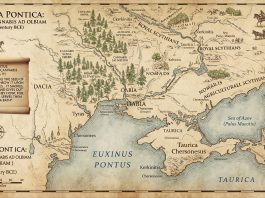
From the mouth of the Tyras, a ship could sail for a single day to Olbia, which became “the headquarters of Herodotus”, whose presence in this Borysthenites’ Marketplace raised almost no objections.” (Soviet Academician B. Rybakov in his ‘Scythia of Herodotus’ book).
The book “Royal Scythia, Greece, Kyiv Rus” has the story of the Persian King Darius the Great’s campaign into Scythia with more insights.