

“We have more compelling evidence of Herodotus’s advance east of Pontic Olbia. Herodotus begins his account of Scythia’s geography from the northwestern coast of Pontus, from the Danube Delta:


“Starting from the Ister [Danube], I will describe, for the purpose of measurement, the coastal part of the Scythian land proper” (§ 99).
In his description, Herodotus leads the reader further east to Crimea. Describing Taurica, Herodotus skips the entire northwestern lowland of the Crimean Peninsula and very accurately describes the entire southwestern coast, inhabited by the Taurians up to “Rocky Chersonesos,” and further east by the Scythians.
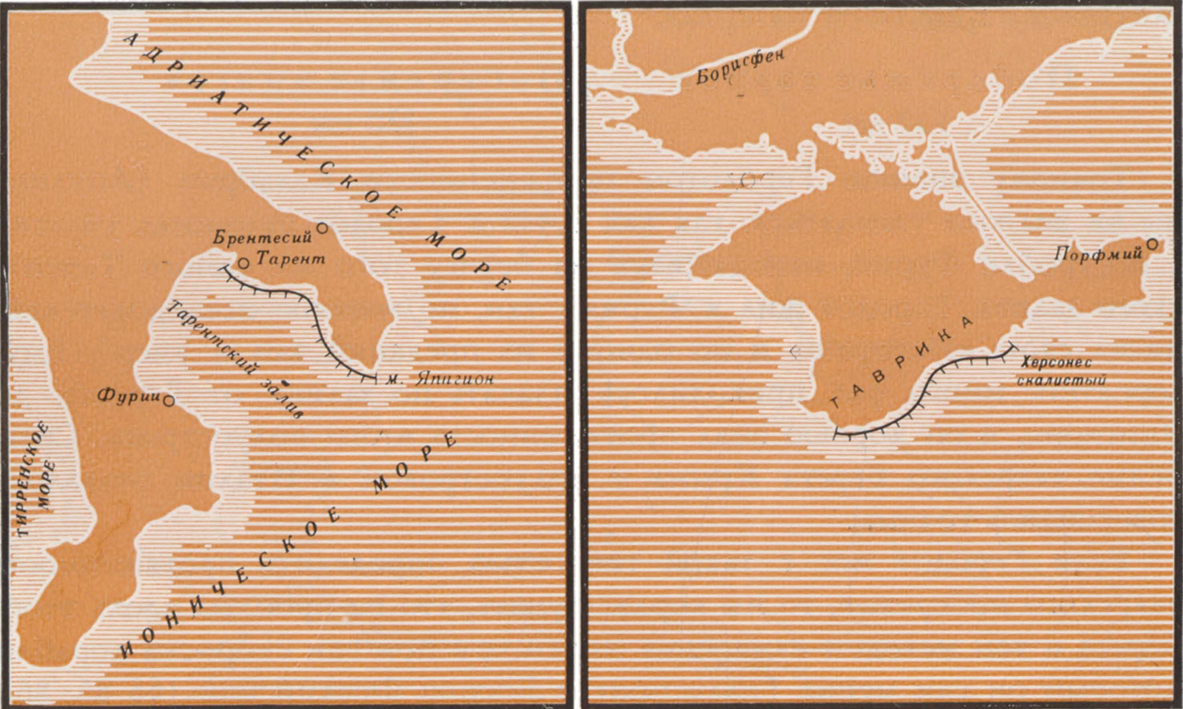
Rocky Chersonesos obviously refers to Cape Meganom, beyond Sudak (also known as Choban Basty), where the height of the rocky shores ranges from 669 to 771 m. At the same time, Herodotus provides two geographical comparisons that are most valuable to us, which have not received sufficient attention: firstly, he compares the southern mountainous spur of the Crimean Peninsula, inhabited by the Taurians, with part of Attica, and secondly, to clarify his comparisons, he draws attention to the Apulian Peninsula in Italy (the heel of the “Italian boot”).
In Attica, Herodotus identifies a small southern section of the peninsula, ending at Cape Sounion (from Anaphlystos in the west to Phoriki in the east). The coastline from any of these points to Sounion is about 10 km. Feeling that this comparison does not clearly describe Crimea, Herodotus makes the following reservation:
“I compare this as far as one can compare the small with the great” (§ 99).
The “small” here is a 10-kilometer section of Attica, and the “great” is the Crimean Mountains – the coastline from Foros in the south to Feodosia is about 130 km. Herodotus then continues with a text that leaves no doubt that he was comparing the coastlines from a navigator’s perspective:
“For those who haven’t sailed past this cape of Attica, I’ll explain with another example.”
“Another example” is intended for Herodotus’s friends living in Thurii, a newly built colony on the Tarentine Gulf:
“The Taurians inhabit this part of Scythia as if in Iapygia another tribe, not the Iapyges, had carved out for themselves the land from the harbor of Brentesium (modern Brindisi) to Tarentum and inhabited the peninsula. Besides these two countries, I could name many others to which Tauria resembles” (§ 99).
Herodotus’s second example is remarkably accurate: the coast from Tarentum to Cape Iapygion is 130 km.
Herodotus’s precise knowledge of the extent of Calabria (Apulia) should not surprise us, since in 443 Herodotus took part in the construction of Thurii, located on the shores of the same Tarentine Gulf. Herodotus lived in Thurii, where, according to scholars, he wrote his “History” and, according to one legend, died there. He had probably sailed the gulf from Tarentum to Iapygion many times, and he knew the extent of this peninsula well. The comparison of the Tauric coast of Crimea with the peninsula in Italy turned out to be completely accurate.
If Herodotus could determine the length of the Taurus coastline with such precision, then we are justified in thinking that he sailed along this coastline using the same method of measuring seas using the speed of his ship, by which he himself measured the Hellespont and the Thracian Bosporus (§§ 85, 86), and identified the space that interested him. It was not without reason that he wrote that he “would describe for the purpose of measurement.” The following text, describing the lands lying east of the Tauric Mountains, is even more convincing in its personal exploration:
“Beyond the Taurians, the Scythians again live partly further to the east on the sea coast, and partly in the west of the Cimmerian Bosporus [Kerch Strait] and Lake Meotis [Azov Sea]” (§ 100).
Let’s check our supporting materials. The landscape zone map confirms that the mountainous regions end immediately beyond Feodosia, and the feather-grass steppe extends all the way to the Kerch Strait.
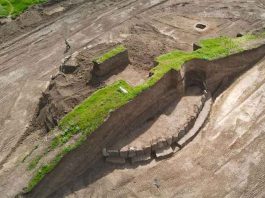
The archaeological map shows us Taurian settlements from Foros to Meganom and almost to Feodosia, and further to the east, on the steppe coast of the Kerch Peninsula, there are indeed Scythian monuments, headed by the famous Kul-Oba burial mound.
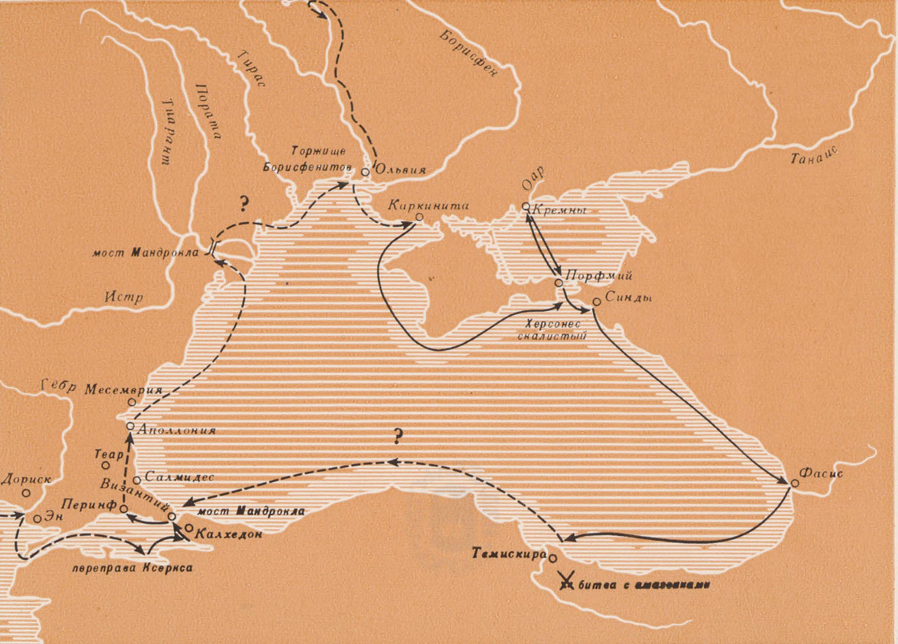
The accuracy of Herodotus’ description of the entire southeastern coast of Crimea and the Kerch Peninsula is confirmed, firstly, by the correct determination of the length of the Tauric mountain coast, similar to the Italian Iapygia, and secondly, by the completely reliable placement of the Scythian settlement both on the sea coast east of the Taurians and on the western shore of the strait. In all likelihood, Herodotus sailed from Olbia to Karkinitis, and from there to the southern end of Taurida, for example, to the Foros lighthouse (this explains the lack of attention to the northwestern coast), and then sailed along the entire southeastern coast all the way to the Cimmerian Bosporus, marking along the way “Rocky Chersonesos” as the boundary between the Taurians and the Scythians.
Having sailed past the Taurus coast and measured its length, Herodotus became acquainted with the Kerch Peninsula, sailed along the Cimmerian Bosporus, and mentioned the northernmost point on the strait— the town of Porfmium (“Crossing”), located at the entrance to the Meotian Sea.
Opposite Porfmium, on the northern, “European” bank of the Meotian, was Kremna, near which, near the Oar River, Darius Hystaspes began to build his fortified region, which he abandoned as soon as he realized the complete hopelessness of the strategic situation:
“Having arrived in the desert, Darius halted his campaign and encamped with his army near the Oara River, then erected eight large fortifications at equal distances from one another, approximately 60 stadia apart. The remains of these fortifications have survived to my time” (§124).
For the last time, we sense Herodotus’s “presence” in the places he describes. Herodotus knows the small Oar River (Korsak?), on which the Persian army built fortifications, he knows the neighboring, equally insignificant Lik River (Obitochnaya?), and he knows the desert, which actually reached right to the sea.
Herodotus knew the dimensions of the fortifications and, most importantly, noted the approximate nature of the figure he provided. 60 stadia is a significant distance (10 km 950 m), and there was no need to measure it precisely. The fortifications were unfinished:
“Darius abandoned the half-erected walls, turned back, and headed west.”
The unfinished camp was a turning point in the entire Scythian campaign; from here, the retreat to the west began, which then ended in flight.
It is quite likely that, while traveling to obtain a reliable picture of the Persian campaign of 512, the inquisitive Herodotus sailed from Olbia around Taurida [Crimea] to the Meotida [Azov Sea], to see that significant place where Darius realized his failure and began his retreat.
At the pier where Herodotus landed, there was, obviously, the only city on the Meotian that he mentioned—the emporium of Kremna (somewhere west of modern Prymors’k).” (Academician B. Rybakov, Scythia of Herodotus).
The book “Royal Scythia, Greece, Kyiv Rus” has more little-known facts about Scythia, including the details of the Kul-Oba Royal mound in Taurica mentioned in the text above.