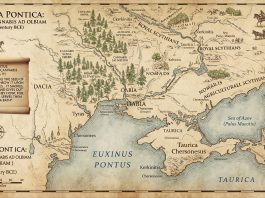


“Darius sent a horseman to Idanthyrsos king of the Scythians with this message: “You extraordinary man! Why do you keep fleeing when you certainly could do otherwise? If you think you are able to challenge my power, then stop your wandering and stand to fight it out. Or, if you acknowledge that you are too weak for that course, then you should stop running away, bring gifts of earth and water to your master; and enter into negotiations with him…”


Scythian kings became enraged when they heard the word “slavery.” They sent the division commanded by Skopasis, which included the Sauromatai, to the Ionians guarding the bridge at the Ister [Danube], with orders to parley with them. Those left behind resolved not to lead the Persians on a wander ing course any longer, but to attack them every time they ventured out to forage for provisions…
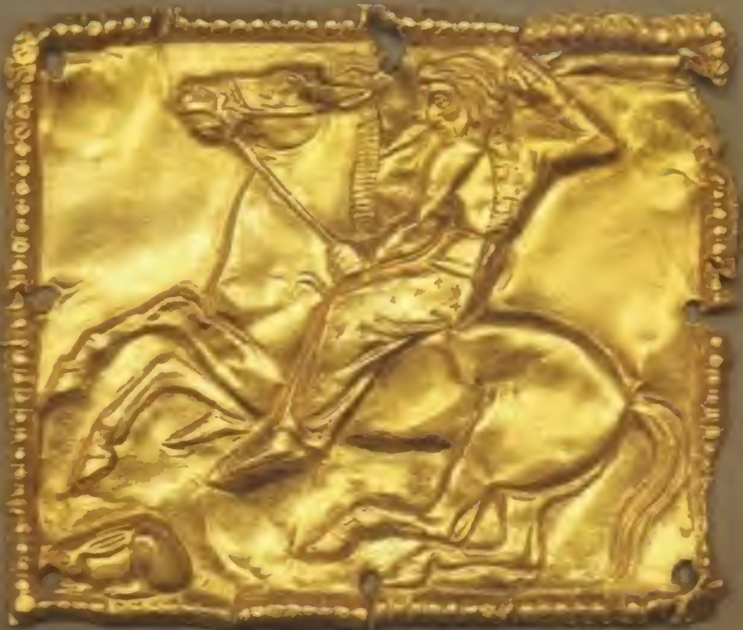
The Scythian cavalry always put to flight the Persian cavalry, and when the Persian horsemen, in their hasty retreat, would fall back on their own infantry, the infantry would come to their assistance! Once the Scythians had driven the Persian cavalry back upon their infantry, they would withdraw, since they feared the infantry. The Scythians conducted attacks like this even at night.
But I shall now describe a most amazing phenomenon that worked for the Persians whenever the Scythians attacked Darius’ army. This was the effect on the Scythian horses of the sounds made by the Persian donkeys and mules, as well as their appearance. For as I have already explained, neither donkeys nor mules breed in Scythia; there are no donkeys or mules in any part of Scythia because of the intense cold. And so when these animals let out their clamorous braying, they would throw the Scythian horses into confusion and disorder; a and often when the Scythians would be in the middle of an assault against the Persians, their horses would become agitated and turn about, pricking up their ears in astonishment when they heard the sound of the donkeys, since they had never heard such sounds nor seen such sights before. This had at least some effect on the outcome of the campaign.
… the division of the Scythians which had earlier been appointed to keep watch along the coast of Lake Maeotis’ but had then been sent to talk to the Ioni ans at the Ister,b now arrived at the bridge and addressed them. “We have come here, Ionians, bringing you the gift of freedom, if only you are willing to follow our advice. We know that Darius instructed you to guard the bridge for just sixty days, and to leave and return home if he did not show up here within that time. So now, if you will take our advice, you will escape his censure as well as ours by leaving this place as soon as you have waited this designated number of days.” The Ionians promised to do this, and the Scythians immediately left and hurried back to their land.
After the gifts had been sent to the Persians, the Scythians who had stayed behind deployed their infantry and cavalry in preparation to give battle to Darius. The Scythians were assembled in their positions when a hare darted into the space between the armies. Now every Scythian, when he saw the hare, began to chase it! Darius noticed that the Scythians were shouting and in disorder and asked what the uproar among his enemies was all about. When he learned that they were chasing a hare, he said to the men with whom he usually discussed everything,
“These men look on us with such contempt! I now believe that Gobryas’ interpretation of the gifts from the Scythians was correct. And now that I, too, finally see things his way, we must form a good plan to ensure that our return journey home will be a safe one.”
In response to this, Gobryas said, “Sire, the reputation alone of these men had led me to a nearly perfect awareness of how impossible they would be to deal with, but since I have come here myself, and have watched them mock us, I have gained an even more profound understanding of them. Here is a plan that seems best to me: as soon as night falls, let us light our campfires as usual, but then deceive those of our weakest soldiers who can least endure hardships and leave them behind. We should tie all the donkeys there with them and then immediately depart before the Scythians rush straight to the bridge and tear it down, or the Ionians decide to do something that could ruin us.” That was the advice of Gobryas…
Night fell, and Darius carried out the plan. He left in the camp the men who were worn out and whose loss would matter least, together with all the donkeys, which had been tied there with them. [2] He left the donkeys behind so that they would make noise, and the men because of their weakness, although the pretext he gave to them was that he was going to attack the Scythians with his most fit troops, and that mean while, they were to guard the camp. [3] Mter thus informing the men being left there, Darius lit the fires and hurried toward the Ister. Left without the crowd of men, the donkeys brayed much more loudly than usual; and the Scythians heard them and remained confident that the Persians were there in their usual place. When day came, the men who had been left behind realized that they had been betrayed by Darius. They stretched out their hands to the Scythi ans and told them about their predicament…
… the Persians had taken care to follow their earlier tracks, which, however, made it somewhat difficult for them to locate the bridge. When they finally arrived there after dark, they found what appeared to them to be a torn-down bridge, which made them think that the Ionians had left them in the lurch, and threw them into an utter panic. But Darius had with him a man from Egypt whose voice was louder than that of anyone else in the whole world. He now ordered this man to stand on the bank of the Ister [Danube] and to call out for Histiaios of Miletus. The man followed these orders, and Histiaios, hearing him on the first shout, sent all his ships over to ferry troops across the river and also set to work to rebuild the bridge. And so the Persians escaped, while the Scythians failed once again in their search for them.
After this, the Scythians judged the Ionians as free men to be the most worthless and cowardly of the whole human race; but as slaves, to be the most fond of servility and the least likely to flee from their masters. Such were the insults cast at the Ionians by the Scythians.” (Herodotus, Histories, Book 4. 128-142]
The “Royal Scythia, Greece, Kyiv Rus” book has more little-known facts about Scythia of that period.
The “Cradle of Civilizations” book takes a new perspective on the battle between Scythian king Atheas and Phillip II of Macedon, the father of Alexander the Great.
Why Scythians chased a hare before the battle with Darius the Great >