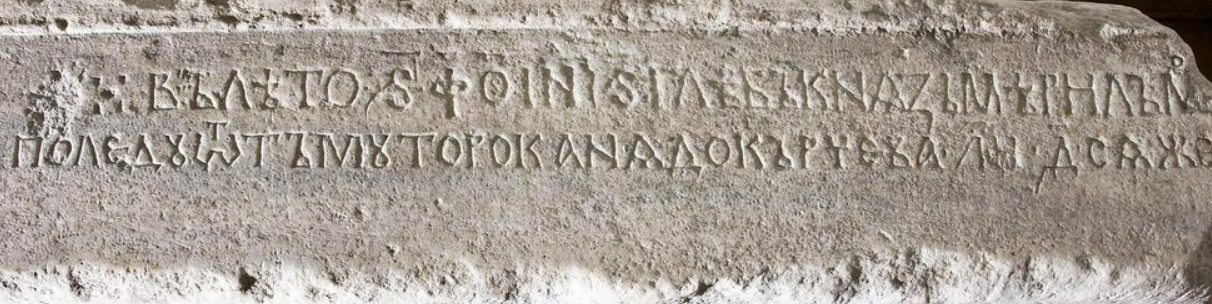
Stone of Tmutarakan was discovered on the Taman Peninsula in 1792. It was the time when the famous English traveler Edward D. Clarke was passing through the area. Dr. Clarke mentioned the finding in his bestselling book:
“Near the gate of the churchyard of Taman lies the marble slab, with the curious inscription which threw so much light upon the situation of that ancient principality of Rus, once the residence of her princes.
The words of the inscription are to the following effect: – “In the year 6576 (1065) Indict. 6, Prince Gleb measured the sea on the ice; and the distance from Tmutaracan to Kertchy was 30,054 fathoms.” Pallas relates, that the freezing of the Bosphorus, so that it may be measured on the ice, is in itself no uncommon occurrence; which, while it serves to ascertain the truth of ancient history, proves also that the degrees of heat and cold do not vary as those of latitude; both Taman and Kertchy being nearer to the equator than Venice, where the freezing of the sea would be accounted a prodigy. The cavalry of Mithridates [VI the Great] are said to have fought on the ice, in the same part of the [Cimmerian] Bosphorus where a naval engagement had taken place in the preceding summer.”
The editors of Dr. Clarke’s book made a footnote: “Dr. Lyall asserts (vol. I. p. 387) that both Pallas and Clarke have misinterpreted this celebrated Sclavonic inscription. ” The year 6576,” says he, “corresponds to A. D. 1068; and the distance of the passage between these places (Tmutarakan and Kertch) is not 30,054 fathoms, which would make 60.5 versts, but only 80.54 fathoms, which make 16 versts. This is the real distance between Kertch and Taman.”
English Wikipedia fails to mention a very important fact that Glib Svyatoslavich, the one mentioned on the stone, was a grandson of the famous Kyiv ruler Yaroslav the Wise. Glib’s father, Svyatoslav II, was Yaroslav’s youngest son.
It is important to know, because in 1036, after the death of Prince Mstislav of Chernihiv, the Tmutarakan princedom of Kyiv Rus immediately passed to Mstislav’s elder brother Yaroslav the Wise, who bequeathed it together with the Chernihiv land and “with the entire eastern region” to his fourth son, Prince Svyatoslav II. Svyatoslav, in his turn, in 1060, gave the Tmutarakan throne to his son Glib.
The inscription on Tmutarakan Stone irrefutably confirms the close connection between Kyiv Rus and modern Crimea. As a reminder, Moscow did not exist at the time.
Dr. Clarke other observation in the same area:
The book “Kyiv Rus in Heimskringla Sagas and Byzantine Texts” helps to see Kyiv Rus through the eyes of the Viking kings and Byzantine historians. The book tells why the future King of Norway, Harald Hardrada, was returning to Kyiv after his service in Constantinople’s Varangian Guard via the Kerch Strait.
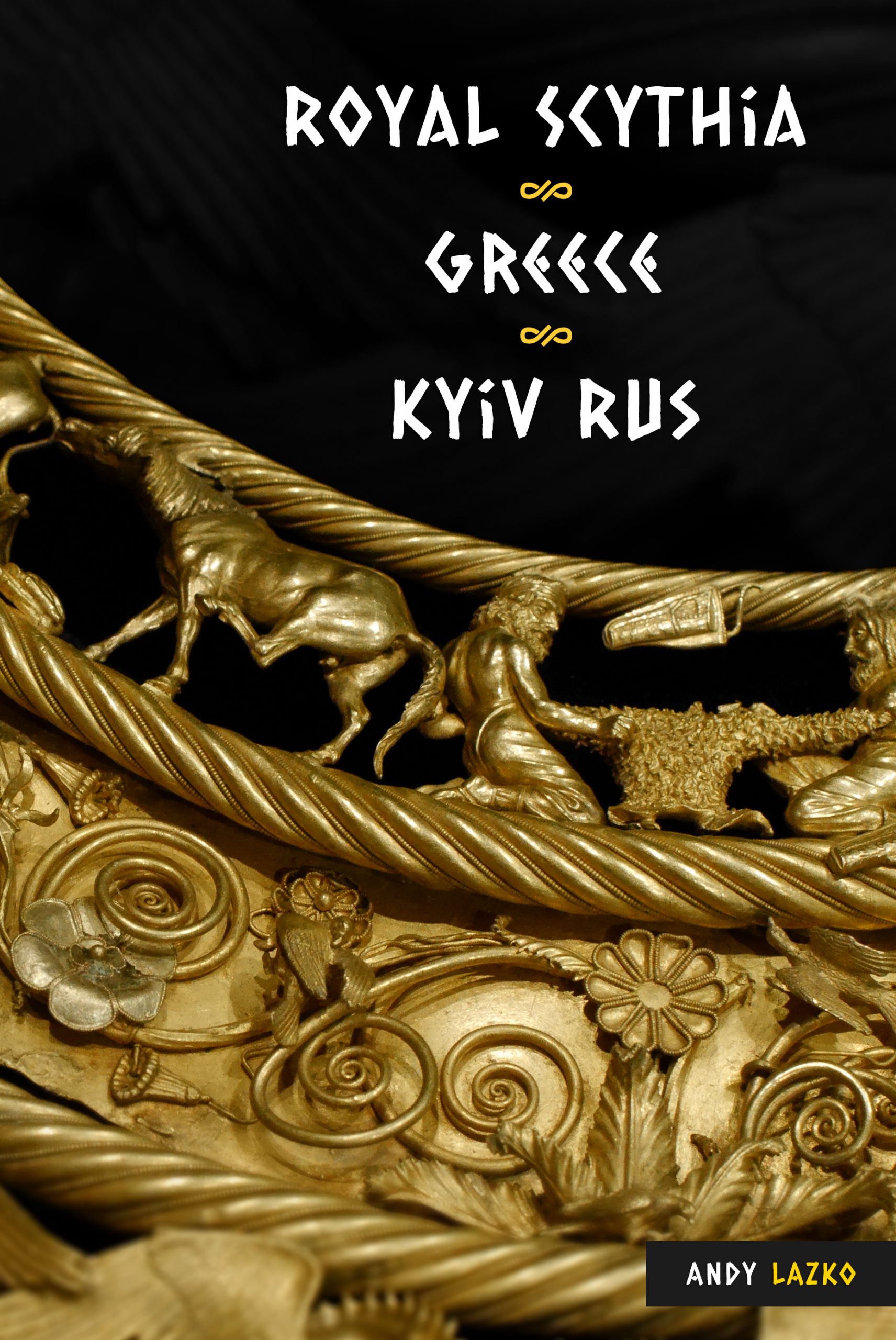
The “Royal Scythia, Greece, Kyiv Rus” book tells the story of Mithridates the Great and how the city of Eupatoria in Crimea got named after him.
< Kyiv Rus’ borders ca. 1000 AD: Largest Kingdom in Christendom >