Academician Borys Rybakov (1908-2001) was a Soviet and Russian archeologist and historian who held a Chair in Russian history at Moscow University since 1939, was a deputy dean of the university in 1952–54, and administered the Russian History Institute for more than 40 years. In 1954, Rybakov and Andrey Kursanov represented the Soviet Academy of Sciences at the Columbia University Bicentennial in New York City.
[The author of this article specifically chose a Russian historian to avoid any possible suspicion of ‘Ukrainian bias’.]
B. Rybakov, in his 1982 book ‘Kyiv Rus and Rus’ Principalities’, observed:
“… In historic sources, an incomparably narrower definition of Rus‘ is found: the Kyiv land, the Middle Dnieper region. A detailed analysis of selected chronicle data was conducted by M. N. Tikhomirov. But the conclusions of M. N. Tikhomirov and his predecessors were challenged by D. S. Likhachev in his commentary on the Tale of Bygone Years. D. Likhachev writes extremely unconvincingly that “the most ancient, fundamental meaning of ‘Rus’ is the general meaning, addressed to all Rus’ lands and to the entire Rus’ people as a whole.”
This view is completely devoid of a historical approach to the question of the formation of a nationality.
A serious study devoted to this issue is the book by A. N. Nasonov. The author very interestingly and thoroughly examines the question of Rus’ in the narrow sense of the word…
Sources from the 12th century (for example, the Tale of Bygone Years), which retrospectively illuminate the events of the 10th century, give us the history of the entire Rus’ land and therefore use the corresponding general term. The chronicles of the 12th century are full of geographical definitions for individual private events that took place in various corners of Rus’, and if among these definitions we come across “Krivichi,” “Rus‘,” “Radimichi,” we should regard them not as innovations of the 12th century, but as deep antiquity, which survived into the 12th century thanks to a tradition that proved stronger than actual geographical innovations—the changing outlines of feudal principalities…
…The region of the ancient Rus people of the 9th-13th centuries can be reconstructed from a number of diverse sources, both written and archaeological, although the chroniclers of the 12th century did not leave us a systematic description of its borders.
…To determine the boundaries of the Rus’ land in the narrow sense… we use, firstly, the method of exclusion…
Not Part of Rus
Regions and cities that were NOT included in the concept of “Rus” in the narrow sense:
Novgorod the Great. Trips from Novgorod to Kyiv, Chernihiv, and Pereyaslavl were always considered by the Novgorod chronicler to be trips to Rus‘.
Vladimir-on-Klyazma, Rostov, Suzdal, Ryazan. The cities of the Vladimir-Suzdal and Ryazan principalities were excluded from the concept of Rus’ in the narrow sense. [That is the area where future Moskva/Moscow would appear].
Smolensk. Izyaslav Mstislavich of Kyiv and his brother Rostislav Mstislavich of Smolensk exchange gifts in Smolensk: “Izyaslav and gifts to Rostislav from the Rus’ land and from all the royal lands, and Rostislav and gifts to Izyaslav from the upper lands and from the Varangians…” “…Rostislav came to him with all the Rus’ and Smolensk regiments…”
Polotsk [in Belarus]. Mstislav Vladimirovich of Kyiv exiled two Polotsk princes to Constantinople for “not obeying his will and not listening to him when he called for help in the Rus’ land.”
Was the Rus a Tribe?
… The list of tribes that took part in Igor’s campaign against Byzantium in 944 is particularly interesting.
“Igor, having united many tribes: the Varangians, the Rus, the Polyans, the Slovenes, the Krivichi, the Tivertsi, and the Pechenegs…”
True Core Rus
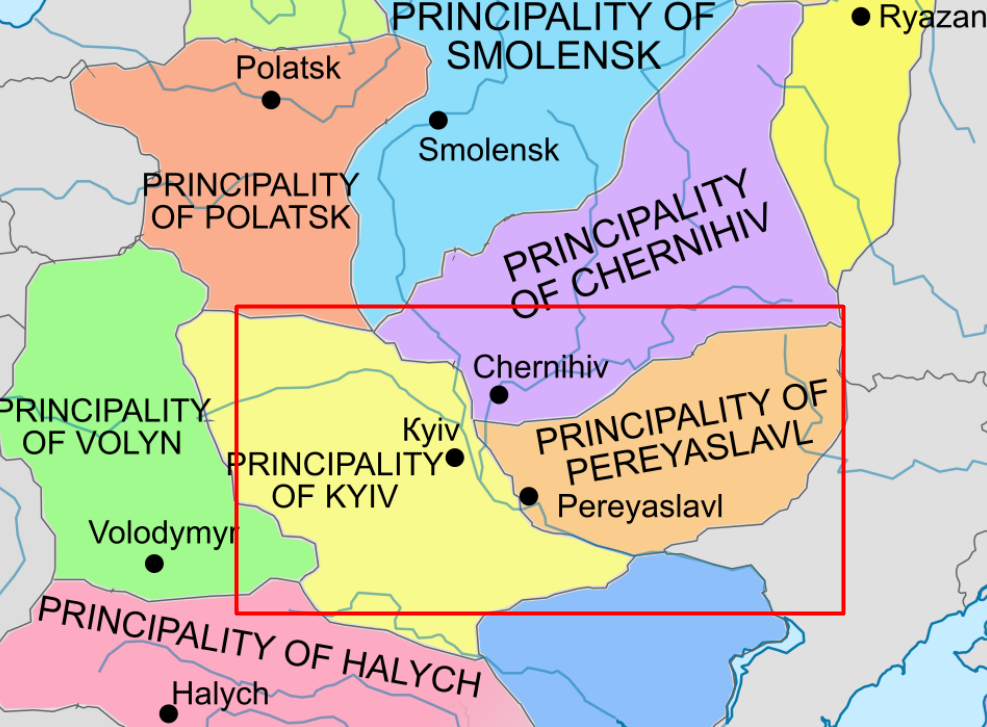
Thus, for Rus’ there remains the Middle Dnieper region with Kyiv, Chernihiv, Pereyaslavl, and the Siversk land, which has never been opposed to Rus’.
Let us now turn to the second half of the question raised, to a feasible definition of those regions and cities that were included in the limited understanding of the geographical definition of Rus’ in the 10th – 12th centuries.
The oldest Rus’ document, an excerpt from Oleg’s treaty with the Greeks in 907, defines the main cities of Rus’ as follows: “Let the coming Rus’ stay at the Monastery of Saint Mamas, and let our kingdom be established and let their names be written down, and then let us take our month: first from the city of Kyiv, and again from Chernihiv and Pereyaslavl, and other cities.
The affiliation of each of these three cities with the main, central core of the Rus’ land is repeatedly confirmed by the chronicles. Regarding Kyiv and the Kyiv region, we have ample information; the princes often said, “Go to the Rus’ land, Kyiv.”
The attribution of Pereyaslavl to Rus’ has been confirmed many times: in 1132, “Vsevolod went to Pereyaslavl in Rus’…” In the chronicle of Suzdal, preserved for us by the Laurentian Chronicle, southern Pereyaslavl is called as belonging to Rus’ eight times…
Chernihiv’s belonging to Rus’ proper is also confirmed by chronicles for the 12th and 13th centuries.
True Origin of Rus
The problem of the origin of Rus’ can currently be resolved, based on the entire set of sources, as follows.
The core of the Rus’ land was the Middle Dnieper region, from the Ros’ [River] basin to the Tyasmin [River] on the right bank of the Dnieper, and part of the Left Bank, including Pereyaslavl and the lower reaches of the Sula, Pela, and Vorskla rivers. This relatively small region (approximately 180 km along the Dnieper and 400 km latitudinally) was located on the southern edge of the fertile forest-steppe.
It was here, in the time of Herodotus and somewhat later, that the agricultural “kingdoms” of the Scythians (Scythian plowmen), who were Slavs or, more accurately, Proto-Slavs, existed. In the 2nd to 4th centuries AD, this region was the core of the Slavic forest-steppe part of the Chernyakhiv culture.” (B. Rybakov)
The book “Kyiv Rus in Haimskringla Sagas and Byzantine Texts” has more material and little-known facts about the origin of the Rus realm.
The ebook “Gardariki, Ukraine” is devoted to the same topic.
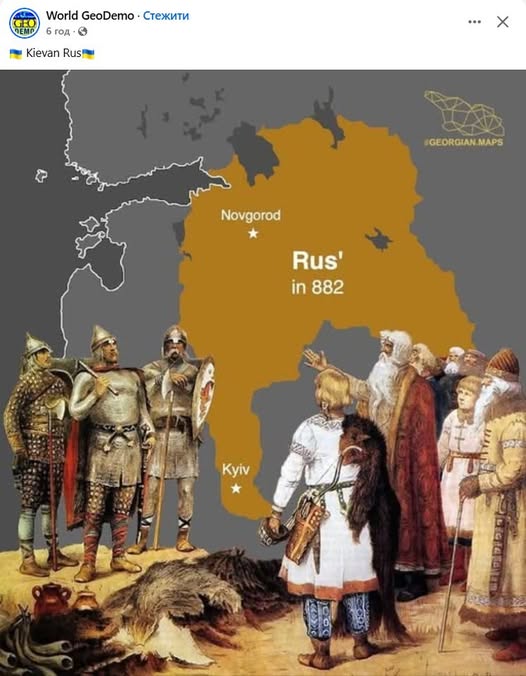
The books will help debunk the lies current Moscow propaganda machine is producing. Like the pseudo-map below:
Moscow’s theft of Kyiv’s legacy is the major reason for the current war. Ukraine’s Total Recall >