M. P. Kuchera (1922-1999) was a Ukrainian archaeologist of Czech origin, Doctor of Historical Sciences, Laureate of the State Prize of Ukraine, and Leading Researcher at the Institute of Archaeology of the National Academy of Sciences of Ukraine. He specialized in the field of research of ancient Rus settlements, defensive structures, fortifications, and military affairs of Kyiv Rus. In his scientific article ‘Pereyaslavl Princedom’, the scholar wrote:

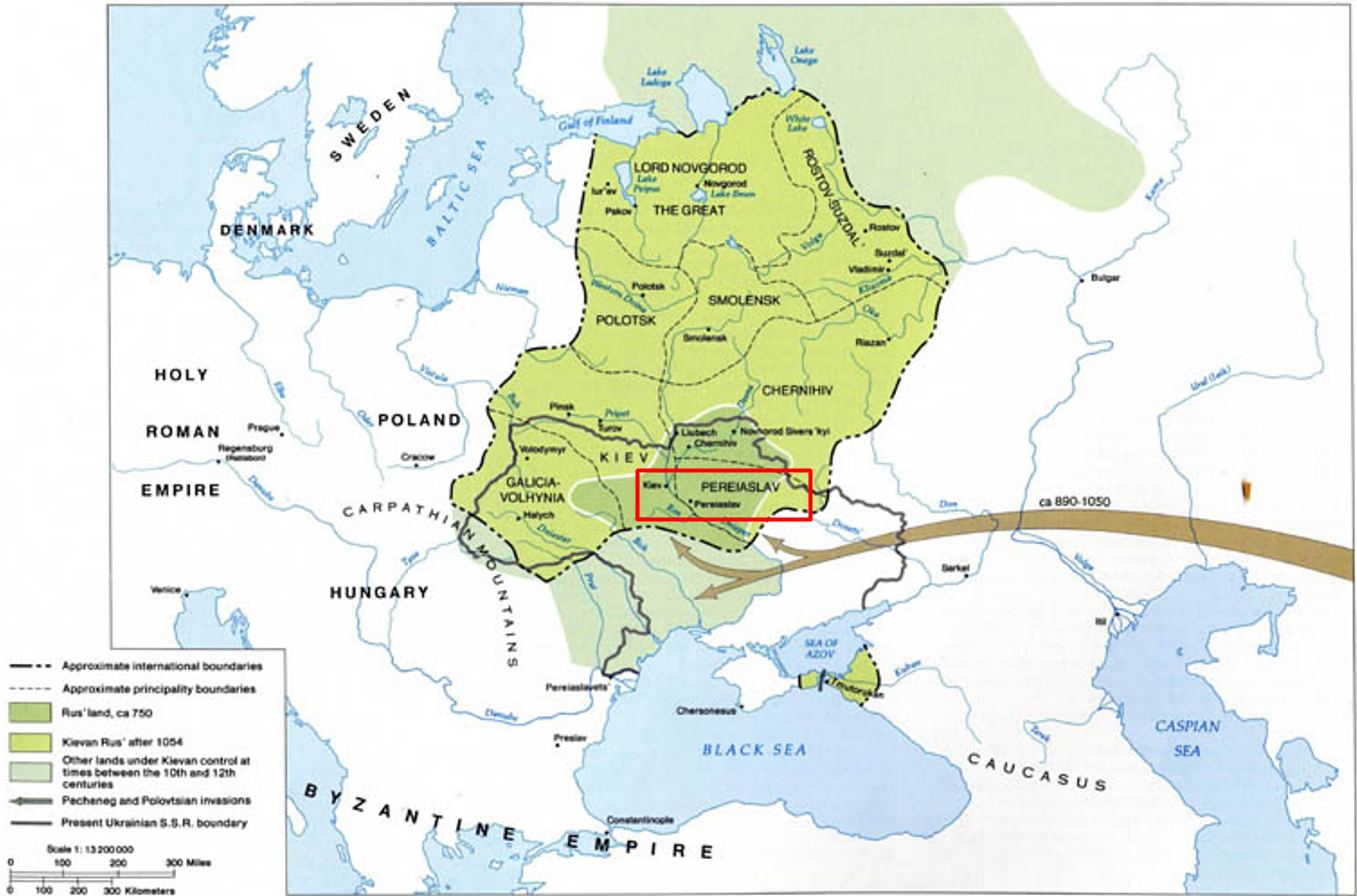
“The activities of Volodymyr Svyatoslavich [Volodymyr the Great of Kyiv] played an exceptionally important role in strengthening Kyiv’s dominance over the left bank, where Pereyaslavl was situated. Under the year 988, the chronicle notes the construction of fortresses undertaken by him: “Then Volodymyr reflected that it was not good that there were so few towns around Kyiv, so he founded forts on the Desna, the Oster, the Trubezh, the Sula, and the Stugna [rivers]…”
The construction of cities, carried out primarily in the Pereyaslav region, was aimed at strengthening the southeastern borders of Rus’, which by that time had already been disturbed by the Pechenegs.
At the same time, a powerful barrier was being created to protect Kyiv itself, especially from the east. As a result, the Pereyaslav lands became covered with a network of fortified towns, firmly linking them to the capital of Rus’, Kyiv…”
In his other works, M. Kuchera added more insights:
“Under Volodymir Svyatoslavich [the Great], the left-bank part of the ‘Rus Land’ was administratively one with the right-bank part. While Volodymir’s sons were [rulers] in other lands, the Chernihiv-Pereyaslav Left-Bank region, together with the Kyiv Right-Bank region, were under the direct control of the Grand Duke.
After the division of the ‘Rus Land’ along the Dnieper between Yaroslav [the Wise] and Mstislav [of Chernihiv] in 1024, the left-bank part remained the only one. After the death of Mstislav in 1036, this part again passed into the control of Yaroslav. The division of the Left Bank of the Middle Dnieper was carried out in 1054 according to Yaroslav’s will, when Chernihiv was given to his son Svyatoslav, and Pereyaslav to his second son Vsevolod…
Among the left-bank cities, Pereyaslav played a leading role in the fight against nomadic invasions, and this was an important reason for the formation of the Pereyaslav principality. The northern fortified points of the Pereyaslav region were the chronicled Ostersky Gorodets on the Desna River at the mouth of the Ostra and Romny on the Sula…
By the end of the 10th century, the Pechenegs posed a serious threat to the ‘Rus land’. In 968, they besieged Kyiv; in 972, they killed Prince Svyatoslav [the Brave] at the Dnieper rapids, in 980 they fought against Volodymyr [the Great], in 992 they invaded the Left Bank from the Sula River, reaching Trubizh, in 996 they approached Vasilevo, in 997 they besieged Belgorod [now Belogorodka near Kyiv].”
The Pechenegs managed to get to Kyiv in 1036. They even broke through the city walls, but were utterly crushed by Yaroslav the Wise. After that defeat near Kyiv, the Pecheneg Horde moved towards the Danube, crossed the river, and disappeared from the Pontic steppes.
“Kyiv Rus in Heimskringla Sagas and Byzantine Texts’ book takes a closer view at the events of that period.