Ptolemy, the famed Greco-Roman mathematician, astronomer, astrologer, geographer, and music theorist, in his second most well-known work, Geography (Book 3.5), provides coordinates of the Tanais River:

Soviet Academician B. Rybakov, in his 1971 book ‘Scythia of Herodotus’, observed:
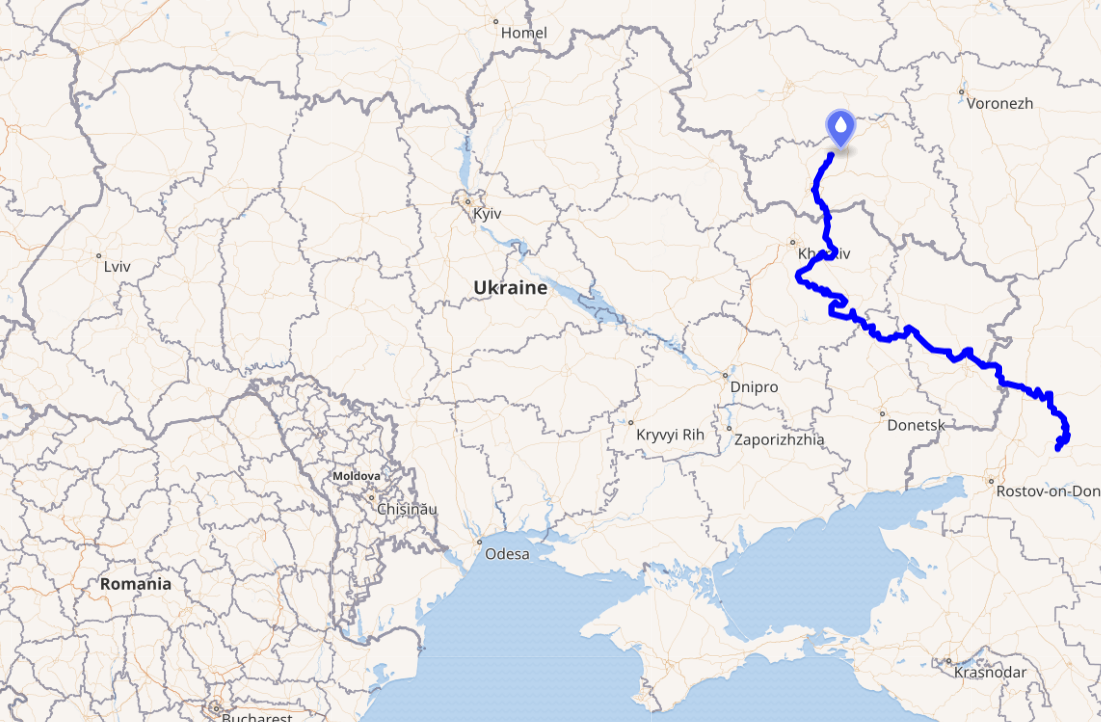
“Translating Ptolemy’s data onto a modern geographical map, we are surprised to learn that the author gave us the coordinates not of the Don as we understand it, but of the Seversky Donets [River] plus the lower section of the Don leading to the sea…
The sources of the Seversky Donets near Belgorod correspond exactly to the Kerch-Panticapaeum meridian, which coincides with Ptolemy’s coordinates. The sources of the Don, as we understand it, are located 160–170 km to the east.
The distance from the sources of the Tanais to the coast of Meotis, according to Ptolemy, is 484 km (5°15′), and on the modern map from the sources of the [Siversky] Donets to the sea along the same meridian it is 470 km.
If we take the Don in the modern sense, then this distance (along the meridian 2° to the east) will be equal to 780 km.
Consequently, according to Ptolemy’s coordinates, in his time Tanais was not the name of the Don, but of the Seversky Donets, which extended along the lower reaches of our Don to the sea itself…
According to Herodotus, a distance of 14 days’ journey should separate the eastern edge of Scythia (at the Tanais) from one of the tributaries of the Borysthenes [Dnieper River]. Counting from the bend of the Don shows that in 14 days, it is impossible to reach any of the rivers of the Dnieper basin; the count from the Donets most accurately determines the wooded banks of the Vorskla-Pantikapa [River]…
It is precisely beyond it, beyond the Donets, that the real archaeological traces of the Sauromatians of Herodotus’ time begin…
“beyond the Tanais River there is no longer Scythia; but the first landholdings there belong to the Sauromatians” (§ 21)…
The Tanais, the river dividing Scythia and Sauromatia, separating Europe from Asia, based on a stable, thousand-year-old tradition, should be called the Seversky Donets plus the lower reaches of the Don (from the mouth of the Donets to the sea)…
The identification of the Tanais with the Don, traditionally accepted in scholarship, would not allow Darius’s campaign to fit within the timeframe indicated by Herodotus. But the establishment of other ideas about Tanais (the Seversky Donets plus the lower reaches of the Don), ideas that existed until the 12th century AD, allowed us to resolve the issue of the Persian cavalry reaching the Sauromatian lands without any stretch of the imagination, “crossing the Tanais.” Tanais-Donets was only one week’s cavalry march away from Darius’s fortifications.”
The material above shows that the facts in the book “Royal Scythia, Greece, Kyiv Rus” were correct. The book also has the story of the Persian King Darius the Great’s campaign into Scythia.
Academician Rybakov’s another important statement, – “in Kyiv Rus, the Seversky Donets continued to be called the ‘Great Don’. It was only in the 14th century that the modern understanding of the Don was established”, – helps better understand the reason behind the famed Igor’s Campaign of Kyiv Rus’ realm:
Kyiv’s Historic Lands as of 1185: Donets River in the Tale of Igor’s Campaign poem >