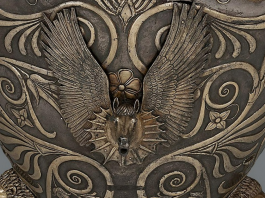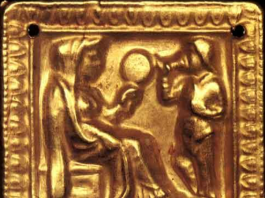


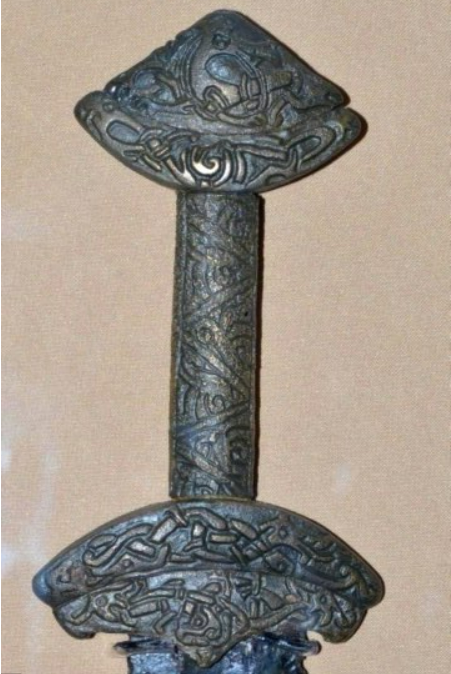
“We have irrefutable evidence that at least the sword hilts were made in [Kyiv] Rus cities. Regarding the peculiar hilts of the swords from the Black Barrow (second half of the 10th century), even such an ardent Normanist as T. Arne [Dr. Ture Johnsson Arne (1879–1965), Swedish archaeologist], wrote that “they are not of Scandinavian manufacture, but are only made according to Scandinavian models.”


I must note that the changes introduced by the Chernihiv master into the Western European model were very significant and were not an imitation, but a serious reworking of it.
Western swords of the 9th-11th centuries have a handle limited on both sides by parallel lines of the pommel and crossguard, which somewhat restricts maneuvering the heavy sword, since the hand is clamped between two planes. This was especially true when cutting from horseback. My experiments using swords from the 9th-11th centuries showed that it was impossible to cut with them using the same techniques as a modern cavalry saber. Later, during the era of the Crusades (perhaps under the influence of contact with the Saracen cavalry?), the following changes in the design of the handle occur: the lower ends of the pommel rise upward, and the crosspiece descends downward. This creates a significant reserve of free space for turning the hand when chopping, since the lines of the crossbar and the pommel are no longer parallel, but represent two arcs.
If in Western Europe this evolution took place in the 12th-13th centuries, then it is especially interesting that in [Kyiv] Rus cities it began two centuries earlier. It is quite possible that this was due to the earlier contact between the Rus cavalry squad and the cavalry of the steppe nomads, which required the development of the cutting capabilities of the sword.
The distinctive hilt of the sword from the Black Grave (decorated with a silver plate with an oriental design) is not unique in Rus’ antiquities. A sword with an arched crossguard and cut-off corners of the pommel was found in Novgorod burial mounds and in Kyiv.

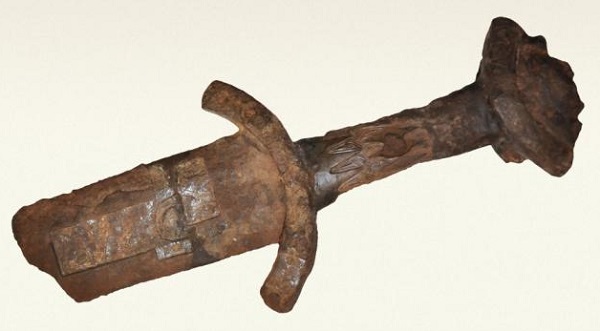
In 1900, near the Golden Gate in Kyiv, a curious burial was discovered of a mounted warrior with a sword, a battle axe, and a dagger with a handle decorated with carved flowers.
The warrior wore a magnificent suit of armor with silver plaques. A glass dice and a checker were also found. The overall appearance of the burial is similar to other princely-squad burial mounds in Kyiv and Chernihiv; the burial can be dated to the early 11th century.
Of particular interest is the sword, which has been preserved entirely except for the tip. The hilt is covered with a chased silver band riveted with silver studs. The embossed and engraved pattern features an interweaving of lush, rich, stylized plants, intertwined with knots. A completely similar pattern is found on the second bull horn from the Black Barrow. Not only is the nature of the pattern on both pieces the same, but also the technique of execution: the design was outlined with a double contour, and the interior was shaded and covered with gilding.

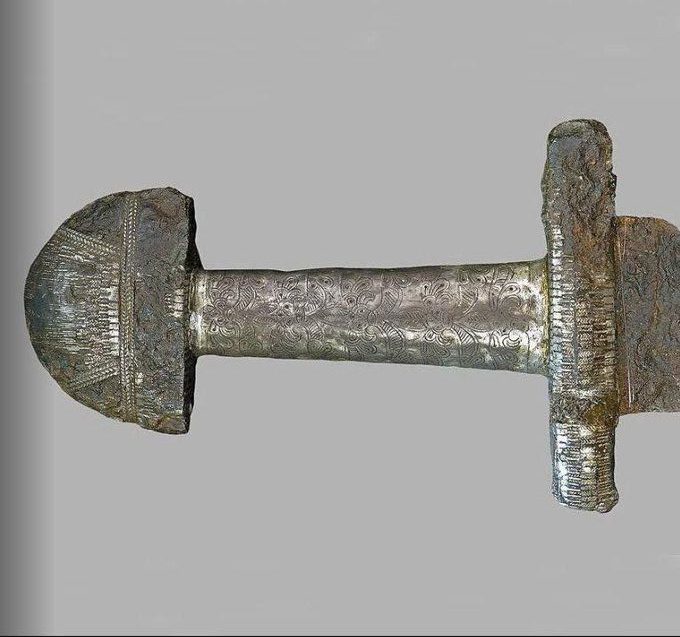
In both cases, we are dealing with the work of [Kyiv] Rus artisans, who worked with Eastern motifs. The sword also differs from Western European designs in the ornamentation of the hemispherical pommel and the crosspiece.
Log Tomb at Golden Gate in Kyiv
The good state of preservation of the items and the depth of their burial indicate that they were buried in a log tomb of the Shestovitsa type.
The terminus ante quem [latest possible date an artifact or layer must have been deposited] is established by the time of construction of Yaroslav’s city, i.e., the second quarter of the 11th century, since after this time the construction of a mound within the city limits was unlikely.” (Academician B. Rybakov)
Read about B. Rybakov and his other conclusions:
Chainmail Armor of Kyiv Rus: Ahead of Western Europe and Vikings by centuries >
The book “Kyiv Rus in Heimskringla Sagas and Byzantine Texts” shows how contemporary Byzantine historians and Scandinavians saw the realm.