

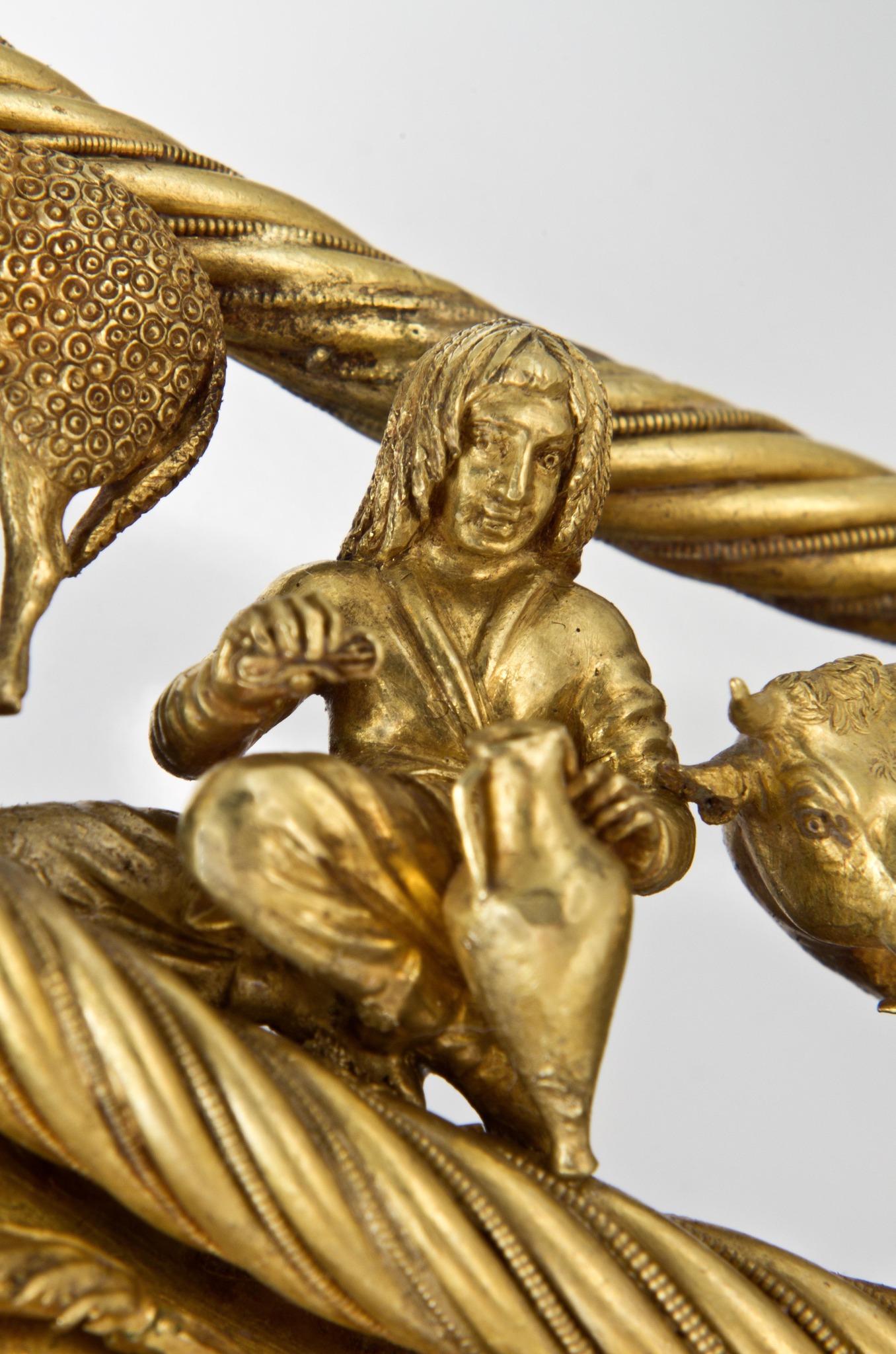

During the 1855 excavations of the Central Tomb of Alexandropol Kurgan, the archaeologists discovered a niche in the western wall that was filled with a thick layer of amphora fragments.


Based on the niche’s dimensions and the amount of sherds, it was calculated that the niche contained up to 30 wine amphoras.
Thus, the amphora niche of the Central Tomb of the Alexandropol burial mound could have contained the largest set of amphoras in terms of quantity among the Scythian burial mounds of the whole Northern Black Sea region.
Chertomlyk Royal Scythian kurgan with 25 amphoras would be the second. Its excavations were discussed in a recent video on this channel.
Six more amphoras were found in the North-Eastern chamber of Alexandropol kurgan.
During the new excavations from 2004 to 2009, the Ukrainian-American expedition discovered the fully preserved remains of a colossal Scythian near-kurgan feast.
The area of this tremendous funeral feast was covered with the fragments of no less than 457 Greek amphoras of 14 different types that were made in 13 different centres of production.
After years of analyzing the sherds and solving the puzzle of how to put them together, the scholars even managed to assemble some of the amphoras.
To appreciate the difficulty of the task, it would suffice to say that the pieces of one amphora were found at a distance of 80 meters from each other.
The scholars established that the most common amphoras were the pithoid series of Heraclea Pontica, totalling 90 vessels and constituting almost 19% of the total number.
Heraclea Pontica was an ancient city on the south-western shore of the Black Sea, not far away from the Bosporus Strait.
Heraclean biconical amphorae counted 46 examples or almost 10%. Fragments of these amphoras were found in the central and northeastern tombs of the kurgan, but mainly in the near-kurgan feast.
2 complete amphoras of this type were found in the North-Eastern lateral tomb in 1856.
29 amphoras and fragments bore the stamp AFΟGΟ.
And since all such stamps on the amphoras of the Alexandropol burial mound are applied with one very expressive stamp, recognizable by its font, the scholars called the stamp Alexandropolian.
These amphoras played a critical role in establishing the chronology of the Alexandropol kurgan, as these particular types do not date later than the third quarter of the 4th century BC.
Although their Heraclean origin was unmistakable because of their fabric, the types of 43 amphoras or 9% of the total could not be determined due to the lack of distinctive profiled parts.
But their quantitative distribution between the pythoid and biconical forms was most likely the same as that of the amphoras of the established form, in a ratio of approximately 2 to 1.
It means that 29 can be added to the 90 amphoras of the Heraclean pithoid series, and 14 can be added to 46 of the Heraclean biconical ones.
Heraclean Circle
Highly unexpected for archaeologists was the discovery at the Alexandropolis funeral feast of a previously unknown series of orange-colored amphoras, with superb external workmanship, morphologically similar to the Heraclean pythoid amphorae.
The “orange series” of the Heraclean circle at the Alexandropolis funeral feast comprises 24 amphorae representing 5% of the total.
These amphoras differ from the Heraclean ones in their unusual bright orange coloring of the outer and inner surfaces, the fabric being yellow or orange at the fracture, but completely lacking the pyroxene that is required for Heraclean amphoras.
One of the unusual and characteristic features of this group is the presence of two finger impressions at the lower attachment points of the handles to the bodies of the amphoras.
The very unusual overall coloring, the color of the fabric, its preparation, the absence of pyroxene, and the absence of Heraclean stamps on them likely indicate their production in a different center.
No less unique among those found at the Alexandropol funeral feast is the second series of amphorae from the Heraclea circle, made of gray-brown fabric mixed with a large amount of sand, individual large particles of crushed quartzite, and isolated grains of pyroxene.
The brown series consisted of 22 vessels, accounting for 4.6% of the total.
All the amphoras of the “brown series” of the Heraclea circle have one feature in common: at the base of the handles, there are large, deep oval finger impressions so unique that there is no doubt that they were made by the finger of one person.
This in turn suggests that the entire “brown series” of the Heraclea circle constituted one batch of amphoras from one run of production.
Ikos
In the Central tomb of the Alexandropol burial mound and in the funeral feast, were found the red-clay amphoras of Ikos, which constitute a series of 46 specimens or 9.6% of the total number.
Ikos was the name of a Greek island in the Aegean Sea, currently called Alonnisos.
The process of localizing these amphoras was very long and controversial.
It was only after the extensive research of amphora workshops on Ikos that it became possible to reliably link these amphoras with the production on that island in the 4th century BC.
The brown-clay amphorae of the Ikos-2 type are represented in the Alexandropol feast by 52 vessels, which constitute 10.9%.
A certain similarity between the separate elements of the series gave it its name, the brown clay series Ikos-2 type, although no relation to that island has been confirmed, and no such wares have been discovered anywhere on Ikos itself.
Their dating is determined by the general chronological context of the Alexandropol feast, namely, to the third quarter of the 4th century BC.
Tauric Chersonesus
The Tauric Chersonesus amphoras from the Alexandropol feast comprised a separate representative group of 47 vessels or 9.8% of the total, and are associated with five relief marks on the handles.
In determining the affiliation and type of this group of amphoras, the scholars encountered a huge difficulty, since they encountered a virtually previously unknown type of Chersonesos amphoras.
For the first time, the authentic form of this type of Chersonesus vessel was demonstrated by a recent find in Zaporizhzhia, where a complete amphora of the exact type with the stamp of the astynomus of Damocles was lifted from the Dnieper River.
Five stamps were located on the handles of both series of Chersonesos amphoras from the Alexandropol funeral feast.
Thasos
The Thasos amphorae in the Alexandropol feast were represented by 20 vessels or 4.2% of the total.
Thasos is the northernmost major Greek island in the Aegean Sea. Its chief product was a famous wine, so the state kept close control of production and sale. Standard measures have been found on the island, and systematic stamping of the containers began very early.
Although the practice of amphora stamping was introduced in Herakleia Pontika earlier than on Thasos, early Herakleian stamps were those of the manufacturers, whereas Thasos introduced magistrates’ stamping right away in the 390s bc.
The Thasos wine law is one of the earliest known legal texts regulating the wine trade in the ancient Greek world. It dated to the early 5th century B.C and was carved into a marble slab.
The most famous ancient Greek painter, Polygnotus, was born on Thasos in the 5th century BC.
There is only one almost completely assembled Thasian amphora from the Alexandropol funeral feast. It is about 72 cm high, has a conical body with a maximum diameter of about 35 cm.
All established diameters of the body of the Thasian amphoras from the Alexandropol funeral feast are 32–35 cm, which exceed the diameters of the classic biconical Thasian amphorae whose diameters range between 23 and 30.5 cm.
They correspond to the amphoras of the Topraisara series whose diameters range from 28.6 to 39.2 cm. Four identical stamps are associated with the main series of Thasian amphorae from the Alexandropol funeral feast.
Murighiol
The so-called Murighiol-type amphoras were manufactured at an unidentified workshop, most likely on the Thracian coast or the western coast of the Black Sea, mimicking the highly successful biconical shapes of Thasos.
They are named after the ancient fortress of Murighiol in the Danube River delta, where this particular style of pottery was first discovered, recognised, and formally cataloged by modern archaeologists.
Murighiol-type amphorae were found in the Central Tomb and the funeral feast of the Alexandropol Kurgan.
They are represented by 37 specimens, accounting for 7.7% of the total, and are characterized by their miniature size.
All the amphoras were remarkably thin-walled, and none of the Murighiol-type amphoras from the Alexandropol kurgan could be glued together.
Sinope
Amphoras from Sinope are represented by nine vessels at the feast, constituting 1.9%. They are associated with one mark on the handle belonging to the magistrate Mnesy.
The dating of this particular Sinope mark to around 340 BC became the most reliable among all other marks in the Alexandropol feast.
It points to the dating of the Alexandropol kurgan, including all of its tombs and feast, to within the decade of 340–330 BC.
Solokha
The Solokha I type amphorae with massive, well-developed mushroom ends are represented by only two amphorae as well (0.4%). Amphoras of this shape were produced in numerous Mediterranean centres.
The main period of such amphorae is limited to the second and third quarters of the 4th century BC.
Northern Mediterranean
The amphorae from an unknown centre in the northern Mediterranean are represented in the Alexandropol feast by 25 vessels or 5.2% of the total. Judging by the context, they must date to the third quarter of the 4th century BC.
Unidentified
Only 3 vessels from the Alexandropol funeral feast, or 0.6% of the total number, remained unidentified due to the absence of characteristic profiled parts of the vessels, their very unusual coloring, and fabric composition.
Mende
Scholars were surprised to uncover two fragments of Mende amphoras in the feast of the Alexandropol kurgan. These amphoras took the most significant place among finds from Scythian tombs of the second and third quarters of the 4th century BC in the lower Dnieper region.
Those fragments belong to the Melitopol type 2-C type. The fabric was brownish-red, which is rare for the Mende type. Such Mende amphorae of Melitopol type with red clay bodies were also discovered in the Chertomlyk feast, which dates to 350 or 340 BC.
The city of Mende owed its name to a species of mint plant growing in the area.
Its white wine was famous in antiquity as one of the ultimate luxury wines of the Mediterranean, praised by elite philosophers, playwrights, and physicians alike.
In the Hippocratic Corpus, wine from Mende was specifically prescribed as a remedy for liver disease.
The merchants of Mende standardized their export amphoras with highly recognizable, distinct shapes and explicitly stamped them with an image of Dionysus riding a donkey.
This marketing idea helped greatly to promote the authentic Mendean wine. Famous Greek statesman Demosthenes famously discusses the lucrative export of wine from Mende to the Black Sea area, approximately at the time the Alexandropol Kurgan was being built.
In his speeches, Mendaean wine was presented like a blue-chip financial asset that served as the primary collateral for massive maritime loans.
Chios
Chios is the fifth-largest Greek island, situated in the northern Aegean Sea. During classical antiquity, the wine from Chios was considered the most luxurious, expensive, and celebrated wine in the ancient Mediterranean world.
In the 4th century BC, Chian wine was the most expensive wine sold in Athens, sometimes four times more expensive than the best wines of the time.
To protect this highly profitable product from counterfeits, Chios was one of the very first regions to implement a strict Appellation of Origin system. Authentic wine from Chios was shipped in distinctively shaped clay amphoras stamped with the island’s official emblem—a sphinx holding a bunch of grapes.
The Alexandropol feast contained fragments of 11 Chian amphorae with a conical toe or 2.3% of the total. Each of the vessels was represented by a small number of fragments, from 1 to 10, and therefore, it was not possible to completely reconstruct a single Chian amphora.
Wine Consumed
How much Greek wine was brought to the Alexandropol Kurgan?
Multiplying 479 amphoras by their standard volumes shows that the attendees of the feast consumed between 5,700 and 7,200 litres of imported Greek wine.
Royal Scythians Wine Choice
And the types of amphoras can probably tell us something about the tastes of the Scythians.
As stated earlier, the amphora niche of the Central Tomb of the Alexandropol Kurgan contained the largest number of amphoras among the Scythian burial mounds of the Northern Black Sea region. It appears that the Scythian King liked wine a lot.
The largest part in the niche constituted the thin-walled amphoras of the Murighiol type, which resembled the amphoras from Thasos and typically carried famous vintages from that island as well.
We may assume that Thasian was the favorite wine of the Scythian King buried in the Alexandropol Kurgan and that a special premium wine was most likely prepared specifically for him at Thasos. The thin-walled amphoras were used to stress the value of their content.
The presence of a smaller number of amphoras from the island of Ikos in the niche may indicate the wine preference of the Scythian Queen.
As for the funeral feast, the relatively small number of amphoras from Chios and Mende may indicate wine preference by other Royal Scythians.
The book Royal Scythia, Greece, Kyiv Rus takes a new perspective on Scythians and their origin.