

![Scythian Priestess-Queen in Griffin Headdress: Richest female burial of European Scythia [Ukraine]](https://i.ytimg.com/vi/GgNPqrBVy8U/hqdefault.jpg "Richest Scythian Female Burial in Ukraine: Priestess-Queen in Griffins Headdress with Her Child and Servants 1")
Side Tomb


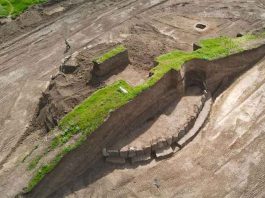
In May of 1971, archaeologists began clearing the Side Tomb of the Tovsta Mogyla Kurgan, which reached a depth of 6.2 m. It was a complex underground structure that began with a deep vertical entrance shaft. The work on it lasted almost a month and a half.
The discovery turned out to be unique – a woman and a child were buried in it, and the burial was found in its original form, completely unlooted and undamaged by natural factors.
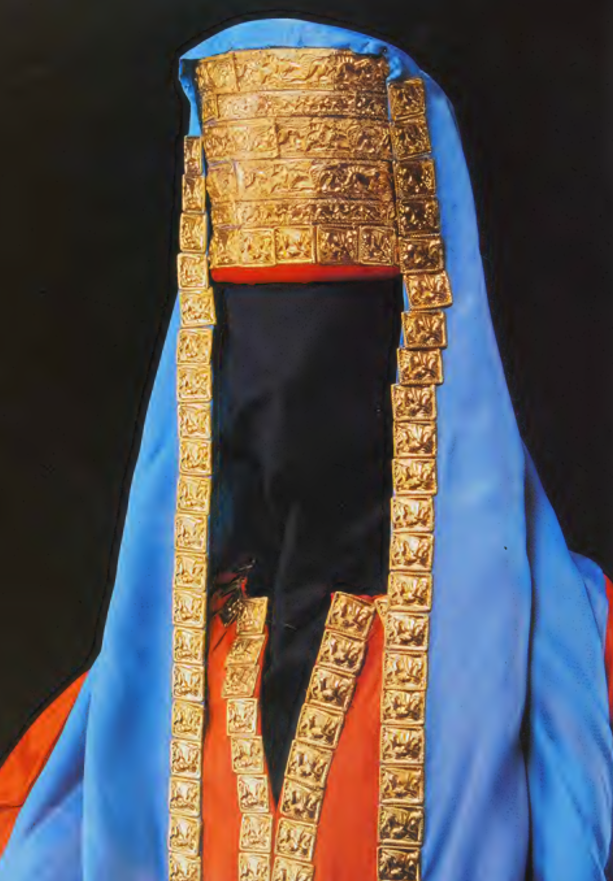
Large “pillows” of sea grass were placed under the woman’s feet and head, and she was dressed in ceremonial attire: a tall golden headdress with a veil, a dress, and shoes. There was also a cosmetic set – whitewash and blush, and several exquisite glass bowls. A Greek black-lacquered bowl and a silver goblet stood nearby.
Gold Decorations
The large number of gold plates with holes was amazing.
They were sewn onto the front of the dress; they also decorated the cape – rows of plates stretched from the head to the waist.
Embroidered plates also decorated her shoes.
Judging by the weight of gold used to decorate the woman’s dress, in Mozolevsky’s opinion, the Tovsta Mogyla female burial was most likely the richest known in Scythia.
Other decorations
Among the jewelry, a gray-blue necklace made of opaque Greek glass was a very valuable item for those times. Several other pieces of jewelry were hidden behind the woman’s head, as they say, “just in case.”
Earrings in the form of a woman sitting on a lion’s throne, in the form of a goddess of animals, with her hands raised in a prayerful pose, plate bracelets and folding bracelets in the form of beads on the hands and wrists, and various pendants were also discovered.
The woman had a gold ring on each finger. Noble Scythian women wore from 6 to 10 rings, and here was a complete set. Another object was found next to the deceased – a bronze mirror with a broken handle.
Headdress
It is likely that the woman buried in the Tovsta Mohyla mound was the wife of a prominent warrior, the owner of a golden pectoral. Presumably, she was not only the mother of the heir but also a priestess serving the Scythian goddesses.
Her headdress is almost identical to the one from Chertomlyk, and Mozolevsky identified her as a Queen.
The headdress consisted of several plates of high-quality yellow gold, each with different ornamentation.
The lowest headband was ornamented with a lush floral ornament.
The two wide gold plates on top of the first one represented the stamped composition of an attack by two griffins on a deer. Two other plates showed a duel between a stylized lion and a winged boar.
Three oblong plates bear relief images of a sphinx and an eagle-headed griffin in a heraldic pose, repeated twice. The unpaired figures of the griffin to the left of them and the sphinx to the right.
Plaques depicting a griffin tearing a deer or horse apart constitute the largest series in the collection, with 94 specimens. They are rectangular, measuring 3 by 3.5 cm.
Torque
The gold hryvnia found on the Queen’s neck is one of the most artistically perfect works of goldsmithing. Its weight is 478.5 grams, and its transverse diameter is 17.5 cm.
The ends of the decoration on both sides are in the form of deer protomes that were cast together with the rod and are 1.7 cm high. The artist carefully conveyed all the muscles of each deer’s head.
Behind each of the deer, there are seven sculptural figures of lions soldered to the rod. None of the 14 lion figurines is a copy of the other, which means that they were cast in separate molds.
They differ in size and posture. The length of each lion sculpture is from 1.9 to 2.1 cm, and the height at the head is from 0.8 to 1 cm.
Cart
The Scythian queen was brought to her resting place on a funeral cart. Details of the cart were discovered in the entrance pit.
One wheel was almost completely imprinted on the backfill, and the scholars received invaluable information about its construction.
It had 12 spokes, most of which were partially preserved. The impressions clearly showed that they widened slightly towards the rim. The length of the spokes was 36 cm.
The total diameter of the rim was 1.3 meters; the width was 15 cm. The rim was made of four arches fastened with iron brackets. The arches were not bent but sawn from thick boards. The remains of three other wheels confirmed their uniformity.
Pole-tops
Long poles were installed at the corners of the cart, to which the pole tops were attached. Six solid bronze pole-tops had a similar design and differed only in size and type of zoomorphic image.
Three openwork pole-tops were crowned with the sculptured figures of a griffin, and three others were crowned with figures of a stylized bearded deer. Notably, the largest of them all was the pole-top with a griffin measuring 18 cm.
Child
Next to the woman, in a spacious alabaster sarcophagus, was buried a child of about four years old, most likely a boy. His clothes were also embroidered with numerous small gold plates. A gold wire necklace adorned his neck, and a plate bracelet adorned his right arm.
On the left hand was also a massive ring made of gold wire. To the right of the child’s head, along the sarcophagus, a row of miniature silver vessels for wine lay: a kylix, a rhyton with a gold tip, and a goblet.
The excavations revealed that the child was buried some time after the mother’s death. The child burial in Tovsta Mogyla is the only unlooted royal one.
Most likely, the child had a belt around him decorated with golden plates. The belt itself was a sign of a Scythian.
Servants
In all, four servants were also buried in the tomb of the queen and the child. The number of persons accompanying the Queen and the child is one of the most notable peculiarities of the burial.
Further Sources
As a reminder, the famous Scythian Golden Pectoral masterpiece was found in this very Tovsta Mogyla Kurgan, but in the Central chamber, and there is a video on the current Royal Scythia YouTube channel detailing its discovery.
The Royal Scythia, Greece, Kyiv Rus book provides a historic account of several Scythian Queens of that period. There is a possibility that one of them is the one buried in Tovsta Mogyla kurgan.
The book Cradle of Civilisations takes a closer look at Scythian rhytons and offers a new perspective on their meaning in Scythian culture. Curiously, this new theory perfectly explains the presence of this famous drinking vessel in the child burial of Tovsta Mogyla kurgan.