In the past century, intense archaeological excavations of the Scythian period kurgans were conducted in Southern Ukraine.
The findings revealed that in Scythian times, female graves with weapons were widely spread throughout south area of Eastern Europe. Such graves were also discovered in the Lower Don, the Caucasus, and in other territories.
It became evident that women carried arms and participated in armed conflicts together with men. For this reason, they were buried the same way as male warriors.
Dr Olena Fialko
Dr. Olena Fialko of the Institute of Archaeology, National Academy of Science of Ukraine, in her article Scythian Female Warriors in the South of Eastern Europe, concluded that the types and sizes of graves, as well as the nature of the funeral rite of the female warriors, corresponded to Scythian canons and, de facto, did not differ from men’s graves.
The analysis of the funerary inventory allowed scholars to date them between the 7th and the 2nd centuries BC.
Dr. Fialko referred to those female warriors as the Scythian Amazons.
According to her, the graves of female warriors constitute a quarter of the total number of Scythian graves with weapons, meaning that every fourth Scythian warrior of the Northern Pontic Area was a woman.
More than 270 female warriors’ graves were found on the territory of European Scythia, particularly in the southern area of Ukraine.
Weapons of Scythian Amazons
Grave goods had a limited choice of weapons. Practically every Amazon had a bow and a set of arrows.
Many Amazons were armed with a spear, or a javelin, or both. However, spears prevailed quantitatively.
The average length of the spear was 2 meters, which fully corresponds to the size of the usual Scythian spears and javelins. In one case, a Scythian female warrior was buried with three spears.
There were fewer javelins than spears. This tendency is typical of Scythian weapons in general. Typically, they were one javelin per grave.
The design features and tactical and technical characteristics of these weapons indicate that the Amazons preferred throwing spears and javelins. The end caps of the spears and javelins were often kept in leather or woven covers, tightened with a cord.
The Amazons were also armed with a sling – another type of missile weapon, designed for long-distance fights. Only stones, from one to five in the set, are conserved in the graves.
Battle-axes were found in only two burials. Only three graves on the territory of modern Ukraine contained iron swords. The Amazons seem to prefer the long iron swords.
Three graves contained bronze war belts. The protective armor of ordinary warriors was made of leather or felt, which implies that females most likely formed light-armed cavalry.
Teenage Amazon with Servants
The Kurgan 5 near Zelene village stands out. There were three graves of girls with weapons in them.
A mound of a teenage girl was the main mound in the kurgan. Her outfit included a spear, javelin, scale armour, three stones for a sling, a mirror, a quern with a wooden beater, and a necklace with glass beads. Girls from two other graves had only glass beads and one and three arrows. Judging by the layout, it was an Amazon with two servants who were buried in this kurgan.
This confirms the evidence of ancient authors, who claimed that Amazons were trained in military affairs from early childhood.
The kurgan is unique, because there were no other warriors in full armour in an array of Scythian monuments.
Attire of Scythian Amazons
The Scythian Amazons’ suit was determined by tradition, a way of life, and their habitats. Written and artistic sources show that militant women preferred Scythian men’s clothing.
However, according to archaeological data, they added ordinary women’s jewelry to it. Necklaces, earrings, bracelets, and rings were typical jewelry.
Pins and fibulae were rarely used. The metal neck-rings were an exception because they were an attribute of the male commander. Some of the Amazons complemented their costumes by sewn metal plates and removable jewelry.
There were several Amazons buried with golden jewelry – earrings, finger rings, and expensive imported black and red-figure pottery. Sometimes the set of equipment included a bronze cauldron.
They indicated a higher social status of the buried women and marked the burials of women-commanders, who led the military sub-division.
Ranks of Amazons
Thus, among the Amazons stood out several social groups: the ordinary combatants, the middle link of successful warriors, highborn, rich Amazons, the commanders, and the security guards from the retinue.
The tomb from kurgan 2 at Zelenoje village is especially interesting for us. The Amazon was buried in one grave with a man, but each had a separate chamber. Both are clearly representatives of the social elite. The woman has a leather patch on her head and leather boots with embossed ornamentation. The jewellery was represented by the gold necklace, the silver ring, and the bracelet of glass beads.
In a set of things were a jewellery box with a mirror, two pyxides, a spindle and an awl; a quern with a wooden beater, three imported vessels, a spear and quiver with 107 arrows. Probably it was a couple buried in the grave. The situation in this funeral complex shows us clearly that Scythian Amazons had the same social status as men.
There are cases when the social rank of the Amazon was clearly above the rank of the other male warriors who were buried in the same cemetery.
The presence, in addition to weapons, of the bronze cauldrons, metal, and especially gold or silver neck rings, and gold jewelry in the sets of funerary items of the Amazons allows us to identify their owners as the commanders of military units.
Ages of Amazons
The burials of the Scythian female warriors were not part of isolated groups or individual burials; they were dispersed among male burials.
As a very rare case, there was a little girl buried with weapons at Skelki cemetery located on the bank of the Kakhovka water reservoir.
Warrior females were not all of the same age – it ranged from 16 to 60, still, half of them were young, aged 25–35.
Ten of the females buried with arms were sixty years old, which is considered an advanced age for the Scythian period. All were unmarried, as evidenced by the occurrence of the weapons. That must have been a relatively peaceful time in Scythian history, so they were unable to kill enemies.
Fighting Side-By-Side with Men
The question of the direct participation of the Scythian women in combat has been settled. The most compelling argument is the existence of wounds on the bodies of the Scythian Amazons.
The analysis of anthropological materials showed that the women had injuries of a military character. There were three types of injuries: wounds made with arrows, loss or fractures of the extremities, and chopped wounds on the skull and extremities.
It is now clear that women participated in military conflicts, and in accordance with the traditional funeral rites of Scythian warriors, these women were buried with the same honors, following the same rituals, and, most importantly, with their personal weapons.
Chertomlyk Amazon
Are there any images of the Scythian Amazons that were discovered in Ukraine?
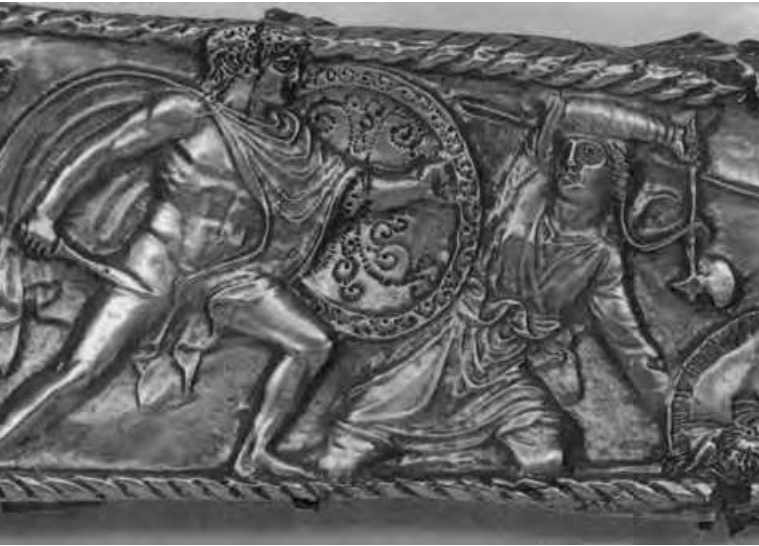
A golden scabbard overlay with the battle scene was unearthed in one of the largest and most famous Chertomlyk Scythian Royal Kurgan in Ukraine. One scene shows a female warrior fending off an attack of a Greek warrior.
The book ‘Cradle of Civilizations’ offers a new perspective on the battle depicted on the scabbard.
The book ‘Royal Scythia, Greece, Kyiv Rus’ describes the details of the Chertomlyk Royal Barrow excavations.
Previous videos on this channel may be of interest to those interested in the history of Scythia.