Black Sea as Scythian Bow
The Scythian bow was so famous in antiquity that ancient writers described the Black Sea as shaped like one. The most famous account comes from the Greek geographer Strabo, who wrote it in his Geography in the first century AD:
“Some have compared the shape of the Black Sea’s circumference to a Scythian bow when bent, the string representing the southern portions of the Sea… and the remainder [of the circumference representing] the wood of the bow with its double curve, the uppermost very much rounded, the lower more in a straight line.” (Geography 2.5.22)
Such a comparison helped ancient navigators and travelers by giving them a planimetric map of unfamiliar maritime space.
By linking the sea to the Scythians’ most prominent weapon, it also tied geography to the image of fierce archers from the northern steppe of what is now Ukraine.
Unique Shape
The Scythian bow remained uniquely shaped for centuries, if not millennia.
In the 4th century AD, Roman historian Ammianus Marcellinus wrote the following:
‘… while the bows of all other nations bend along the whole of their material, those of the Scythians and Parthians have a straight rounded line in the centre, from which they curve their spreading horns to present the figure of the waning moon.’ (22.8.37)
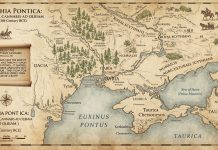
According to Ammianus, the ends of the imaginary Scythian bow were represented by two straits – the Thracian Bosporus and the Cimmerian, or Kerch Strait:
“The thin extremities of the bow at each end are commanded by the two Bospori, the Thracian and Cimmerian, placed opposite to one another.” (2.8.12)
Vodoslavka Kurgan
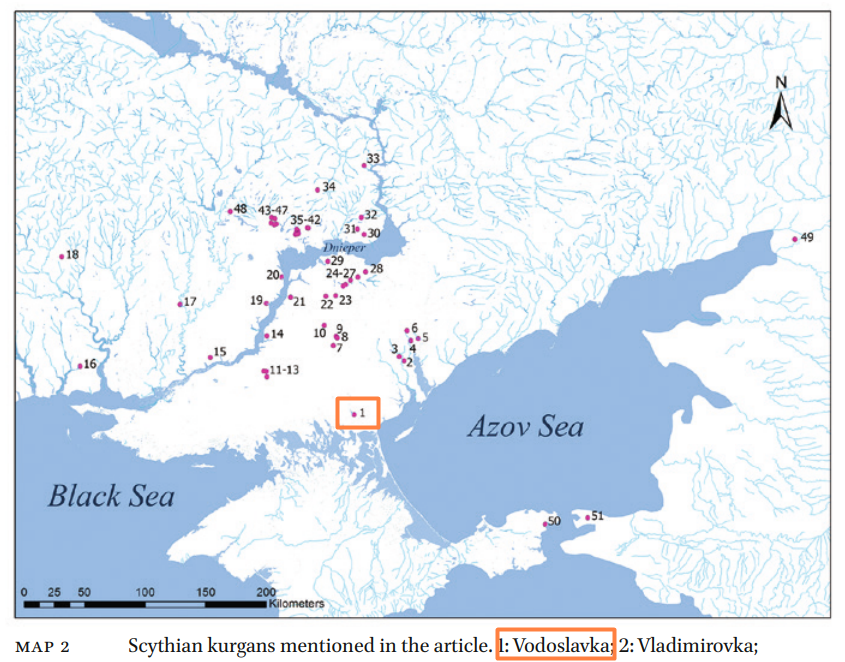
The Vodoslavka burial ground, located in the Kherson Oblast, north of Crimea, was excavated in 1983 by the Expedition of the Institute of Archaeology of Ukraine.
The Vodoslavka burial ground consists of 15 kurgans: 12 date to the Scythian period of the 4th century BC, and 3 belong to the Bronze Age.
Kurgan 8 became famous for yielding a remarkably well-preserved Scythian wooden bow together with quiver fragments.
Marina Daragan’s Paper
34 years later, in 2017, at a conference held at the British Museum, Dr Marina Daragan of the Institute of Archaeology, National Academy of Sciences of Ukraine, presented the research results on the Scythian Bow from Vodoslavka.
Burial with Bow
According to her, the bow was found in the fourth burial of the Scythian kurgan 8. The burial was an intrusive one, meaning that it was dug into a pre-existing structure.
The grave was sunk to a depth of 4 m with a bridled horse buried at the entrance.
A young man, possibly a teenager, lay on a central wooden platform covered with leather and cloth. He wore leather and fabric clothing and leather boots. He had a single earring in his right ear, and two cloth bags filled with herbs were suspended from his neck.
The bow was placed over his body, and a leather quiver containing arrows was placed to his left. The quiver also contained a knife lying beneath the arrows. There were 88 arrows with bronze arrowheads of two types inside. An image of a griffin was preserved on one of the fragments of skin on the upper part of the quiver.
The burial was dated to the second or third quarter of the 4th century BC.
Sigmoid (B-Shaped) Asymmetric Scythian Bow
The bow was almost completely preserved. It was buried with the bowstring removed, so it lay in its resting position: the ends of the bow and both shoulders were strongly bent in the opposite direction from its drawn state, as confirmed by the location of the bowstring notches.
The bow was made of a single piece of oak core and measured 74 cm in length.
The shape of the bow was asymmetric. The length of the longer lower shoulder of the bow was 41 cm, while the length of the shorter upper shoulder was 33 cm. The short shoulder of the bow was thinner, while the longer one was thicker.
Studies carried out at the Department of Technologies and Design of Wood Products of the National University of Bioresources and Environmental Management of Ukraine found that the bow was cut from a young oak tree because it had more elastic vessel walls and could be flexed.
In the northern Pontic region, oak was the densest, most resilient, and moisture-resistant material.
Tendon Wrap
The bow was covered with layers of horse’s sinew in a spiral-like manner along the entire length of the bow. The sinew resembled the form of a ribbon.
This sinew cuff along the bow’s entire length allowed it to shorten its arc significantly without affecting the length of tension. The elastic energy of the tendons exceeds the ultimate elastic energy of any wood. Because the bow was made of oak, it was hard, but when it was bent, the tendons stretched and thus prevented the bow from breaking.
Recurve Design
Another interesting feature of the Vodoslavka bow is the fact that it was reflexive in shape. Such bows are also called recurved because their limbs curve away from the archer when unstrung.
A recurve bow stores more energy and delivers energy more efficiently than the equivalent straight-limbed bow, giving a greater amount of energy and speed to the arrow. A recurve permits a shorter bow than the simple straight-limbed bow for a given arrow energy. For this reason, the archers preferred a recurve bow in environments where long weapons could be cumbersome, such as in brush and forest terrain, or while on horseback.
The Vodoslavka bow was an ideal short bow for the rider, and it is unsurprising to therefore find that a horse was buried in the entrance pit of the grave where the young archer was buried.
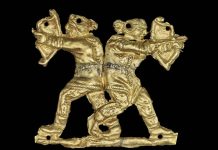
By the way, the plaque the Wikipedia uses to illustrate the Scythian recurve bow was manufactured in Crimea in the fourth century BC, just at the very time the Vodoslavka burial took place a little to the north from the semi island.
Bone Lining Myth Refuted
The study of the total number of Scythian burials of the northern Pontic region allowed scholars to refute one of the myths about the design of Scythian bows, namely, that they used bone lining. To date, no bone findings, which could be correlated with reinforcing lining on the bow, have been identified in the Scythian burials of the 5th–4th centuries BC in the northern Pontic region.
Four Bows Found in Ukraine
Only four Scythian bows of very similar design have been discovered in Scythian burials of the 4th century BC in the northern Black Sea region. All are whole-wooden, sigmoid-shaped, and recurved. Tendons and bark were used as the reinforcing materials in their design.
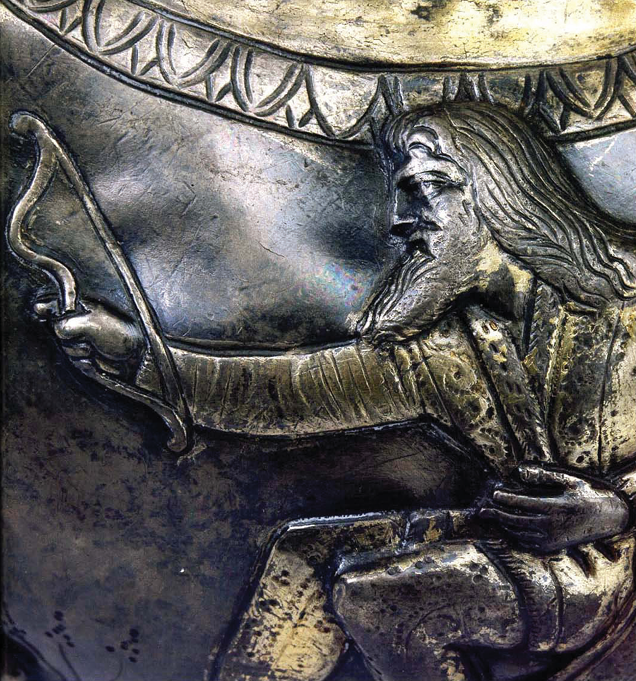
The prevalence of tight Scythian bows, similar to the one from Vodoslavka, is clearly illustrated on a vessel from the Kul Oba kurgan.
Scythian Bow Know-How
Scythian bows were extremely rare in burials in the northern Black Sea region, and poor preservation cannot explain this. For example, no bows appeared in burials where organic parts of quivers were preserved.
Scholars attributed this to the Scythian bow’s material value.
The bow was the Scythians’ main weapon. It was a highly developed piece of Scythian know-how, and its invention was directly related to the development of new equestrian tactics. This weapon’s emergence sparked a wave of Scythian conquests and the spread of their military practices.
The complicated design of the Scythian bow, the whole wooden recurved device with additional reinforcing elements, demonstrates the high value of such a bow.
The process of making such a bow, which included digestion, evaporation, and drying, took a very long time.
Bows As Heirlooms
Another reason Scythian bows were extremely rare in burials may be that the bow held a special place among Scythian weapons.
For Scythians, the bow was more than a weapon. It symbolized the Scythians as the true heirs of Heracles. The previous video on this channel provides the details.
The book ‘Royal Scythia, Greece, Kyiv Rus’ has more interesting details about Scythian culture and artifacts.