Herodotus & Anacharsis

The famous Greek historian Herodotus is the earliest author who mentioned Anacharsis. Here is what the Father of History wrote around 450 BC:
We cannot cite the wisdom of any nation there, other than the Scythian people, nor do we know of any man noted for wisdom in the Pontic region other than Anacharsis.
The Scythians were more clever than any other people in making the most important discovery we know of concerning human affairs.
Let us highlight a couple of very important points in the quote above.
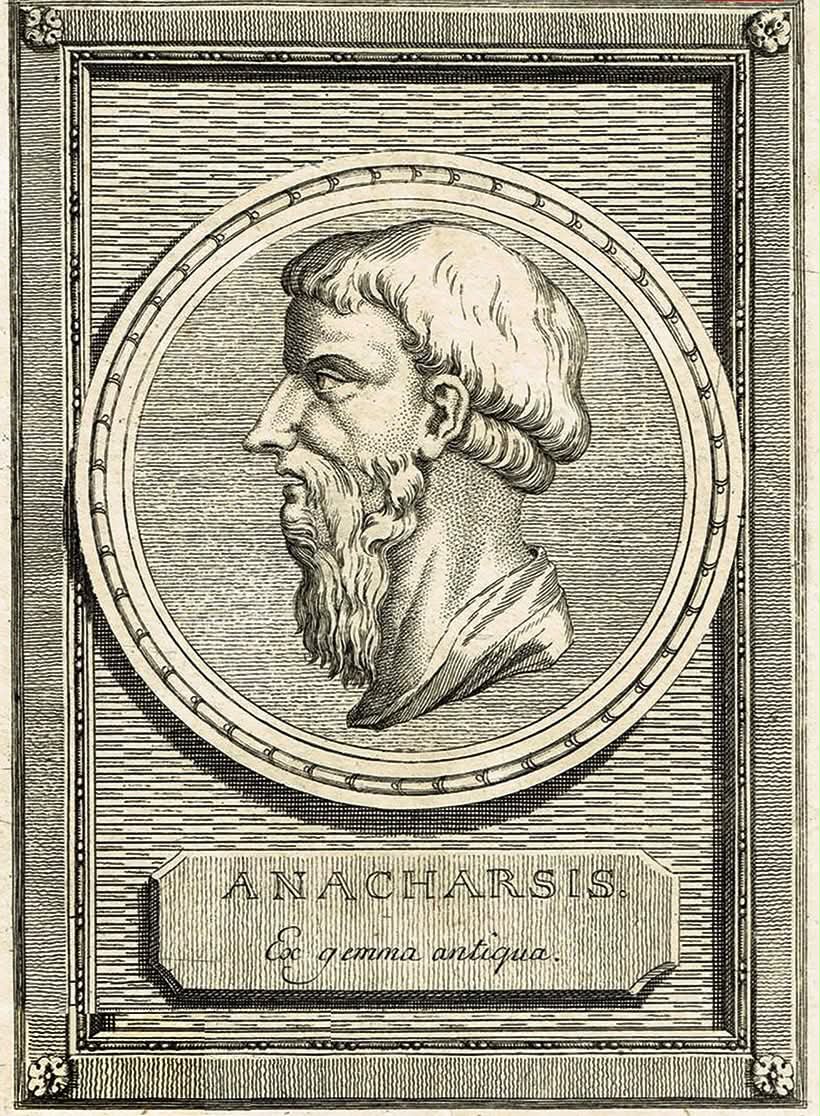
First, Anacharsis, who lived around 550 BC, only a century before Herodotus, was known not only to the Greek historian but also as the most famous wise man in the entire Black Sea region.
Second, the Scythians were a nation and not a tribe.
And they were wise and smart in the eyes of the Father of History, who met them in person. They were not primitive barbarians as some try to portray them.
The brilliant discovery by the Scythians was the military strategy of total mobility.
Scythians Repel Persian Invasion
It was this military strategy of total mobility that the Scythians used during the invasion of Scythia by the Persian king Darius the Great in 513 BC.
Thanks to this strategy, the Persian king was defeated but managed to escape across the Danube River, leaving wounded soldiers behind.
Herodotus traveled to Scythia specifically to learn the details of that grand event that had taken place only some 60 years before.
The first video on this channel shows how the Scythian victory influenced the outcome of the Greco-Persian wars.
Anacharsis & Foreign Customs
Later in his book, Herodotus mentions Anacharsis again only to demonstrate how unforgiving the Scythians were towards foreign religions. He wrote:
“The Scythians are the people who avoid foreign customs at all costs, especially those of the Greeks, as is clearly illustrated by the cases of Anacharsis and Skyles.
Anacharsis went abroad and saw a great deal of the world, demonstrating great wisdom along the way, and on his return home to Scythia, he sailed through the Hellespont and put in at Cyzicus.
There he saw the citizens celebrating a splendid festival in honor of the mother of the gods. And he vowed to institute such a festival for her in his homeland.
And when he returned to Scythia, he retreated to the place called Hylaia, which is next to the Racecourse of Achilles.
Anacharsis Slain
There he celebrated the rites of the goddess in their entirety, with a drum and with images tied upon him.
But one of the Scythians saw him doing this and told the king, Saulios.
The king went to that place, and when he saw Anacharsis performing these rites, he shot him with an arrow and killed Anacharsis.
A couple of comments on the passage just quoted.
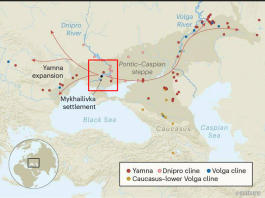
First, one can see where the place called Hylaia, where Anacharsis was killed by his brother and king, was situated in antiquity.
Currently, it is a part of the Kherson region of Ukraine.
Second, Herodotus writes that Anacharsis went abroad demonstrating his great wisdom along the way.
It is important to pay attention to the word ‘demonstrating’ because there have been many prejudiced historians who insisted that Anacharsis went to Greece to study.
Although the Scythians chose to forget Anacharsis for having betrayed their religion, his fame in Greece endured for centuries after his visit.
Those who doubt the historicity of Anacharsis should know that Herodotus was reading his Histories in Athens, including his stories about Anacharsis just quoted.
The citizens of Athens would have corrected those stories about Anacharsis if they were not true.
Uncle of Idanthyrsos
Herodotus mentions that Anacharsis was a paternal uncle of Idanthyrsos, the Scythian king who defeated the Persians.
It allows us to narrow Anacharsis’s life to the period shortly before 513 BC, the date of the Persian invasion.
But his trip and life in Athens took place sometime before 560 BC for the reason that will be mentioned later.
Spartans & Anacharsis
This time gap is worth keeping in mind when reading Herodotus’ next passage.
In it, he testifies that the fame of Anacharsis in Greece was not limited to Athens alone, but that his wisdom was known in Sparta also.
According to the historian, the Spartans told him that Anacharsis even preferred discussions with the Spartans to conversations with the Athenians.
In other words, there was some competition between Sparta and Athens for the compliments from the Scythian sage.
Although Herodotus calls this story a joke, Anacharsis remained popular throughout Greece for many decades after his departure.
But when one comes to think of it, there truly was a certain closeness between the Spartans and the philosophy of Anacharsis.
The Spartans were known for their strict way of life focused on severe self-discipline and the total rejection of comfort or luxury.
Similar frugality was the cornerstone of Anacharsis’ worldview.
Cicero Quotes Anacharsis
500 years after Anacharsis, the famous Roman philosopher, orator, and writer Cicero quoted the legendary Scythian sage in one of his most important works.
In Tusculan Disputations, Cicero uses Anacharsis as an example of frugality for all other philosophers. He writes.
“Could the Scythian Anacharsis disregard money, and shall not our philosophers be able to do so? We are informed of an epistle of his in these words:
“Anacharsis to Hanno, greeting. My clothing is the same as that with which the Scythians cover themselves; the hardness of my feet supplies the want of shoes; the ground is my bed, hunger is my sauce, my food is milk, cheese, and meat.
So you may come to me as to a man in want of nothing. But as to those presents you take so much pleasure in, you may dispose of them to your own citizens, or to the immortal Gods.”
The comment to the passage in the book is worth quoting as well.
Solon & Anacharsis
Anacharsis came to Athens while Solon was occupied in framing laws for his people.
By the simplicity of his way of living, and his acute observations on the manners of the Greeks, Anacharsis excited such general admiration that he was reckoned by some writers among the Seven Wise Men of Greece.
It is Anacharsis’ acquaintance with Solon that helps us place Anacharsis’ trip to Athens in the period before 560 BC, the year Solon died.
We will learn more exact dates of his arrival shortly.
Plutarch on Anacharsis
Plutarch in the first century of our era gave his account of the first meeting between Solon and Anacharsis.
In his most famous Parallel Lives, Plutarch writes that Anacharsis came to Athens, knocked at Solon’s door, and said that he was a stranger who had come to make ties of friendship and hospitality with Solon.
When Solon replied that it was better to make one’s friendships at home, Anacharsis said
“Well, then, since you are at home, make me your friend and guest.”
Solon, admiring the man’s wit, received him graciously.
This meeting took place when Solon was compiling his laws that would become the foundation of Athenian democracy.
Anacharsis, after reading part of that legislation, made a statement that is still quoted today. Here is what he said:
Written laws are like spiders’ webs. They hold the weak and delicate who might be caught in their meshes, but are torn in pieces by the rich and powerful.
Solon defended his laws, but Plutarch thought that Anacharsis was correct in his judgement: “But the results justified the conjecture of Anacharsis rather than the hopes of Solon”.
Plutarch also recorded another famous saying of the Scythian. Quote:
Anacharsis, after attending a session of the assembly, said that he was amazed to find that among the Greeks, the wise men pleaded causes, but the fools decided them.
Anacharsis in Diogenes Laertius
3rd-century biographer Diogenes Laertius, in his work Lives and Opinions of Eminent Philosophers, devoted the whole chapter to Anacharsis.
According to him, Anacharsis came to Athens during the 47th Olympiad.
That Olympiad lasted from 592 BC to 588 BC, and we can view this period as the dates we were looking for – Anacharsis came to Greece around the year 590 BC.
Diogenes Laertius mentions that Anacharsis composed a short poem titled The Customs of the Scythians and the Greeks, devoted to frugal living and warfare.
Anacharsis was so frank in his speech that it inspired a proverb: an honest conversation was called “Scythian talk”.
When asked how to avoid becoming a heavy drinker, Anacharsis advised, “Keep before your eyes the indignities of those who are drunk.”
There were busts of Anacharsis inscribed with “Control your tongue, belly, and privates.”
According to Diogenes Laertius, Anacharsis invented an anchor and a potter’s wheel.
More about Anacharsis can be found in the book Royal Scythia, Greece, Kyiv Rus.
The book also quotes a 10th-century Byzantine historian who related Anacharsis to a famous Kyiv ruler.
The Cradle of Civilisations book takes a new look at the origin of Scythia and explores some little-known facts about Troy.
By the way, is it possible that Homer mentioned Scythians in the Iliad? The book answers that question – yes, he did.
Ukrainian Mentality vs. Russian Mentality >