Patroclus Burial
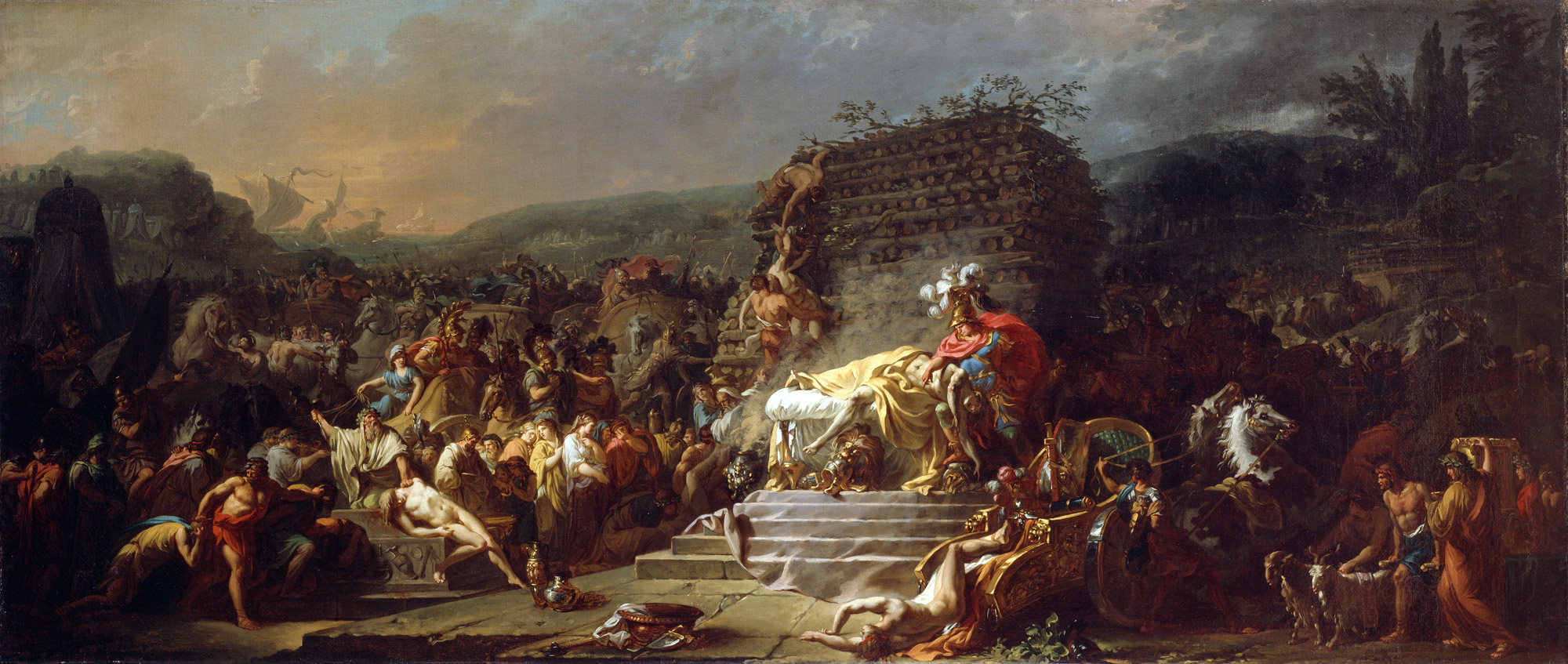
In Chapter 23 of the Iliad, Homer describes the epic scenes of Patroclus’ burial, which Achilles organized for his friend.
The funeral ritual included feasting, games, gift-giving, ceremonies, and sacrifices that Achilles staged in honor of his fallen comrade.
The sacrifices were very unusual because they included animals and humans.
The post-cremation treatment of Patroclus’ bones was highly unusual as well. His bones were collected and placed in an urn, covered with fat and placed on a cloth-covered couch.
In such a way, the bones of Patroclus were reserved for later burial with the bones of Achilles after Achilles’ eventual death. Here is a quote from the Iliad:
Then let us collect the bones of Menoetius’ son Patroclus, pick them out with care, but they cannot be mistaken: he lay amidst the pyre, apart from all the others burned at the edge, the ruck of men and horses. Then let us place his bones in a golden urn, sealed tight and dry with a double fold of fat, till I myself lie hid in the strong House of Death. For his barrow, build him nothing large, I ask you, something right for the moment. And then, later, Achaeans can work to make it broad and lofty, all who survive me here alive in the benched ships when I am gone.
Horses
Scholars noted that the inclusion of horse sacrifice in Patroclus’s burial ritual speaks particularly of Indo-European influences.
And because no horse sacrifices are mentioned in any of the other Homeric funerals, this case is viewed as a unique remnant of an older tradition.
That older tradition was well known to both Achilles and Patroclus.
Barrow
Another interesting feature was the burial mound’s construction. Another quote from the Iliad:
And the men obeyed the swift runner’s orders.
They first put out the fires with glistening wine, as far as the flames had spread and the ashes bedded deep.
In tears they gathered their gentle comrade’s white bones, all in a golden urn, sealed with a double fold of fat, and stowed the urn in his shelter, covered well with a light linen shroud, then laid his barrow out. Around the pyre they planted a ring of stone revetments, piled the loose earth high in a mound above the ring, and once they’d heaped the barrow turned to leave.
Hammond
Renowned British historian, geographer, and classicist Nicholas Hammond, in his book about ancient Epirus, observed:
The burial of his cousin Patroclus by Achilles provides an example. It does not correspond with any known practice in the Mycenaean world, and it is perhaps peculiar to Achilles and his people, whose origins and traditions seem to have come from Central Epirus. Now we know that in the Bronze Age, the most important burials in some of the tumuli of North Epirus were cremations; that such cremations, marked by a cairn of stones, became the centre of a large circle 20 m. or more in diameter, and that the circumference was marked sometimes by a single or a double layer of unworked stones; that jars for liquid (and at Vodhinë dippers) and weapons were placed beside the urn which contained the ashes; and that a tumulus of soil was raised over the circle to a height of at least 3 m.
Phrygians Origin by Hammond
Another of Nicholas Hammond’s observations about a certain people who took part in the Trojan War is of particular interest for our story. In his most celebrated book, A History of Macedonia, he draws readers’ attention to the Phrygians, writing the following:
Before and during the Trojan War the ‘Phryges’ occupied a territory called Phrygia on the southern side of the Propontis; in Priam’s younger days they had fought against the Amazons at the Sangarius river, and they were allies of Troy in the Trojan War (Il. 3. 184 f. and 2. 862 f.).2 In the Iliad, they alone have the epithet ‘with gleaming horses’.
The land allotted to the Phryges in the Trojan Catalogue was a district which, according to R. D. Barnett, ‘may very well mark the earliest area of Phrygian settlement’. We may for convenience call it Hellespontine Phrygia. It was held by the Phryges from circa 1260 B.C. at the latest.
After the Trojan War, the Phryges came from Europe and the region left of the Pontus’, wrote Xanthus the historian circa 460 B.C. The opening phrase refers, as usual, to the period of the Nostoi, and the record here is of Phryges crossing from Europe into Asia and in particular from Ukraine into inland Phrygia at some time after 1200 B.C.
It is exciting to learn that the migrants from the territory of what is now Ukraine took part in the Trojan War.
The epithet “the ones with the gleaming horses” speaks volumes about those people and their culture.
It would not be surprising that people with such an outstanding relationship with horses would take the horses with them in the afterlife. And archaeological excavations did reveal evidence of horse and dog sacrifices in the Phrygian barrows.
Similar to the components of Patroclus’ burial ritual.
Bryges of Macedonia
The Phrygians had a strong influence on the history of Macedonia and Epirus.
Actually, the name of the first capital of ancient Macedon is derived from the Phrygian word for water.
There was also a people known as the Bryges, most likely a tribe of the Phrygians.
Nicholas Hammond described the Bryges as “a very powerful people who held part of Pelagonia, occupied the western part at least of the plain of Central Macedonia, and also occupied central Albania and threatened Epirus.”
In his opinion, “the first invasion of north Epirus by these people happened in the decades immediately after 1190 B.C.”
Megalithic Barrow in Ukraine
It is time to speak about the barrows encircled with stones. Where could this burial ritual originate? If the Phrygians migrated from the area of what is now Ukraine, could such a practice be found there?
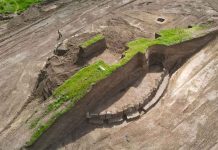
In early 2021, south of Dnipro city in central Ukraine, archaeologists started excavating a huge mound that was 7.5 meters high and 50 meters in diameter.
Inside the mound, they found gigantic stone blocks several meters high.
Each stone weighed about a ton, and the stones were carefully cut into a circle.
Such circles of standing stones are called cromlechs.
This megalithic construction turned out to be 5,500 years old and dates back to the Bronze Age. It is older than Stonehenge and the Pyramids of Giza by at least half a millennium.
Some sensationalists wrongfully named this ancient structure the ‘Ukrainian Stonehenge,‘ but it is in fact an ancient burial mound.
This burial mound with a stone circle in Ukraine is at least two thousand years older than the barrow of Patroclus with stone revetments described by Homer in the Iliad.
The next video will be about the Megalithic Kurgan just mentioned. Subscribe to the Royal Scythia channel so as not to miss it.
The book Cradle of Civilizations explores the common symbols and myths of the Indo-Europeans. It tells the little-known facts about how the burial place of Philip II of Macedon, the father of Alexander the Great, was discovered. It mentions new facts about the true outcome of the battle between Phillip of Macedon and Scythian king Atheas.
Those looking for new information about Scythian culture and Scythian artifacts discovered in Ukraine are welcome to check out the book Royal Scythia, Greece, Kyiv Rus.