Chertomlyk Amphora
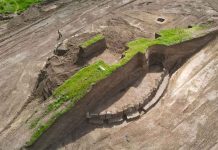
The vase was discovered during the initial excavations of the Chertomlyk Royal Scythian Kurgan in Ukraine in 1862. The video on this channel describes the excavation details.
The Chertomlyk silver-gilt amphora is usually described in words such as:
‘One of the most beautiful specimens of Scythian metalwork’!
And ‘one of the finest extant examples of toreutic at the moment of its most consummate mastery’.
The amphora is 70cm. high, has an egg-shaped body, a narrow neck with a mouth rim turning outwards, and two vertical handles.
The vessel is flawless in its exquisite shape and its rich decorative finish. The exceptional subtlety of the chased work is displayed by the decoration of the vessel’s body.
It is made up of floral patterns – palmettes, offshoots of plants, bluebell and lotus flowers, spiny leaves of acanthus, and rosettes.
Storks and other birds in the branches are also part of the vase decoration. Some see it as a reminiscence of the luxuriant vegetation of the steppe of the 5th century BC.
Friezes
Griffins
Below the neck, the vase is decorated by two bands of reliefs. The upper one, slightly repousse and heightened with gilding, shows on each side a scene of two griffins attacking a stag.
Breaking In Horses
The chief occupation of the Scythians was looking after their many horses, and the Chertomlyk amphora provides a splendid illustration of a part of that culture.
In the second frieze, we see portrayed in greatest detail the process of catching the wild horse of the steppes and breaking a horse in.
In the scene, we see three Scythians pulling their lassos, while the fourth, half-naked Scythian, appears to be coordinating their actions.
The figures were cast separately, then gilded and soldered onto the ground. Lassos and reins that used to be in silver wire are now broken away but remain in the grasp of some figures. The scene is an example of artistic perfection.
Its exactness is also shown by the care with which two different breeds of horses are distinguished.
The artist displayed outstanding talent in showing all the figures in complicated foreshortenings and in conveying their various emotional states.
The composition of the scene is full of vigour and movement.
Faucets
At the bottom of the amphora, two side faucets are made in the shape of heads of lions.
Each outlet was furnished with a plug attached by a chain.
Central Idea
Overall, all the scenes of the frieze as well as the other parts of the decor are closely interrelated and subordinated to a single idea, which incorporates mythological conceptions and religious beliefs of the Scythians.
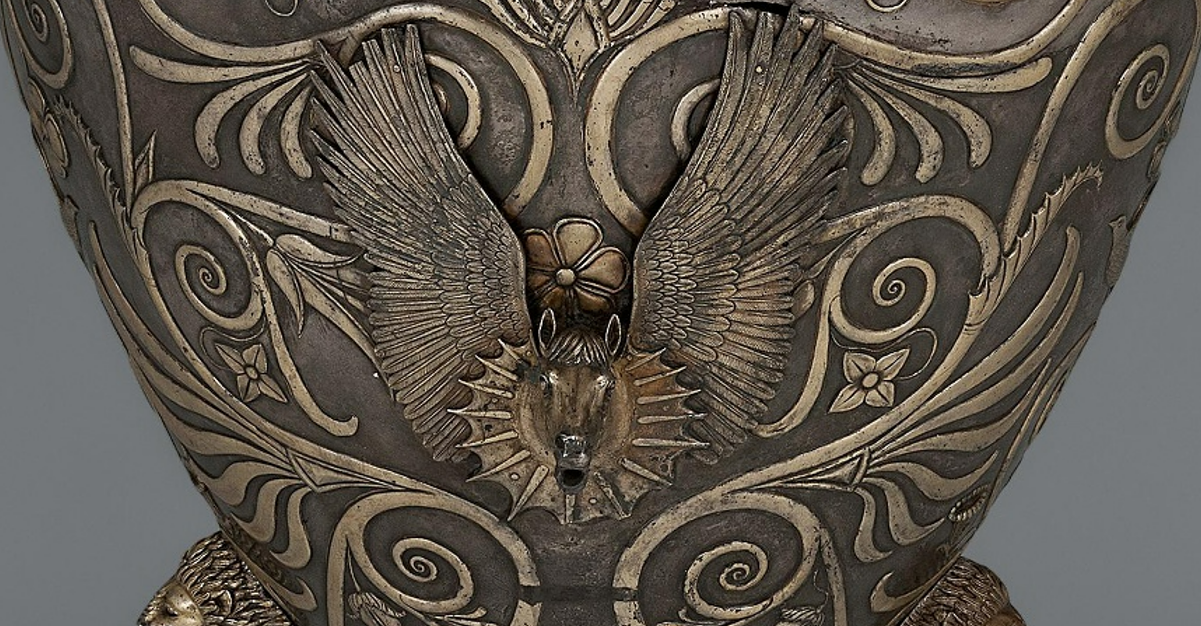
The centerpiece of the whole Chertomlyk amphora is the third faucet in the form of a horse’s head.
The horse’s head is rendered realistically but is surrounded by a frill and is flanked by great wings.
Is it Scythian Pegasus?
Scythian Pegasus
The winged horse imagery was present in Scythian barrows on numerous plaques. What could those images mean?
Prominent scythologist known for his groundbreaking research into the mythology, iconography, and spiritual culture of the ancient Scythians, Doctor of History Dmitriy Raevskiy offered his view on the subject:
Let us recall the story from the genealogical myth about Herakles, who accidentally found himself in the cave of the snake-legged goddess while seeking his lost horses. This plot was essentially built in such a way that the hero’s journey to the lands where that chthonic creature lived, or to the chthonic world beyond, became possible only because he was following the road along which his horse had gone. This technique concerning the plot is explained well with the notion in the Indo-Iranian tradition about the horse as a creature simultaneously linked to the three levels of the Universe and accordingly capable of penetrating into each of the three worlds. This notion most probably accounts for the popularity of the winged horse in Scythia, a horse to which the upper, celestial world was also accessible.
So, who borrowed the image of the winged horse from whom? Did the Scythians take it from Greeks and incorporate it into their mythological system? Or was it the other way around, and it was the Greeks who adopted the Scythian imagery? In which of the two cultures did the horse first appear, by the way?
Genetics
A 2026 Horse Genetics study published the following conclusion:
Yamnaya groups in the period between 3200 and 2600 BC rode the breed of horses who became the direct ancestors of modern domestic stock, while incorporating them into diets, rituals, and mobility systems.
The video about the Yamnaya Culture and the original homeland of the Indo-Aryans is available on this channel.
The book Royal Scythia, Greece, Kyiv Rus has more little-known facts about Scythian Culture that was centered in the area of present-day Ukraine.
The book Cradle of Civilisations zooms in on the events in the same area that led to the emergence of Proto-Indo-European culture and its spreading into Greece and the Near East.