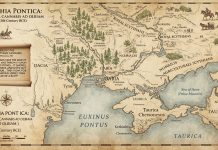
Scythian Theory
Boxhorn
In 1647, Leiden professor of eloquence Marcus Zuerius van Boxhorn published a dissertation arguing for the Scythian origin of the Greek, Roman, and German languages. He summarized his work with the following passage:
“In their explanation of the true origin of this similarity of languages, many scholars have long been misled. For it may be easy and obvious to observe this similarity, but many were misled because they had not realised the common origin of these peoples, the Scythians. This is why they attributed a Greek origin to these peoples, while that origin is in fact Scythian, as is that of Greek itself.”
In another text, Boxhorn formulated it more vividly: ‘The true reason for these correspondences in these languages is the fact that Greek and German have lain on the breasts of one mother, and have learnt to speak from one mouth’.
This notion of abstract proto-language would eventually evolve into the current notion of Proto-Indo-European.
Elichmann
But Boxhorn did not originate the Scythian theory. That honour belongs to Johannes Elichmann, a highly educated physician and renowned expert of various oriental languages who was also active in Leiden.
Elichmann introduced the Scythian hypothesis in Leiden in 1631 but did not publish it because of his premature death in 1639.
Claudius Salmasius
Elichmann’s friend, Claude de Saumaise, also a Leiden professor, published a summary of Elichmann’s Scythian Theory in 1943, four years prior to Boxhorn’s publication.
Here is how it appeared in Saumaise’s book De Hellenistica:
“There is scarcely a single people of Europe or Asia which did not spring from the north. Thence set out the ancestors of the peoples by whom most of the regions of Europe and Asia were cultivated. Scythia, therefore, which was the land to the north, poured forth nearly all the peoples who flooded over Europe and Asia, with their languages. For since the kingdom of the Scythians was extremely large, and extended a long way to east and west, by disgorging towards the south, it brought forth various peoples, here in Europe and yonder in Asia.
On the Asian side it reached as far as India, and produced the Indo-Scythians. It poured forth the Parthians and the Persians. For the Parthians, as everyone agrees, are of Scythian origin. For there is no difference between the name Parthians and the name Persians.
I do not say that exactly the same language was spoken by the Greeks, the Getae or Thracians, and the Teutons or Germans, but that these three peoples had many words in common, coming from the same origin.
The Persian or Parthian language as well, which came from the same Scythian founders, offers innumerable words which are alike found in the Greek and the Teutonic language. The inflections of verbs are the same in these three languages, as are the order of words and many other features.”
It is worth stressing a very important fact. In this theory, the Persians who would later become Iranians were the migrants from Scythia, not vice versa. The Persians were a branch of the Scythian nation, not the other way around!
Not Iranian Speakers
How do we know that Iranian was not the language of the Scythians?
We can infer it from the fact that no Greek, Latin, Byzantine, Arab, or Persian author ever claimed that the Scythians spoke a Persian language, even though many of these writers described the finest details of the Scythians’ everyday life, culture, beliefs, customs, and habits.
Importantly, Herodotus, whose information Scythologists have been using extensively, was a native of Halicarnassus.
This city, situated in Asia Minor, was one of the ancient Persian satrapies, and Herodotus could not but distinguish the Persian vernacular from other languages or dialects. Besides, he visited Persia and not once met Iranians outside of Persia. However, Herodotus never says anywhere that the language of the Scythians was Persian or Persian-like.
Scythian Theory Confirmed
How does the Scythian Theory look four centuries later? Was it debunked or was it confirmed?
Indo-European Language Origin
In January of 2026, the Archaeology Magazine published an article, ‘The First Indo-European Speakers’. Here is a direct quote from it:
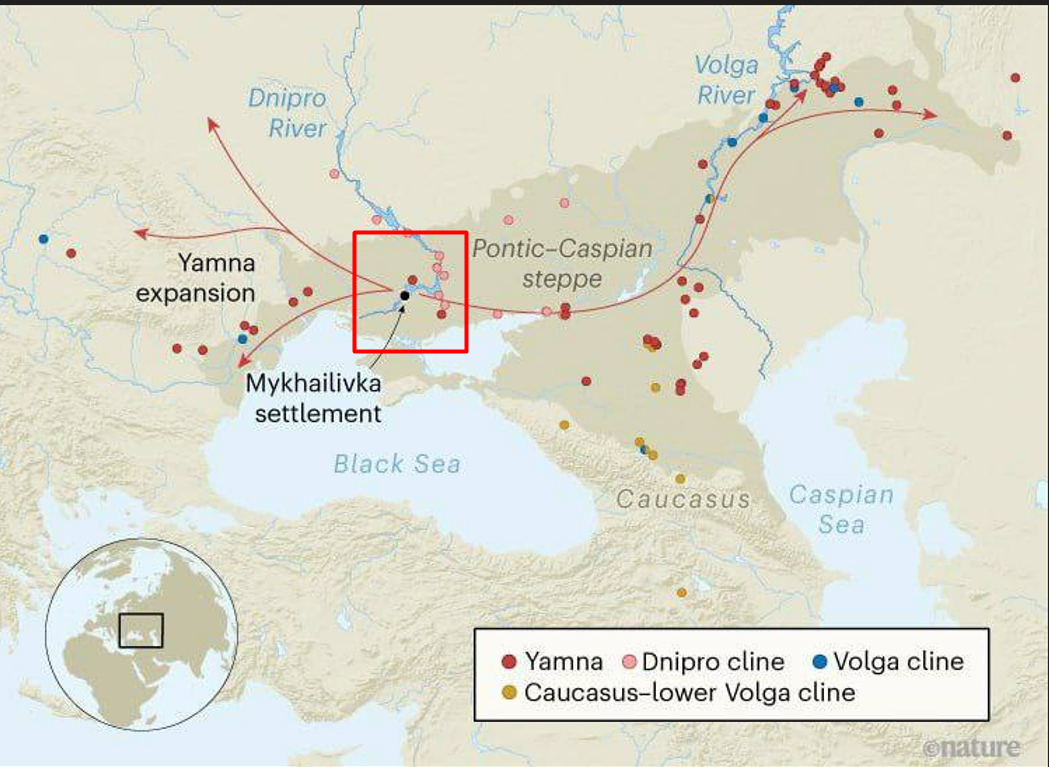
“Archaeological, linguistic, and genetic evidence suggests that a nomadic Bronze Age culture called the Yamnaya, who built massive burial mounds known as kurgans in the steppe north of the Black Sea, spoke a form of Proto-Indo-European. Beginning around 3100 B.C., the Yamnaya migrated as far as Bulgaria and western Siberia, spreading their language with them…
It suggests that these Proto-Indo-European speakers, whose ancestors went on to spread their languages across Eurasia, originally descended from a small clan of perhaps just 2,000 people living in what is now eastern Ukraine.”
Yamnaya Origin
In March of 2025, the Wall Street Journal published a scientific article titled ‘The Ancient Horsemen Who Created the Modern World.’
The summary under the title is very important because of the widespread misconception about the Yamnaya Culture boundaries:
“New DNA research shows that half the human beings alive today are descended from the Yamnaya, who lived in Ukraine 5,000 years ago.”
Following are several crucial quotes from that study:
“The Ukrainian hamlet Mykhailivka, now under Russian occupation, was pinpointed as the genetic cradle of the Yamnaya. From there they exploded across Eurasia, spreading their genes and their way of life from Portugal to Mongolia. This expansion, archaeologists and geneticists say, defines much of the world’s genetic and cultural heritage to this day. “They changed the populations of Europe, and ultimately, the world,“ a geneticist at Harvard Medical School, David Reich said.
Reich’s award-winning lab at Harvard has one of the largest ancient DNA databases in the world and uses state-of-the-art proprietary gene-analysis software.
The language of the Yamnaya, which was not written down but can be partly reconstructed by linguists, was the ancestor of 400 later tongues, including Latin, Greek, English, German, Persian and Macedonian.
The Yamnaya were also likely the first people to ride horses and use wheeled carts, technologies that allowed them to conquer the Eurasian steppe.
The Yamnaya also had biological advantages. Studies comparing their skeletons with those other contemporary groups show that, on average, they were about 6 inches taller, possibly as a result of their meat and dairy consumption, researchers believe.
It was a group of Arnold Schwarzeneggers riding into conquest.
One group derived from the Yamnaya were the Aryans, who shaped the cultures of ancient India and Iran.
Yamnaya-Scythians Link
Scythians were the descendants of the Yamnaya, and it has been recently confirmed by the studies described in the video on this channel.
The book Royal Scythia, Greece, Kyiv Rus had arrived at this conclusion by analyzing the Scythian myths and archaeological finds several years before the DNA study.
The book Cradle of Civilisations traced legends and symbols as they spread from the original Indo-Aryan homeland, the territory of present-day Ukraine was. It offered the interpretation of the myths about Heracles and the Centaurs, which is compatible with the image of a group of Arnold Schwarzeneggers riding into conquest mentioned above.