Excavations
Kurgan Soboleva Mohyla lies near the town of Nikopol in Dniropetrovsk Oblast of Ukraine. Renowned archaeologist Borys Mozolevs’ky directed its excavations in 1991 and 1992. Dr. Mozolevsky is best known for discovering the world-famous Golden Pectoral in 1971.
The kurgan lies within a constellation of some of the largest and richest Scythian kurhans, including Chortomlyk, Tovsta Mohyla, and Aleksandropol.
Soboleva Mohyla, 50 meters in diameter and 6 meters high, was constructed during the third quarter of the fourth century B.C. Construction occurred in three phases, each linked to a male burial.
The other burials in the kurhan were of a woman and an adolescent, accompanied by three servants and a bridled horse.
A circular ditch around the kurhan contained remains of Greek amphoras used in the funerary feast, along with the bones of ox, dog, and wild boar. Most of the burials had been looted twice, one not long after the funerary ceremonies, presumably by people who took part in them.
One male burial, registered as number 2, however, survived intact and contained numerous grave goods.
Horse Burial
The horse burial accompanied burial number 2 and was located 2 meters from the male burial. The horse was laid on its belly with its legs bent. The horse’s skull had silver bridle decorations of the following type:

Scythian Archer Burial #2
The Scythian warrior buried in this grave lay on a large wooden stretcher with a lattice structure, head to the west. His personal jewellery was made of gold.
Earring
A gold earring was found near the right temple.
Torque with Lions
A massive hryvna was placed around his neck. Bead-and-reel design decorated its spiral of heavy wire along the entire circumference. The finials were recumbent lions with engraved detail. The lions were shown in full length with their heads resting on outstretched paws.
Two Bracelets with Wolves
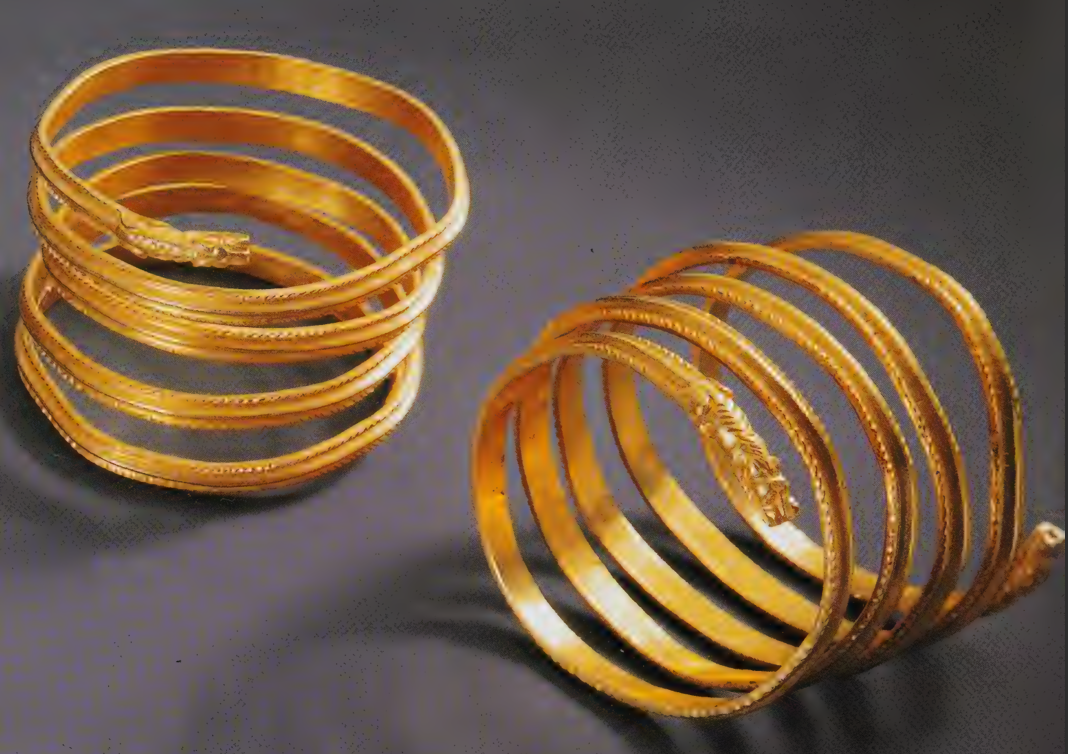
The wrists of both hands were decorated with spiral bracelets. They were made of bronze with thin gold overlays. Each finial was in the form of a recumbent wolf with its head resting on extended forepaws.
Two Rings
On the ring finger of his right hand, he wore a ring with an image; on the middle finger he wore a ring with a smooth shield.
The first ring portrayed a relief scene of animal combat. In the scene, a lion attacks another animal, but the identity of the prey can not be distinquished. The second ring with the smooth oval bezel had an adjustable hoop.
Drinking Horn/ Rhyton
A silver drinking horn with a gold ram-head finial lay to the right of the buried man’s head. The horn’s neck was engraved with a scene of two griffins back-to-back. One griffin attacked a spotted leopard preceded by another spotted leopard.
Greaves
Bronze greaves covered the shins of the deceased warrior.
They were modified for horse riding. The parts of the greaves that covered the knees were shortened. The greaves completely covered the front of the leg from the foot to the knee, the outer lateral and partly posterior sides of the calves. The inner side of the calves was only partially covered. Most of the inner sides of the calves remained open, which was due to the specifics of equestrianism, when the inner part of the leg adjacent to the horse’s body does not need additional protection.
Strips from a Whip
Along the left arm of the warrior, on the edge of the stretcher, lay the gold strips of a whip handle in the form of a flattened spiral. Thin gold strips were pierced along each side with a row of ornamental holes. These thin bands used to be wrapped around the wooden haft of a whip.
Gorytos
Under the warrior’s left hand and along his thigh lay the bow-and-arrow holder with the sword attached to it.
The next video will be devoted to the gold decoration of the bow-and-arrow holder and other artifacts discovered beside the archer.
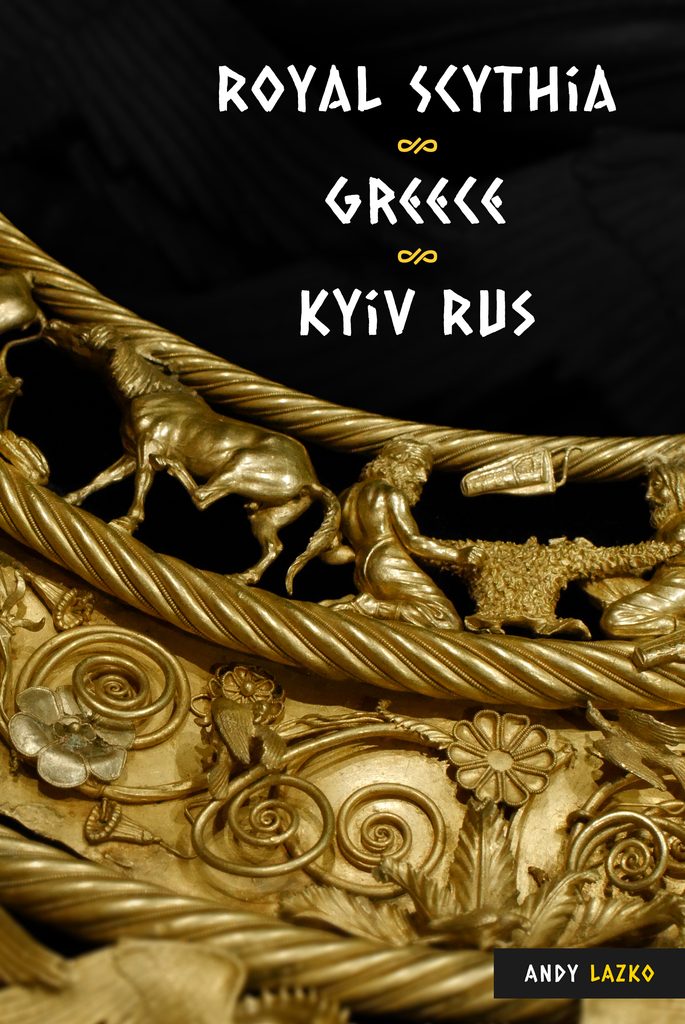
Meanwhile, you are welcome to check the “Royal Scythia, Greece, Kyiv Rus,” which has many little-known facts about the Scythians and their culture.