

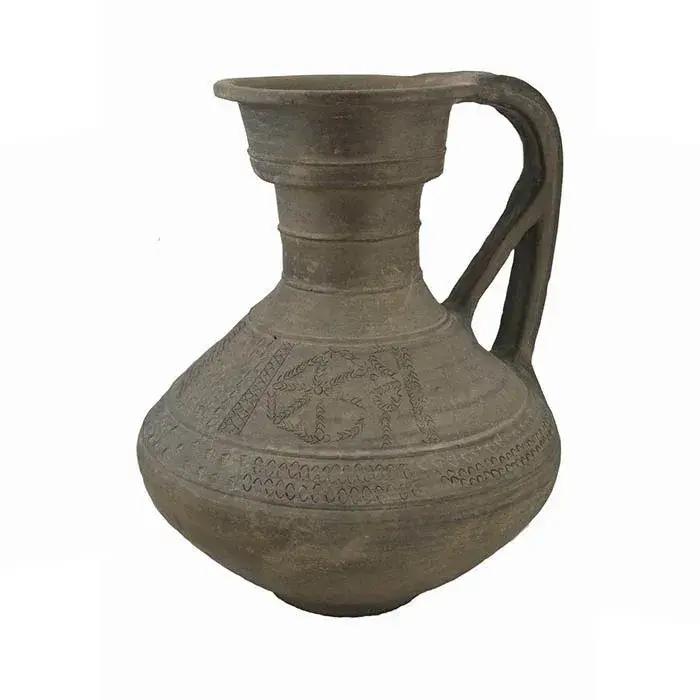
The ancient jug was found in 1899 during excavations near the village of Romashky in the Kyiv region by the prominent Czech archaeologist Vikentii Khvoyka. (The village of the Chernyakhiv, which gave the entire culture its name, is not far from Romashky). And this seemingly ordinary clay pot became one of the most famous artifacts of the Chernyakhiv culture.


Academician B. Rybakov studied the jug’s ornamentations in 1962 and here is what he concluded:
“An analysis of the ‘lines and cuts’ on these vessels led me to the conclusion that what we have here is a well-developed calendar system, with which the ancient Slavs counted days and months.
To date, approximately ten vessels are known that can be classified as calendar vessels. All of them originate from the region of intensive Slavic agriculture in the forest-steppe zone…
[But] of all the vessels from the Slavic agricultural forest-steppe that contain calendar themes, the most remarkable and important for science is undoubtedly the jug from the burial ground at Romashky on the Ros River, not far from Chernyakhiv itself.
The jug is meticulously crafted on a wheel. A complex “ornament” in two bands is applied to the wet clay before firing, using special stamps. The upper band is wider, the lower band is narrower.
It is impossible to consider combinations of several hundred symbols, arranged without any rhythm or repetition, as an ornament. The Romashky Jug had been published repeatedly, but for a long time, it attracted no attention. In 1962, I attempted to decipher the contents of this complex composition, and it met with no objections…
I’ll focus on the most important part of the images. I consider this to be the lower band, consisting of two rows of identical squares, stamped, like all the other designs, into the wet clay before the jug was fired…
All the rhythmic changes in the lower tier of images strictly follow the most important images of the upper tier. I believe the meaning of the squares was that they depicted individual days and, according to the calendar, precisely designated the dates of the most important pagan festivals in honor of Yarilo [Slavic god of vegetation] , Kupala Night [traditional East Slavic midsummer festival celebrated on the night of June 23–24, marking the summer solstice], and Perun [god of the sky].
First of all, we need to select and justify a starting point for calculating the proposed days. This is suggested to us by the “calendar” itself, whose author particularly emphasized the wheel-shaped hexagon with six radii—this symbol is drawn in large relief across the entire width of the upper band.
Only near this sign is the chain of squares—the days of the lower zone—interrupted, and there is a sharp change in the direction of the wavy lines: up to the wheel, the streaming lines go vertically, like rain, in four places of the “calendar”, and after the “thunder sign” they disappear from the upper tier and move horizontally in the lower tier under the image of a harvest field.
The semantics of a six-spoke wheel can be clearly understood using ethnography:… in Ukraine, where the function of lightning protection is performed by an old cart wheel or its rim, placed on the thatched roof of a hut or barn.
The widespread use of the same thunderstorm amulet among all Eastern Slavs—a hexagon or circle, but always with six radii—forces us to distinguish this figure from the general mass of symbols conventionally called solar, and to recognize such a wheel as a special “thunder sign.”

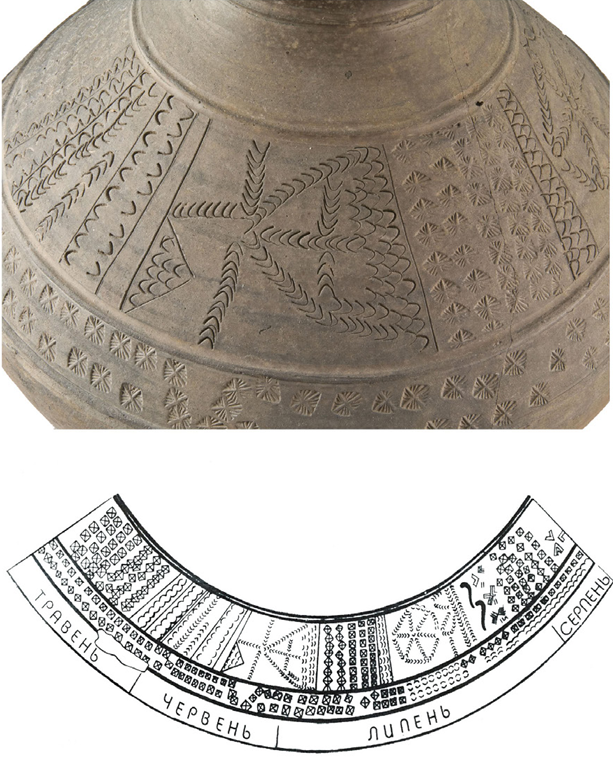
In analyzing the “calendar,” it’s most convenient for us to take as our starting point the wheel-shaped symbol, located almost directly in front of the harvest scene and serving as a “thunder sign,” a talisman against incinerating ball lightning. Taking this as our basis, we, as in proving a theorem, assume that the thunder sign is associated with the only date in the Slavic calendar when the day of the god of thunder and storm was celebrated with bloody sacrifices—July 20th.
Let’s check the validity of the assumption that the two crosses in the middle of the “calendar” are associated with the Kupala holiday. From July 20, which we took as our starting point, to Ivan Kupala Day (June 24), there are 27 days, counting both holidays. On the Romashy Jug, from the “thunder sign”—the wheel—to the two crosses, there are 27 square stamps, which we took as day designations. The coincidence is clear.
It is known that the Ivan Kupala holiday (as well as the celebration of Ilya’s Day and New Year) is preceded by a preparatory week, known as Mermaid Week. On our clay calendar, a garland of squares, disrupting their rhythm, closely adjoins Kupala Day (June 19–24), preceding it. This garland consists of six stamps, including Kupala Day itself, which concludes this week.
The fact that the week here is limited to six days should not confuse us, since it is precisely the six-day week that should be considered ancient Indo-European. Traces of it are found among both the Slavs and Germans; in written sources, it is recorded for the Sogdians. So, the ethnographically well-known Mermaid week is precisely marked on our calendar—June 19–24.
Thus, after four tests, the hypothesis that the unevenly spaced squares of the Romashkovo jug’s lower tier represent the days of the summer months was confirmed, and the holiday symbols were assigned to specific dates in June and July: June 4 – Yarilo Day; June 19–24 – Mermaid Week; June 24 – Kupala; July 20 – the day of the god of thunder and lightning.
The fifth clue is the fact that four squares after the “thunder sign” on the jug are depicted as sickles and sheaves. The spring crop harvest in the Kyiv region begins around July 24, so again, there is a coincidence with the dates of the clay calendar.
I believe that the above coincidences are sufficient to apply the word “calendar” to the Romashky Jug without quotation marks. Until now, I have examined it selectively, but we should be interested in this entire 96-day calendar, its beginning and end, the meaning of choosing this particular segment of the year, and the interconnectedness of all the images of the upper “belt of holidays” and the lower “belt of days.”
To determine the entire calendar, we must turn to some ancient calendar system that would help us most reliably divide this 96-day period of the year into months. Our modern counting system, with months of 30, 31, 28, and 29 days, is, of course, unsuitable.
It can be assumed that the ancient Slavic year was divided into 12 months of 30 days each, ending on December 25. Each month may have had its own Kalends, which is preserved in the concept of 12 Fridays distributed throughout all 12 months. The remaining six days were obviously preparation for the New Year’s holiday on January 1st. The sacred New Year’s fire, “badnyak,” was lit on the night of December 25th.
Counting from our reliable reference points—Kupala and Ilya’s Day—we find that the counting of days began on the jug calendar on May 2 and ended on August 7 (in Ukrainian terminology, from Traven’ (’grass’ month) the 2nd to Serpen’ (’sickle’ month) the 7 – B. Rybakov found it important to mention Ukrainian language, not the translator of the text).
Given that all the memorable days marked on our calendar are associated with agrarian magic, and that the calendar itself ends with images of sickles and ears of grain (arranged like sheaves in sacrums), the overall meaning of the entire calendar should also be sought in the area of the agrarian interests of the ancient Polyans [Slavic tribe].
If we consider the growing seasons of the most important, basic grains that have been cultivated in the Kyiv region since the Trypillian period, we will see that this period of the year almost exactly corresponds to the ripening periods of spring wheat and barley, and diverges significantly from the timing of later-emerging crops—millet, winter wheat, and rye.
According to current data for the Kyiv and Zhytomyr regions, spring wheat germinates on average from April 26 to May 1 (varies by region), and reaches wax maturity between July 13 and 22. Barley germinates between April 27 and May 1 and ripens between July 13 and 20.
Our calendar starts counting from May 2nd, i.e., from the very first shoots that have just emerged. The beginning of the harvest on the calendar is July 24th, i.e., soon after the waxy ripeness is reached.
The holiday of May 2nd (close to the pan-European holiday of spring) is a holiday of sprouts, young shoots.
The period from July 24 to August 7 is the time of harvest, drying the sheaves in the field, and transporting them away. The final deadline signifies the final settlement with the field works. The sheaves had been taken away for threshing, and only a few last ears of grain remained in the field… Incidentally, at the very end of the calendar signs of the Romashkov jug, a solitary symbol of ears of grain sheaves is depicted.
Do the beginning and end dates of this spring cycle have any significance in the folk calendar? Are there any holidays, pagan or Christian, close to May 2nd and August 7th?
On August 6, the Transfiguration Day, popularly known as the “Second Savior,” was widely celebrated throughout Ukraine. It was a harvest festival. Loaves of bread from the new year, apples, pies, and honey were displayed on tables in the village or brought to the church.
In Ukraine, until the 20th century, this was one of the most solemn days of the year, the day of “fruits of the earth.” The difference of one day between August 6 and 7 means absolutely nothing, since we know that as a result of the fusion of pagan holidays with Christian ones, some ancient festivities migrated along the Easter calendar.
It is very likely that the “second savior” covered up an ancient harvest festival that was close in time, but completely different in content.” (’Paganism of Ancient Slavs’)
The book “Cradle of Civilisations” takes a closer look at the Trypillia Culture and other amazing artefacts of that and much earlier periods.