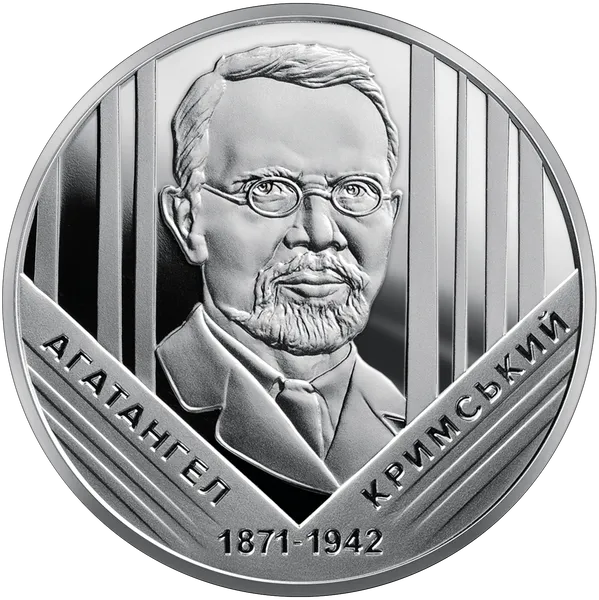
Agathangel Krymsky (1871-1942) was a polyglot who was fluent in 35 languages (some estimates put it at up to 60), including Arabic, Persian, Turkish, Hebrew, Coptic, Ethiopian, Sanskrit, Chinese, Japanese, numerous Caucasian and Turkic languages, as well as Slavic and Western European.
From 1892 to 1896, Krymsky lived in Beirut and Damascus, where he studied the Arabic language and culture in a natural setting. It was there that he collected a vast amount of material for his works on Arabic dialectology, Islamic history, and literature. After his return, he taught at the Lazarev Institute (1898–1918), becoming a professor of Arabic and Turkish philology.
The phenomenon of Agathangel Krymsky consisted of a remarkable memory, a systematic approach, and a profound interest in Eastern and Slavic languages simultaneously.
The main turning point was his decision to devote himself to Ukrainian science. Even in his youth, Krymsky became fascinated with Ukrainian literature, corresponding with Ivan Franko, Lesya Ukrainka, and Mykhailo Hrushevsky. Although Krymsky was not ethnically Ukrainian, he described himself as a “Ukrainophile”.
“You know, I don’t have a single drop of Ukrainian blood; I was just born and raised in Ukraine. Although I am not Ukrainian by birth, I am completely Ukrainianized”.
It was he who became one of the pillars of Ukrainian science: he laid the foundations of Oriental studies, wrote and translated, and left behind thousands of scientific works and dictionaries.
Krymsky researched the history of the Ukrainian language. He became a major opponent of Russian Professor of Linguistics Aleksey Sobolevsky (1857-1929), who defended the chauvinist concept that a single Russian language was divided into a ‘Great Russian’ (including Belarusian) and a ‘Little Russian’/ ‘Malorussian’ (ie, Ukrainian) dialect.
Krymsky debunked Sobolevsky’s claim that the language of the ancient Kyiv Rus was more Russian than Ukrainian in three polemical studies published from 1904 to 1907. One of those studies, titled ‘The Language of Ancient Kyiv’, is currently freely accessible at the Archive. org.
Translations of the first and the last pages of the work are below:
“In the 1905 issue of Izvestia, Mr. Sobolevsky published an article entitled “Old Kyivan Dialect” (pp. 308–323), in which he tries to convince readers that the Old Kyivan dialect was closer to the Great Russian [Russian Language] than to the Little Russian [Ukrainian Language]. I mean to dwell only on some, namely, the newer parts of this article, and not on the whole, and there are reasons for that.
To challenge Mr. Sobolevsky’s article as a whole would be a completely superfluous, completely unnecessary, and completely useless undertaking, because Mr. Sobolevsky almost entirely repeats in it all the same arguments that he put forward 20 years ago. The groundlessness of all the arguments put forward by him then has already been already thoroughly revealed by outstanding historians and philologists, moreover, among the names of philologists who rejected the idea of Mr. Sobolevsky, one can name two such deeply authoritative names in the study of Slavic-Russian philology as Academician Shakhmatov and Academician Yagich (the patriarch-head of all modern Slavic scholars).
Sobolevsky, repeating now in Izvestia his old, clearly scientifically refuted, considerations, not only did not try to refute first the arguments of his accusers, – scientists, authoritative historians, and philologists, – but on the contrary: he repeats all the same old ideas of his with such an air as if he did not know that they had long been refuted.
I will only note that Mr. Sobolevsky continues to propose studying the Old Kyivan dialect not from genuine Kyivan monuments, but from such unreliable ones as the Mstislav’s Charter of circa 1130, which in another case Mr. Sobolevsky himself recognized as “undoubtedly written in Novgorod.”
A. Krymsky summarized his conclusion at the last page of the work cited:
“We have examined all of Mr. Sobolevsky’s arguments that are at all novel. This examination has once again confirmed that the Old Kyivan dialect is the direct ancestor of the current Little Russian [Ukrainian] speech of northern and central Kyiv and Chernihiv regions, along with adjacent parts of Polesia.”
In his other book, Philology and Pogodin’s Hypothesis, A. Krymsky is even more categorical:
“[If] we review literary monuments, both those actually written in Kyiv and those imposed on Kyiv by Mr. Sobolevsky, it turns out that
in ancient Kyiv, there was nothing at all Non-Little Russian
[Nothing Non-Ukrainian].” (p. 11)
Krymsky was a very prolific author, writing over 1,000 scientific papers. For his incredible work in the study of Oriental studies, his name was included in the UNESCO list of outstanding figures of the world.
Since the late 1920s, Krymsky was systematically persecuted by the Soviet authorities. He was accused of “Ukrainian nationalism,” “bourgeois cosmopolitanism,” and “anti-Soviet activity.” He was especially remembered for his refusal to sign the Russified spelling of 1928 (Kiev instead of Kyiv as an example) and his proximity to the “nationalist underground.”
Therefore, in the 1930s, Krymsky was deprived of the opportunity to publish and teach. His scientific activities came under strict control of the Soviet authorities, and he himself became the object of ideological attacks.
In July 1941, during World War II, the 70-year-old, almost blind scientist was arrested in Zvenyhorodka (Cherkasy Oblast), where he was staying with his sister. He was accused of being “an ideologist of Ukrainian bourgeois nationalism who led the nationalist underground for years.” After interrogation and torture, Krymsky was transferred to Kustanai prison (Kazakhstan).
The official cause of death, which occurred on January 25, 1942, was exhaustion, old age, and general weakness. However, researchers believe that the real causes were cold, hunger, terrible conditions of detention, and the effects of torture.
The place of burial is still unknown. Only in the late 1950s was Agathangel Krymskyi posthumously rehabilitated. His name was returned to Ukrainian science, but the tragedy of the genius’s life remains a symbol of Stalin’s destruction of the Ukrainian intelligentsia.
In modern Ukraine, scientific institutions are now named after Krymsky, and there are awards and international conferences honoring his work. Multi-volume collections of his works continue to be published for modern researchers.
Agatangel Krymsky is not only a world-class polyglot and orientalist. He is a man who chose Ukrainian identity despite his Tatar roots and paid the highest price for it.
His legacy is restoring the historic legacy of Ukraine over Kyiv Rus history and identity, which neither repression nor time could destroy.
Russian is a dialect of Ukrainian language, – famous lexicographer Vladimir Dal concluded >
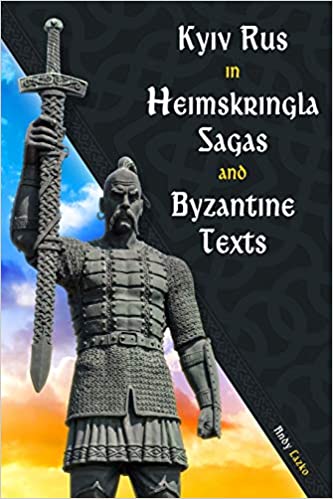
The book ‘Kyiv Rus in Heimskringla Sagas and Byzantine Texts‘ strives to recreated true history of Rus-Ukraine using Scandinavian Sagas and historic accounts of contemporary Constantinople.