Discovery
On June 21, 1971, while working inside the Scythian Kurgan, the head of the expedition, Borys Mozolevsky, began clearing the dromos, where a large three-handled amphora had already been discovered standing against the wall.
And it was there, almost at the transition from the dromos to the cell, that the archaeologist came across an improbable find – a pectoral. Borys Mozolevsky described this event in his work diary:
“It happened at 2:30 p.m. The pectoral was cleared on the spot, but it was all covered in clay mud. Then they lifted it up and washed it in a basin. Everyone immediately screamed and started kissing.”
Next to the pectoral in the middle of the dromos lay an iron sword with a hilt decorated with a gold plate. The sword was placed in a scabbard decorated on the front with a gold plate embossed with animal images.
“No, that’s enough for today,” Borys Mozolevsky emotionally concluded his diary entry that day.
Tovsta Mogyla Kurgan
Tovsta Mogyla was the name of the large Scythian Royal Kurgan of the 4th century BC that Borys Mozolevsky was excavating. It is situated in the Dnipro region of Ukraine, only ten kilometers to the west of the famed Chertomlyk discussed earlier on this channel.
The central vault contained the remains of a Scythian nobleman. The vault had been looted in antiquity, and why such valuable objects were not in the chamber, next to the deceased, but in the dromos remains a mystery.
But it is likely that this very location saved the pectoral and sword from the robbers. Mozolevsky suggested that by the time the thieves entered the tomb, the objects in the dromos were covered by soil that had collapsed from the vault.
According to Mozolevsky, the looters even walked over the two treasures without noticing them.
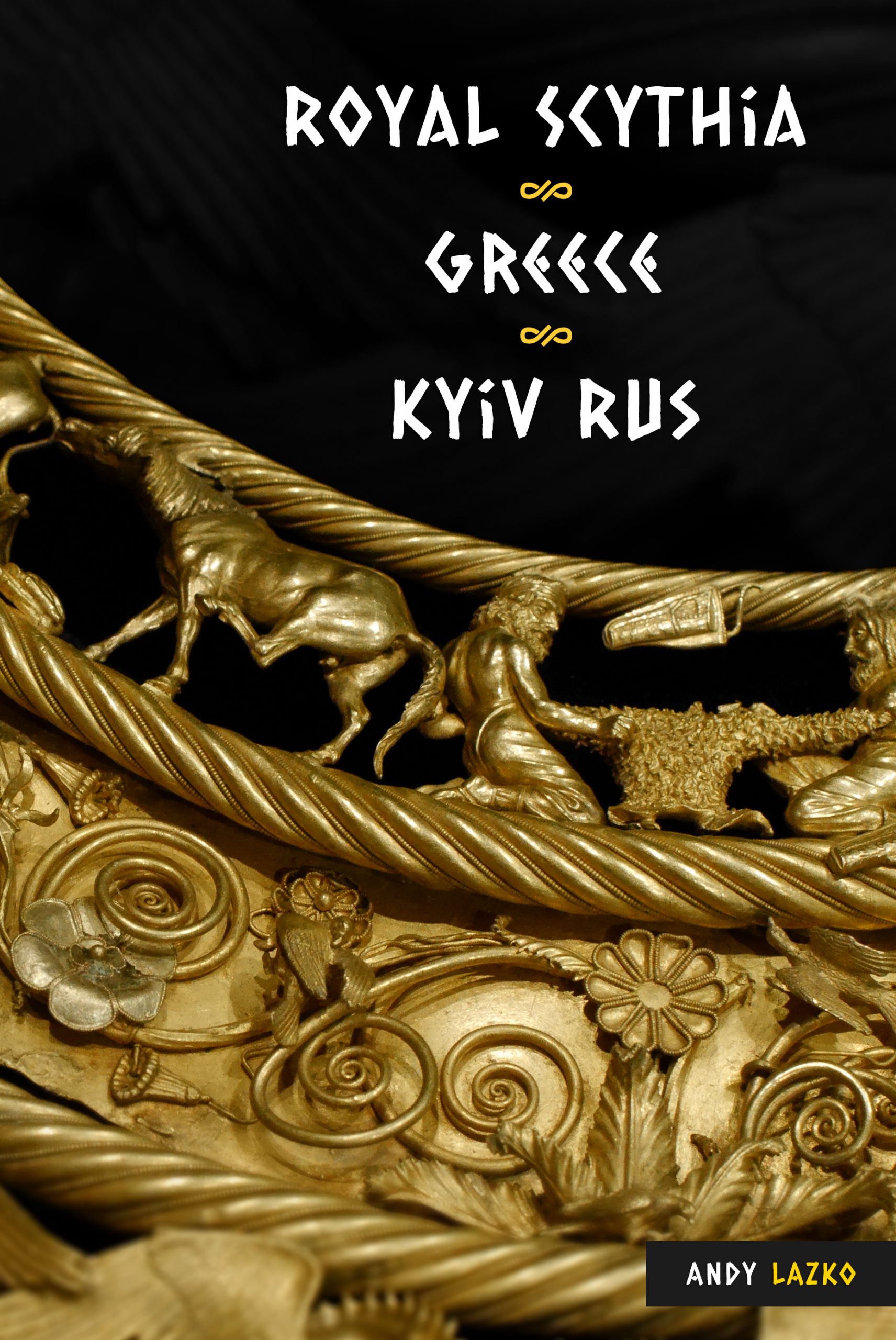
The discovery of the pectoral caused an unprecedented sensation. Especially in Scythian studies. The pectoral from Tovsta Mohyla is rightfully considered a unique work of ancient jewelry art for its artistic design, manufacturing techniques, and distinctive features.
Mozolevsky pointed out that the abundance of images depicted on the pectoral is unparalleled throughout the ancient monuments of Scythia. No less important is the virtuosity with which the artist has achieved the coordination between each image and its place in the composition.
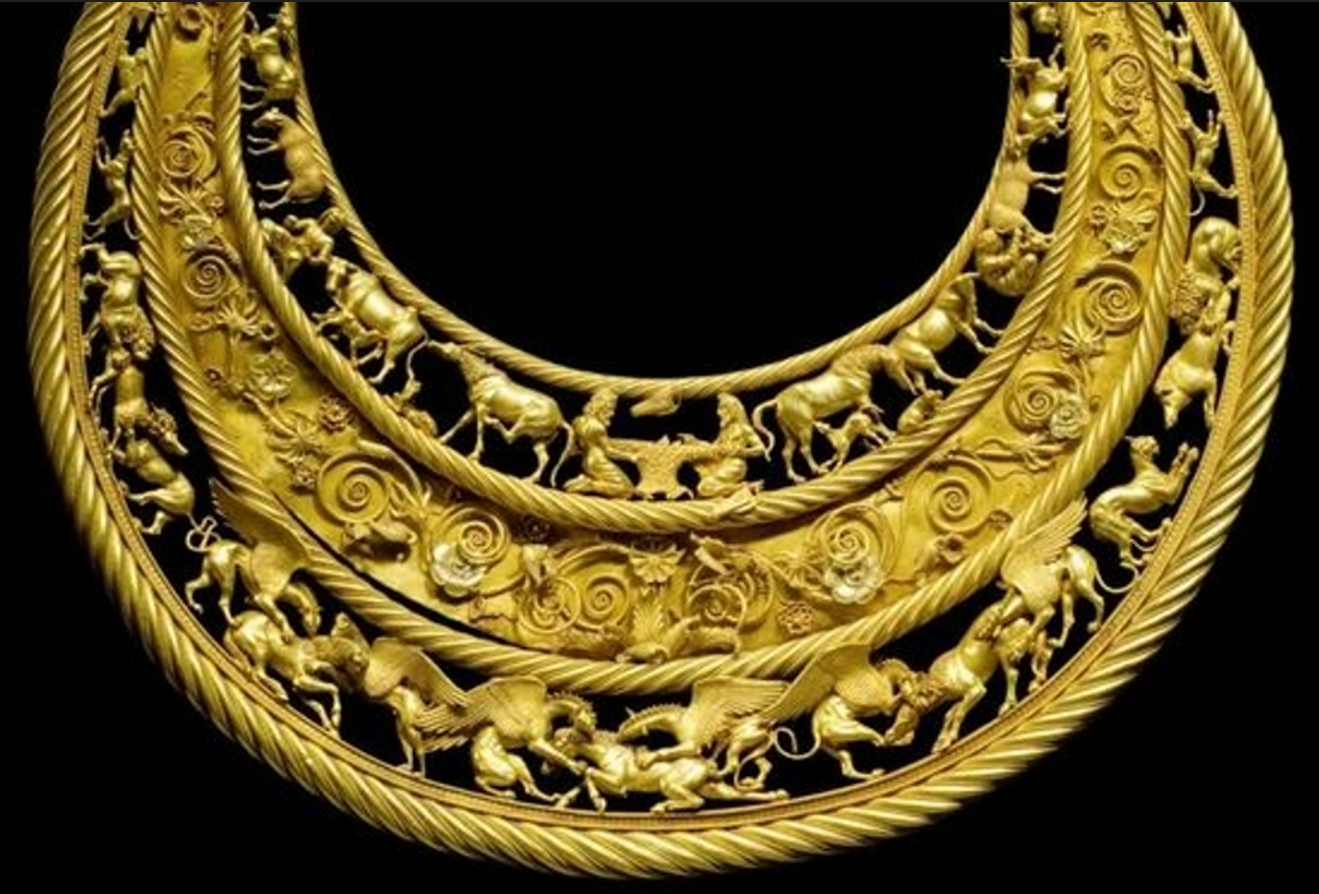
A massive yet elegant piece of jewelry, crafted from high-quality gold, is shaped like a crescent moon, measuring 306 mm in diameter and weighing 1149 grams.
Its moon-shaped field is divided into three tiers by four twisted strands. Each tier of the pectoral is filled with sculptural images of different subjects.
The top tier is believed to depict aspects of Scythian daily life. The middle tier presents various animals, and the bottom tier illustrates real and supernatural creatures.
Bottom Tier
In the center of the bottom tier, griffins tear horses apart, on the sides – a fight between a wild boar and a deer with panthers and lions, then – dogs chasing hares. The dynamic animal figures are full of life – the pain and doom of the horses, the despair of the boars, the rage and bloodthirstiness of the predators, each with its own unique character and emotional coloring.
The horrific scenes of wild beast fights are completed by small figures of grasshoppers facing each other.
Middle Tier
The grasshoppers smoothly transport us to the world of blooming nature of the middle frieze, which connects the images of the three tiers into one perfect composition.
The openwork interweaving of shoots and flowers of the central frieze, complemented by five miniature bird figures, enchants with its tranquility.
Top Tier
The culminating plot of the entire work is the central scene of the upper tier, where two unarmed men, stripped to the waist, appear to be sewing wool clothing.
To the right and left of them are depicted figures of domestic animals – cows, horses, sheep with their newborn babies, and between them are symmetrically arranged figures of two young Scythians: one milks a sheep, the other covers an amphora with a tuft of grass. The master realistically recreated the pictures of the peaceful life of the Scythians and completed them with figures of birds flying in all directions, creating the impression of the steppe’s boundlessness and, at the same time, the completeness of the idea.
Technical Issue
However, the uniqueness of the pectoral is not only in its unique artistic images, but also in the technical perfection of its execution. It seems that all the technical means known to ancient jewelers were used to make the ornament.
This suggests it could have been created in a jewelry workshop equipped with sophisticated machinery, reflecting the highest achievements in the artistic processing of metals in the ancient world.
The pectoral consists of over 160 parts. These are four frame harnesses, a channel-shaped border, paired holders, hinges, pins, braids, tips, rings, and cast figures of the upper and lower tiers, as well as a floral ornament with sculptural images of birds of the middle tier.
The advanced and complex technology of manufacturing pectorals involved several dozen technological operations: melting metal; manufacturing blanks of various shapes, gold sheets, wire, and their refinement to give them different diameters and profiles;
cutting blanks of the required shape from sheets; cutting wire to the required size; making wax models of high-relief or sculptural images; creating clay casting molds from wax models and casting itself;
punching, forging of metal; stamping, engraving; drawing and twisting of individual parts; figured bending; figured cutting; preparation of solders and soldering; wire weaving; enameling; the complex process of assembling the entire product using various devices and wire; grinding, and so on.
Ornamental finials in the form of lion heads
As an example, let us take a closer look at paired ornamental finials, which are typical of ancient jewelry art. Their general appearance and production technology are characteristic of hryvnas and bracelets found in Scythian Kurgans of the Northern Black Sea region.
The Pectoral finials consist of clips, high-relief endings in the form of two lion heads, and movable connecting elements such as hinges and braid.
The upper part of the holders is decorated with gold wires curved in the form of a floral pattern and edged with ribbed wire.
From a technological point of view, braided chains that are made of thin wire with a diameter of 0.5 mm are interesting. The length of each, including the fastening in the holder, is about 10 mm, the width is 17 mm, and the thickness is 5 mm.
The technology of weaving wire braid is similar to that of weaving threads, from which it was probably borrowed. Analysis of the dimensions of the braids and wire links of the chains made it possible to calculate the total length of gold wire used by the craftsman to make them.
It turns out that each wire braid was made of 18 double chains, the interweaving of which required at least 1 meter of gold wire, meaning that about 2 meters of wire was used to make two ribbons.
Fugures
One of the most striking features of the unique artistic design of the gold pectoral from Tovsta Mohyla is the filling of its lower and upper tiers with miniature gold figures, which form complex compositional scenes.
It has been proven impossible to produce miniature figures of the quality of the pectoral with a large number of small details by simply pouring metal into a mold.
Because the gas released during the casting process inside the mold and the characteristics of the metal do not allow it to freely fill the smallest gaps and narrow channels without additional high pressure, which can only be created artificially.
How ancient craftsmen generated the necessary pressure to cast such miniature products is currently unknown, and the secret of the lost-wax casting technique still remains unsolved.
In terms of craftsmanship and technological perfection, the pectoral is unparalleled not only among Scythian gold but also among all jewelry of antiquity.
Its decoration is striking not only in the number of details, but also in its extraordinary miniature. For example, the dimensions of the bird figurines are only 5 by 13 mm, the gorytos are 6 by 10, the grasshoppers are 7 by 13, the people are 25 by 20, and the horses are 18 by 60 mm.
The size of many details is one-fifteenth or twentieth of the size of the figurines themselves. So one can only imagine what delicate tools the jeweler used to create them. He was undoubtedly a master of miniatures, skillfully working in the millimeter range, possibly using magnifying lenses made of rock crystal.
The accuracy of the figures and the skillful reproduction of the smallest details are mesmerizing. Creating figures of animals, the artist demonstrated a deep understanding of the peculiarities of their anatomy and behavior. It is illustrated by an almost photographic image of each animal.
The faces, hairstyles, and physiques of the Scythians are individual and differ from each other. One scholar observed that the faces of the two central Scythians were executed with such precision that they were most likely depictions of real people.
Workshop
The pectoral was made not just by an extremely talented craftsman but also by one well acquainted with the life and customs of the Scythians.
Borys Mozolevsky thought that the pectoral was made in the jewelry workshop of Panticapaeum, which is now the city of Kerch on the eastern shore of the Crimean Peninsula.
Bolshaya Blyznitsa Kurgan
Mozolevsky saw clear parallels between the scenes of pectoral with the scenes on the famed vase from the Chertomlyk Royal Kurgan. Both the excavations of Chertomlyk and the discussion of the vase are the subjects of the Royal Scythia, Greece, Kyiv Rus book.
A much simpler pectoral was discovered in the Bolshaya Bliznitsa Kurgan situated on the east shore of the Azov Sea. Several elements of the pectorals from Tovsta Mohyla and Bolshaya Blyznitsa indicate that they may have been made by the same master or at least in the same workshop.
The book Cradle of Civilizations tells the details of some amazing discoveries that the Bolshaya Blyznitsa excavations produced.