“Given the lack of folklore materials that could retrospectively illuminate the Slavic-Scythian relations of the 7th – 3rd centuries BC, one should turn to archeology and the applied art of the animal style…
First of all, it’s necessary to identify from the vast array of animal-style subjects those that can be firmly linked to geography, a specific landscape zone, and the fauna of a known historical area. Here, the moose, whose image in animal style has already been highlighted, deserves special mention.
Elk are not found in the steppe; their habitat is forests, dense thickets with swamps, lakes, and oxbow lakes. In the south, elk enter large forest islands in the forest-steppe zone, but never venture into the pure feather-grass steppe.
In other words, the elk is an animal incompatible with the area of Scythian nomadism, but common in the area of settlement of the Proto-Slavs, from the border with the steppe to the north to the Pripyat swamps, and their eastern neighbors, the Budins, the forests north of the Seim River.
And it is precisely in this forest-steppe zone that images of elk are found in “Scythian” applied art: in the Seim River area, there are fewer, in the Dnieper Right Bank, there are significantly more.
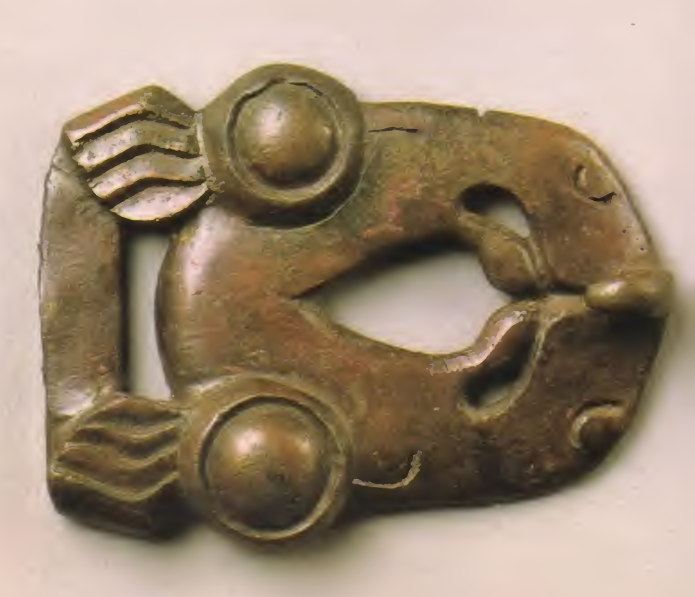
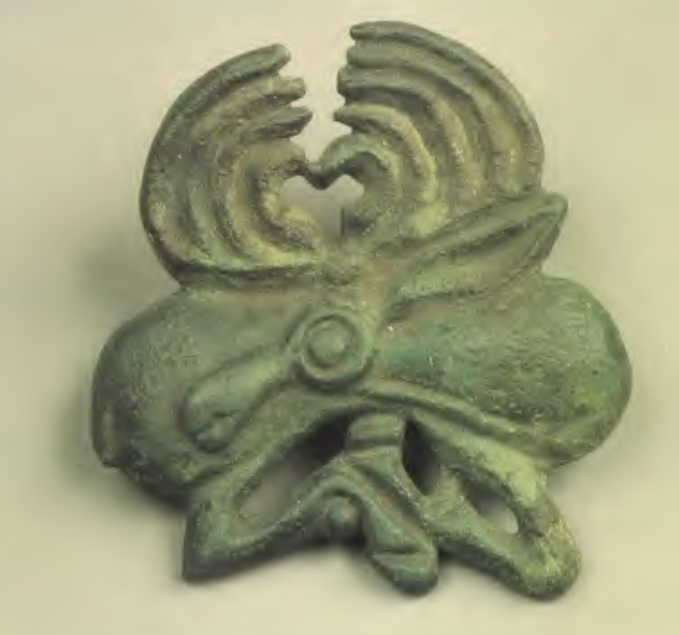
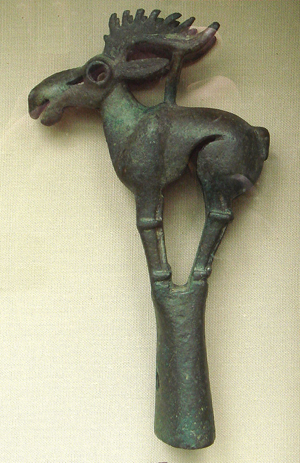
In the Skolots’ Right Bank, moose were depicted on sewn-on plaques, cheekpieces, banner tops, and horse harness decorations.
Of particular interest is a remarkable set of horn plates that decorated harnesses, found in a burial mound dating from the 7th–6th centuries BC near Zhabotin (village in Cherkasy region of Ukraine, situated on the Tiasmyn River, a right tributary of the Dnieper).
Two plates with massive tabs (cheek plates?) are each decorated with images of a female elk with a young calf. This archaic motif immediately brings to mind hunting myths about two female elk—a mother and daughter—who are the Heavenly Mistresses of the World.
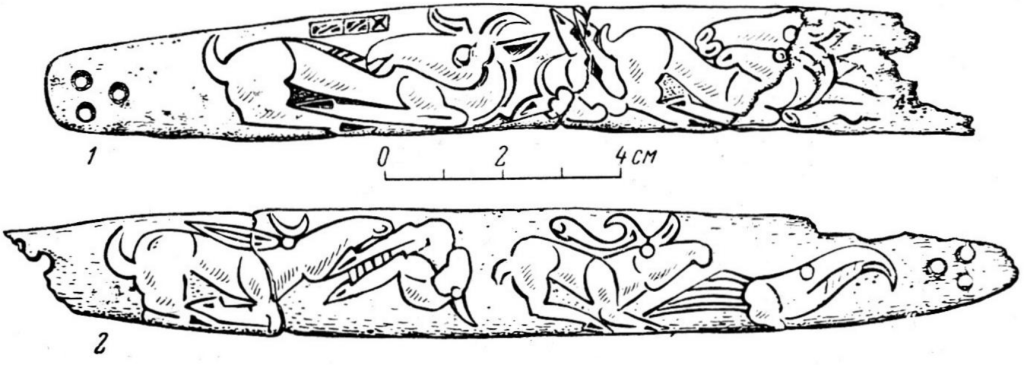
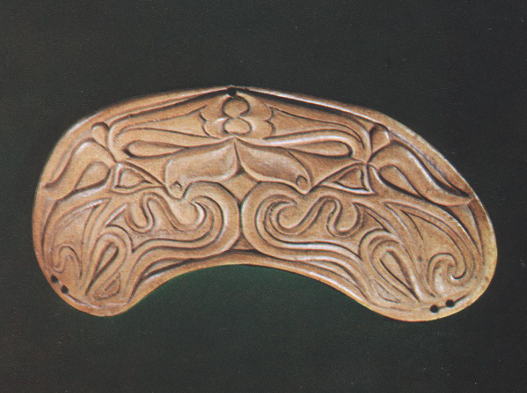
Of even greater significance for our topic are four long plates, apparently sewn onto the papers – the straps on the horse’s chest that hold the saddle…
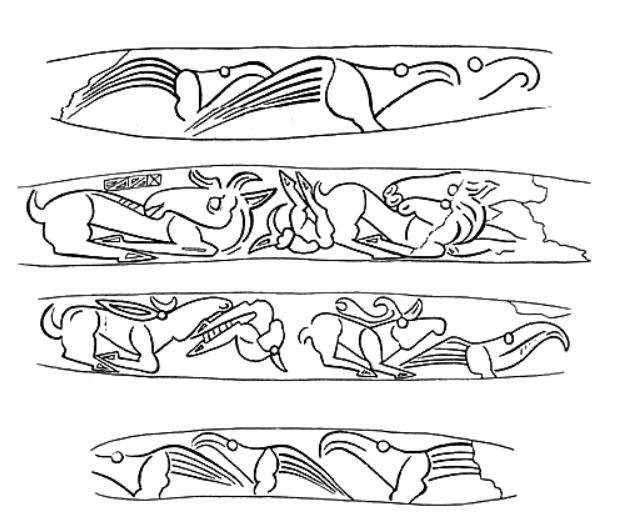
The ornamented horn plates from burial mound No. 2 in Zhabotin deserve more careful consideration. As for the ethnicity of the artist who engraved the images on the plates, the main argument here is the artist’s excellent knowledge of the life and anatomy of moose of different ages; he skillfully depicted a newborn moose calf, a young moose with sprouting antlers, and a powerful elk with heavy antlers lying on its back.
All this was inaccessible to the Scythian steppe dwellers who traveled in kibitkas across the treeless steppe, and, on the contrary, was quite natural for the inhabitants of the vicinity of Zhabotin, where on one side there were large fortified settlements, which were the center of crafts, and on the other, northern side, there was a huge forest island of a hundred square kilometers – the right bank of the Ros River…
The meaning of the entire composition is easy to determine: a flock of predatory steppe birds, similar to vultures with huge hypertrophied beaks, attacks a herd (family) of elk at the moment of calving of the females, when the predators still have hope of carrying off the intended prey – newborn little elk calves.
The herd of elk is positioned exactly as it should be in a moment of danger: in the middle stands a cow elk with a young elk calf—this pair repeats the images on two cheekpieces; near her rear is a newborn elk calf—shown upside down, almost in statu nascendi [in the state of being born], shielded from the birds by a young elk, two years old (?), with small antlers.
The right plate depicts another young moose, not a cow moose as Vyazmitina thought, covering with its muzzle another newborn hanging upside down. Typically, a cow moose gives birth to two calves; both are shown here. At the right edge of the herd, the leader moose, the only adult moose in the entire group, is engraved. He leaps forward and chases away one of the vultures, forcing it to fly back to the herd.
What we see here is a small family herd of moose confronting a raid by large avian predators. The herd consists of three generations: a male moose with a mother moose; a young cow clinging to her mother; and two young moose directly involved in rescuing the tiny newborn calves.
To the right and left of the defending family are shown long rows of vultures flying toward their prey. If the broken ends of the plates with the birds were restored, they should be able to accommodate five vultures on each side.
The artist who engraved this remarkable composition clearly sided with the moose. He subtly depicted the herd’s intelligent organization; he depicted the hostile birds grotesquely, almost replacing the bird’s figure with a single monstrous beak. He chose an unusually dramatic moment—the hour of the birth of defenseless calves. He also demonstrated the results of the moose family’s defensive actions: the leader forced the most brazen of the leading vultures to retreat.
Analyzing the symbolic meaning of the composition, we have the right to think that in the historical conditions of the 7th – 6th centuries BC, when the Scythians, having defeated the steppe Cimmerians, invaded the Dnieper steppes and became immediate neighbors of the Proto-Slavs, such an image of an elk family, attacked by steppe predators, fully corresponded to the historical situation and expressed the idea of protecting the northern, “elk” land from the steppe vultures.
The choice of elk and vultures to symbolically depict the confrontation was precisely in keeping with the geographic location of the burial mounds at Zhabotin: they were located on the border line of forts separating the Slavic agricultural world from the southern, Scythian one. They were at the southernmost edge of the landscape zone inhabited by elk.
Beyond lay the steppe, with its treeless expanses and nesting sites for eagles and vultures. The symbolism was based on a real possibility: it was here, in the area of Zhabotin, Matronin, and Pastyrsky, that steppe birds could overtake a wandering herd of elk.
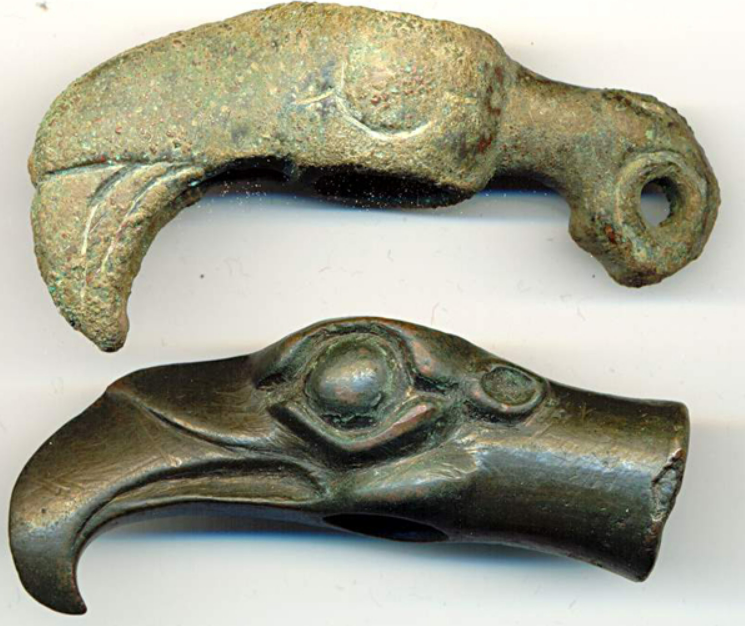
The identification of the Scythians with steppe birds in the symbolic composition may have been facilitated by the symbolism of Scythian banner finials. A bird of prey with an exaggeratedly curved beak is widely represented in early banner finials from Kuban Scythian burial mounds of the 7th–6th centuries BC.
Under these bird banners, the first raids of the Scythians took place upon their return from their distant eastern wanderings.
Later, when the Scythians had already occupied all the steppes and created a “land of sacred tombs” near the Dnieper rapids – the “region of Herr”, the situation was as follows: from the mouth of the Panticapa-Vorskla up the Dnieper, 10-11 days’ sail away, lived the Proto-Slavic tribes of plowmen, who had adopted much of the Scythian culture and had by this time reached a fairly high level of development.
From the mouths of the Sula and Vorskla to the bend of the Dnieper, near the modern city of Dnipro, there was a kind of neutral steppe strip, 3-4 days’ horse ride away.
The Dnipro region, where the Dnieper turns toward the rapids, was the northernmost point of the land of the Royal Scythians. Here, as if at the gates of the royal tombs, some guard must have been stationed, protecting the entrance to this region from various northern tribes who, descending the Dnieper, might be interested in the rich royal burial mounds located before the Dnieper rapids. It’s no wonder that folklore is so full of memories of underground gold in the steppe and coastal areas.
And indeed, at the very bend of the Dnieper, above the rapids, somewhat separated from the main territory of the sacred tombs, as if covering it from the north, the burial mounds of Scythian military leaders with a large number of banner tops are known (Krasnokutsky, Alexandropol burial mounds).
Many banners, or bunchuks, were topped with the heads of birds of prey with deliberately curved beaks, figures of winged griffins, and hippocampi tearing apart lambs. All of this is entirely consistent with the flock of steppe birds attacking elk in the engraved plaques of the Zhabotin burial mound.
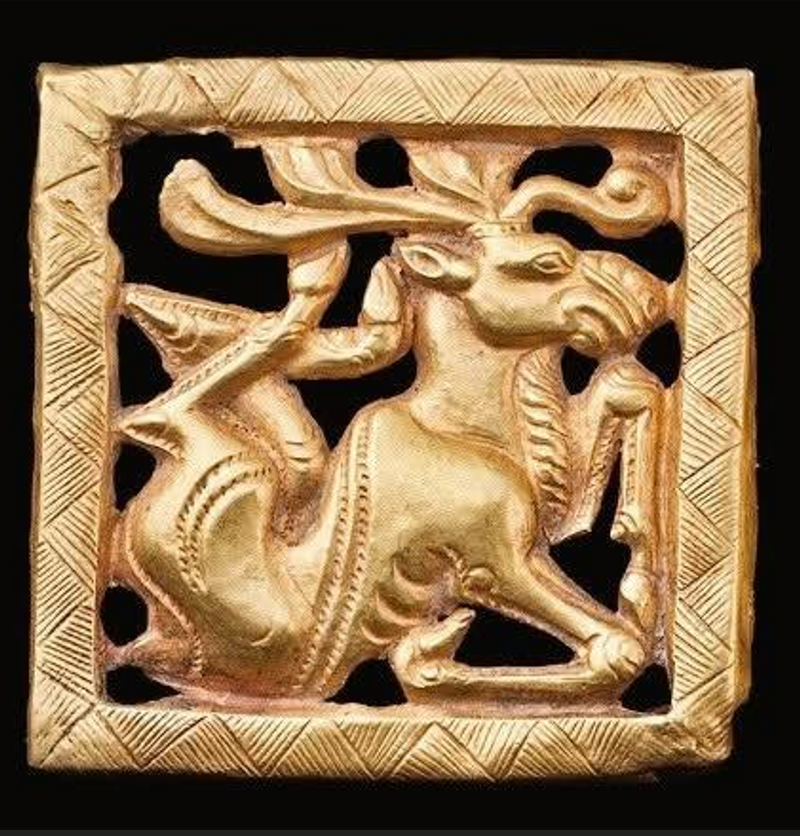
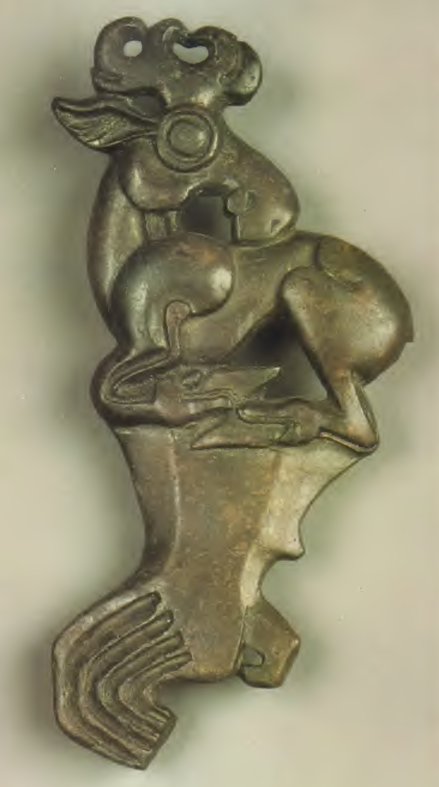
So, on the northern border of the land of the nomadic Royal Scythians, there was a sacred site symbolizing the steppe expanses and burial mounds of military leaders with standards, often decorated with images of birds of prey. And further north, beyond the empty strip and the line of border fortresses, we see finials in the form of an elk lying on a bird’s paw, and numerous elk images on various objects used by warriors.
The Zhabotin horn plates are of particular historical and cultural interest as a symbolic expression of the first Scythian raids on the bordering Proto-Slavic lands: the predatory steppe birds represent the Scythians of the 7th – 6th centuries BC, and the successfully defending family of elk is a symbolic representation of the Slavs…
The images of an elk or two female elks, sometimes replaced by deer, are well preserved, as we saw above, in East Slavic art – [Ukrainian] pysanky and embroidery.” (Academician B. Rybakov, Paganism of Ancient Slavs).
The book “Royal Scythia, Greece, Kyiv Rus” has more interesting facts about Scythia and Scythian Royal barrows.