“In exploring Herodotus’ route through the northern Scythian regions, it is necessary to touch upon the detailed description of the city of Gelon in the land of the Budinians, which may suggest Herodotus’s visit to this city.
“There is a city among them called Gelonos, built entirely of wood. Each side of its surrounding wall is quite high, measures almost three and a third miles [5.3 km], and is constructed only of wood, as are also the city’s houses and sanctuaries. For here they have sanctuaries of Greek gods, built in the tradition of the Hellenes, with statues, altars, and wooden temples; and they celebrate the biennial festival to Dionysos and conduct Bacchic rites” (§ 108).
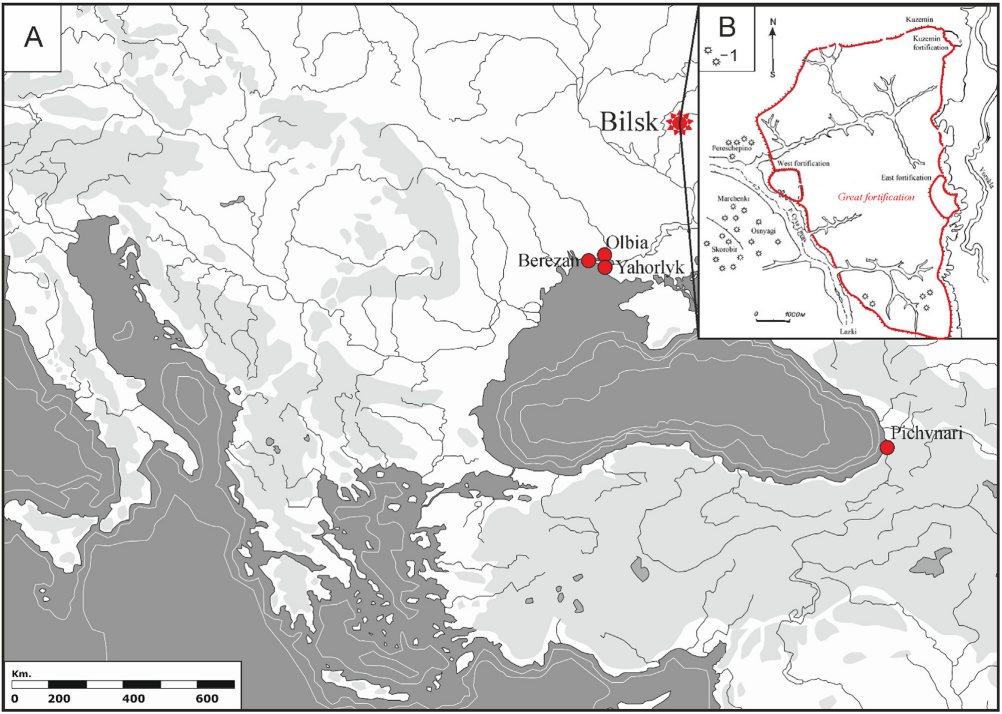
It is tempting to see in this description a reflection of the traveler’s personal impressions, especially since we know of a similar huge wooden city – the Velskoye settlement on the Vorskla River.
However, it should be said that the “effect of presence” is not perceptible here. It should not be forgotten that Greek merchants lived in Gelon, and that Hellenic speech was heard there. Archaeological evidence confirms the extensive trade relations between the residents of the Velskoye settlement and the Greek cities of Pontus. All the above-mentioned features of this city could well have been communicated to Herodotus by these Hellenic traders, who connected Olbia with the distant Panticapa [Vorskla River]. And Herodotus must have been interested in Gelon, must have asked merchants about him, since Gelon was, in all likelihood, the northernmost point reached by the Persian cavalry during the campaign of 512 BC.
It seems that the detailed and colorful description of Gelon is the result not of Herodotus’s personal impressions, but of a survey of Hellenic merchants who knew this unusual city of the Dnieper Left Bank well.
Herodotus didn’t even mention which river Gelon stood on, which he would have certainly done if he had personally inspected it; he was good at connecting the unknown to the known, but he didn’t do it here…
Herodotus’s Gelon has long been identified with the grandiose Belsk settlement on the Vorskla River, 35 km above Poltava. In all of Scythia and the surrounding lands, Herodotus names only one city—Gelon.
This is not surprising, since “the Velskoye settlement of the 7th-3rd centuries BC is the largest settlement of the Scythian period in Eastern Europe. The settlement covered an area of 4,000 hectares.
The dimensions indicated by Herodotus correspond not so much to the ramparts that have survived to this day, but rather to the traces of ancient ditches, clearly visible on the plan. Herodotus’s 30 stadia equal 5,320 m. The northern wall of the original Gelon is 5,300 m, and the eastern wall is 5,500 m. The coincidence is complete.
B. A. Shramko convincingly defended the identification of Herodotus’s Gelon with the Belsk settlement, rejecting other points of view. To his numerous arguments, I can add one more consideration: adjacent to the southern end of the Belsk settlement is the ancient Rus’ town of Glinsk, mentioned in a 14th-century list of towns. The root consonants (GLN) are identical to those of Gelon (GLN). It is possible that the name of this ancient town has survived into the Middle Ages and modern times.” (Soviet Academician B. Rybakov, ‘Scythia of Herodotus’).
The book “Royal Scythia, Greece, Kyiv Rus” has the story of the Persian King Darius the Great’s campaign into Scythia with more insights.