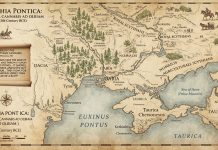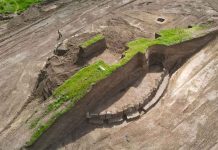
“Without repeating what has already been said about Herodotus’s brief excursions around Olbia (Cape Hippola, the sanctuary of Demeter, Hylaea, the mouth of the Dnieper), we must pay special attention to the traveler’s deepening into Scythia.
Direct evidence of Herodotus’ stay on Exampai [most likely ], four days’ journey from the estuary to the north (about 140 km), is the example of the cauldron of King Ariantus, which Herodotus “could see” (§ 81).
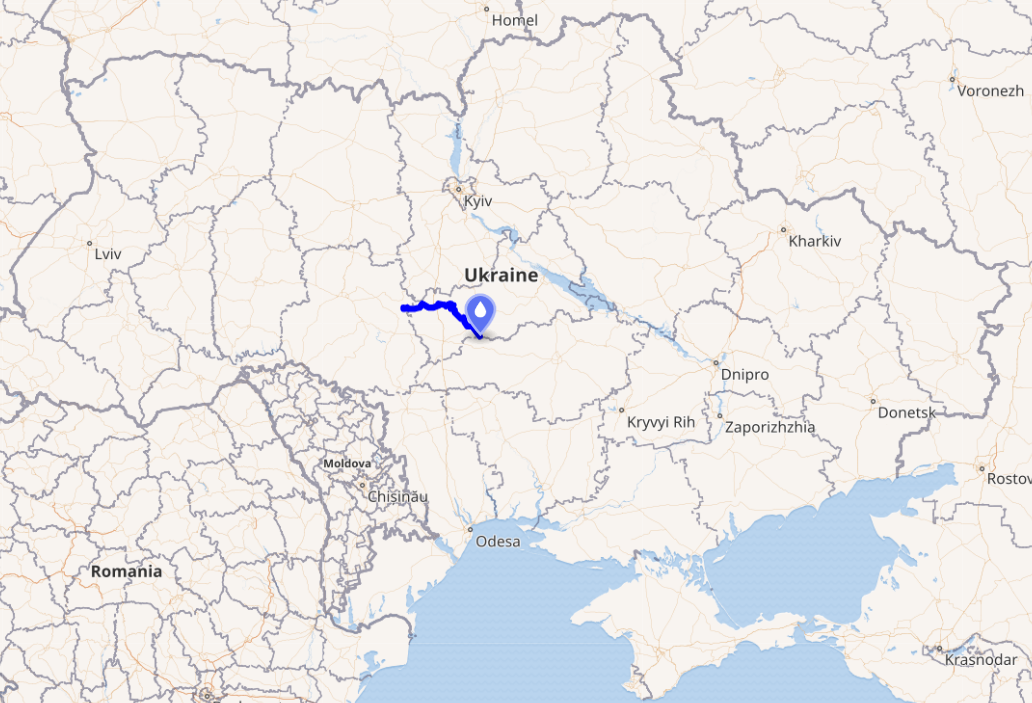
[Unexpected, but in Academician Rybakov’s opinion, undeniable, was the difference between Herodotus’ Hypanisand the Southern Bug, with which it was usually identified. The following composite form of Hypanisseems most likely: the Hirskyi Tikych– the Sinyukha River– the lower reaches of the Southern Bug. The entire river takes nine days to sail. The “insignificant river” Exampai is, in all likelihood, the Hnylyi Tashlyk, a left tributary of the Sinyukha.]
Based on the fact that the river Exampai “flows on the border of the Scythian farmers and the Alazons” (§ 52), we must admit that the inquisitive historian reached those agricultural tribes of the forest-steppe, “which the Greeks living near the Hypanis River (calling themselves Olbiopolitans) call Borysthenites” (§ 18). The lively trade relations between the Olbiapolitans and the Borysthenites, brilliantly confirmed by extensive archaeological material, facilitated Herodotus’ journey along the well-trodden routes from Olbia to the border “Sacred Ways” of the agricultural Scythians.
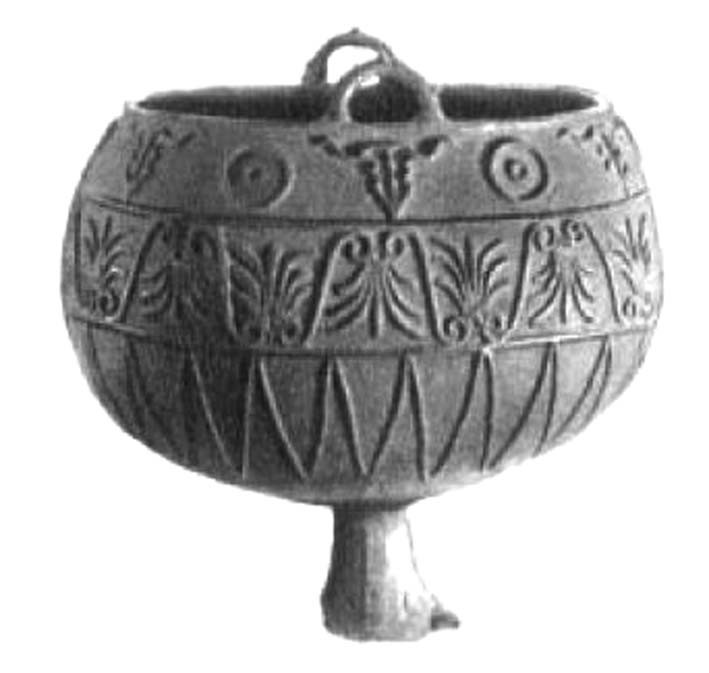
Judging by the archaeological map, Herodotus came into contact with the southern edge of the Kyiv group of agricultural cultures of the Scythian type, where burial mounds were located near Turiy, Zhurovka, Makiyivka, and such large, famous settlements as Sharpovskoye and Pastyrskoye.
Here, the basins of the Hypanis and Borysthenes (tributaries of the Tiasmina-Tysmeni) met, and here the forest-steppe with islands of oak groves and hornbeams began. This was no longer the Scythia about which Darius had been warned: “You are preparing, O king, to invade a country where you will not find either a plowed field or an inhabited city” (§ 97). There were also powerful border fortresses and plowed fields: Herodotus may have had them in mind when he wrote with admiration about the banks of the Borysthenes [Dnieper], “along which stretch excellent arable fields” (§ 53)…
The lack of details about the Exampai River itself, which separated the Scythian farmers from the Alazoni, makes it impossible to claim that Herodotus traveled through these areas. The Hypanis River’s description, however, is replete with many details.
No other Scythian river, except the Borysthenes, has been described with such a thorough understanding of its features as the Hypanis. It cannot be denied that Herodotus was able to describe the upper reaches of the Hypanis not only from the accounts of local residents but also from his own observations; he knows: firstly, that the upper reaches of the river are five days’ sailing; secondly, that the river is shallow along this stretch, that its water is sweet to the taste; thirdly, he has a very good idea of the river’s sources. There are pastures here where wild white horses graze. There is a large lake here, from which the Hypanis River flows (the Hirskyi Tikich). Herodotus, as it were, reinforces and confirms with his testimony that the Hypanis originates from a lake: “This lake is rightly called the mother of the Hypanis” (§ 52).
The system of lakes from which the Hirskyi Tikich flows forms a triangle with sides measuring 15 and 20 km. Lake Hirskyi Tikich [Buky Canyon] itself, stretching 8 km, deserves the name “large.” It is indeed located on the edge of a narrow zone of meadow steppes with excellent pastures, and wild horses roamed these meadows as early as the 11th-12th centuries AD.
[The Ros’ River basin and the Tikichi River basin are closely adjacent, and specifically for the Ros’ region, we have valuable evidence of the presence of wild horses there right up until the Middle Ages. This evidence is found in Volodymyr Monomakh’s “Instruction”: “Near Chernihiv I have with my own hand caught ten and twenty wild horses in the forests. And I have, besides, caught many wild horses with my hands, as I travelled through the Ros’ River region.”]
The Hirskyi Tikich flows parallel to the Dnieper for 70 km, and the distance between them (i.e., from the Hypanis to the Borysthenes) is exactly three days’ journey (approximately 105 km) in this section. This reminds us of Herodotus’s words that the Scythian agricultural tribes “occupy a space to the east for three days’ journey…”(§ 18)…
It cannot be said for certain, but it can be assumed that Herodotus, studying the two halves of the Scythian world, the nomadic and the sedentary agricultural, wanted to become familiar with those Scythian farmers who were so closely connected with Olbia that they gave it their name—”Harbor of the Dnieper,” the Marketplace of the Borysthenites.
To Herodotus’s reliably known route to the Sacred Ways, we can, with less certainty, but still with sufficient justification, add his further route north almost to the Rosi River basin. The historian’s route passed through sparsely populated (or rather, archaeologically poorly studied) regions, where he might have encountered unfortified villages and burial mounds.
The border chain of fortress-fortresses remained to the side, to the east of his route, which, perhaps, explains the complete silence about the cities.
Lake “Mother Hypanis” (35 km north of Uman), the supposed final destination of Herodotus’s journey north, was located almost in the geometric center of Agricultural Scythia, on the border between two archaeological groups — Kyiv and Eastern Podillia ones, about 50 kilometers north of the line drawn from the Nemyrov settlement on the Bug to the Matroninsk settlement on the Tyasmina.” (Soviet Academician B. Rybakov, ‘Scythia of Herodotus’).
The book “Royal Scythia, Greece, Kyiv Rus” has the story of the Persian King Darius the Great’s campaign into Scythia with more insights.