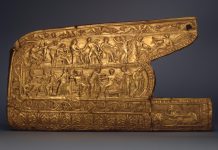
Fibulae is a brooch or pin for fastening garments, typically at the right shoulder. The fibula developed in a variety of shapes… Unlike most modern brooches, fibulae were not only decorative; they originally served a practical function: to fasten clothing for both sexes, such as dresses and cloaks.
“In 375, the Goths, defeated by the Huns, went to the West; they took with them many different things, mainly of Bosporan [Crimean Kerch] manufacture, and lost them along the way in Western Europe, but among these items, not a single one originated from the banks of the Middle Dnieper…
We have to start with the radial brooches, which, after the research carried out, can be described as local Dnieper products that have no connection whatsoever with the Goths. The appearance of radial (fingered) brooches on the Dnieper during the era of Justinian [527–565 AD], clearly imitating earlier Kerch examples, must be linked to the campaigns against the Bosporus and the export of radial brooches from there. On the Dnieper, the heyday of the complex craftsmanship of champlevé enamel falls precisely in the post-Gothic period…
It is very important for understanding the history of Dnieper brooches to note that in Kerch and its environs, where Bosporan brooches were common in the 5th century, radial fibulae completely disappear in the 6th century, i.e., exactly when they appear on the Dnieper. This circumstance forces us to take a particularly close look at the Kerch ray brooches and compare them with the Dnieper ones. The general shape of the Dnieper brooches is very similar to those from Kerch. It’s clear that the somewhat later Dnieper brooches, copying their predecessors from Kerch, carefully reproduce both the general outline, the spiral ornamentation and individual details. But despite the significant similarities, there are both obvious and subtle, but important differences… It is impossible to talk about the capture of Bosporan masters, since the technique of the Dnieper brooches differs significantly from the technique of the Kerch ones.
The events of the sixth century set in motion vast masses of the barbarian tribes of Eastern Europe. The Slavic conquest of Byzantium, which began under Justinian, produced extremely significant changes in the Middle Dnieper region and other adjacent areas. It can be assumed that the Antes’ campaigns of conquest were not limited to just one southwestern direction (in the lower reaches of the Danube and further to Thrace), but also took place against the closer and more accessible cities of the Azov and Black Sea regions. Is it not with these campaigns that we should connect the mysterious disappearance of radial brooches in the Bosporus and their appearance on the Dnieper precisely in the era of Justinian, in the era of fierce Slavic invasions, from which they returned with rich booty and thousands of prisoners? An indicator of the rich loot taken by East Slavic squads from the Balkan possessions of Byzantium are the hoards of Byzantine objects from the 5th to early 6th centuries in the Dnieper region. An indicator of relations with the Bosporus are radial brooches, the center of production of which moved in the 6th century from the Bosporus to the Dnieper…
It is impossible to determine the exact place of production of the brooches, but the area of probable location should be considered Porosye [Ros River near Kyiv], where not only the largest number of them were found, but also all the links of the evolutionary series were most fully represented.
The area in which radial fibulae were distributed is of particular historical interest. If we try to superimpose the map of radial fibulae on the map of natural zones, we will get a striking coincidence with the forest-steppe zone. Nowhere do radial fibulae go beyond the forest-steppe, either into the forest or into the steppe.
Along the right bank of the Dnieper, from Kyiv to Chigirin, stretches a narrow forest-steppe strip (with forests to the west); many radial brooches have been found here. Further to the east, the brooches go through the forest-steppe almost to the Don. Everywhere the radial fibulae coincide territorially with the later Rus’ burial mounds and cities mentioned in the chronicles, i.e., they do not go beyond the boundaries of Rus’ settlements…
The people of Ros or Rus, mentioned in the 6th century by pseudo-Zechariah, must be localized precisely here, on the Middle Dnieper, on the Ros River, in the very thick of the treasures and burials of the Antian era.”
Academician Borys Rybakov (1908-2001) was a prominent Soviet archaeologist and historian who represented the Soviet Academy of Sciences at the Columbia University Bicentennial in New York City in 1954. According to Wikipedia, “his first groundbreaking monograph, Handicrafts of Ancient Rus (1948), sought to demonstrate the economic superiority of Kyiv Rus to contemporary Western Europe.” The text above is a translation of several excerpts from that work.
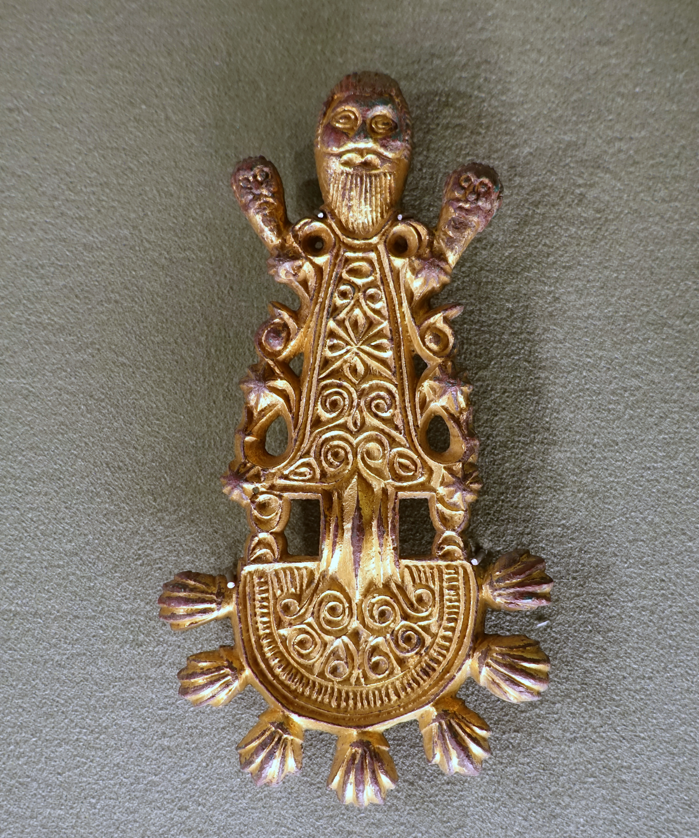
Rybakov’s description of the fibule on the title image:
“The artistic tastes of the Polyans [Slavic tribe] masters were especially fully expressed in the late types of brooches of the 7th-8th centuries. The central place here is occupied by an anthropomorphic figure with a human face and bird or animal heads instead of hands. The faces are rendered quite realistically; the hair and beard are engraved. The animals, birds, and snakes are highly stylized.”
The Wikipedia page for the Polyans has the following image of the fibulae by them in the 2nd-3rd century AD:

Chainmail Armor of Kyiv Rus: Ahead of Western Europe and Vikings by centuries >
“Royal Scythia, Greece, Kyiv Rus” book has little-known facts about Scythian artifacts unearthed in Ukraine including the most famous barrow in Bosporus near Kerch.